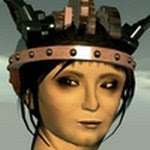
Posted by Alpha Auer
Cybernetics
Cybernetics is the interdisciplinary study of regulatory systems, closely related to control theory and systems theory. Both in its origins and in its evolution in the second-half of the 20th century, cybernetics has been pronounced to be equally applicable to physical and social systems; preeminent whenever the system under scrutiny is involved in a closed signal loop: An action by the system in an environment causes some change to that environment and in it's turn that change is manifest to the system via information / feedback that causes the system to adapt to the new environmental conditions. Ergo, the system changes its behavior.
Cybernetic theory uses high level concepts such as order, organization, complexity, hierarchy, structure, information and control, investigating how these are manifested in systems of different types; allowing us to ask questions such as whether complexity tends to increase with time? How do the components differ from or connect to each other? How does the one transform into the other?
According to Cybernetic law, systems rely on feedback loops whereby outputs are fed back into the system as inputs, increasing or decreasing effects. While input can be defined as the result of the environment's influence on the system, output is constituted by the influence of the system on the environment. In every feedback loop information about the result of a transformation or an action is sent back to the system in the form of input data. If these new data facilitate and accelerate the transformation in the same direction as the preceding results, they are positive feedback - their effects are cumulative. If the new data produce a result in the opposite direction to previous results, they are negative feedback - their effects stabilize the system. In the first case there is exponential growth or decline; in the second there is maintenance of the equilibrium.
Yet another key concept in cybernetics revolves around control, which includes two subsystems: "the controller", and "the controlled", in perpetual interaction with one another. The controller may change the state of the controlled system in any way, including the destruction of it. A whole new twist is brought into the mix however, as soon as the word "observer" is substituted for the word "controller": In quantum mechanics the observer and the observed cannot be separated, and the result of observations will depend on their interaction. Thus the observer too is a cybernetic system, trying to construct a model of another cybernetic system. To understand this process, we need a "cybernetics of cybernetics", i.e. a "meta" or "second-order" cybernetics. Thus, second order cybernetics emphasizes autonomy, self-organization, cognition, and the role of the observer/controller in modeling a system, recognizing the observed system as an agent in its own right, interacting with another agent, i.e. the observer. This creates a closed system wherein the effect of the environment is minimized and the feedback loop takes input and output from within the system itself. Thus, self-organization is a process of evolution where the development of new, complex structures takes place primarily in and through the system itself, leading us to autopoiesis (self-production), the process by which a system recursively produces its own network of physical components, thus continuously regenerating its essential organization in the face of wear and tear.
MosMax Hax, "the system"
I have to say that I am approaching all of this with the utmost of care: These are heady, sexy concepts and terms which I have seen tossed around, alas all too often and often all too carelessly, during many an art paper/presentation that I have sat through wondering how they could possibly be related to what was under discussion on the table. Well yes, of course... Anything and everything under the sun does after all operate under cybernetic laws. We are all systems, relating to other systems and our environments, operating under the ceaseless give and take of feedback loops. So yes! Everything can indeed be related to cybernetics. However, shouldn't there be something peculiarly, if not downright dramatically pertinent to the matter at hand before the names of the likes of Pask, Varela and Maturana can even be evoked?
It seems to me that the artist Max Moswitzer/MosMax Hax justifies the analogy. And on two levels at that: Cybernetics as well as second order cybernetics.
Semiautonomous Puppet Architectonics, at Odyssey. Photograph courtesy of MosMax Hax
The precursors of the oeuvre of Whitenoise are already present in the very early video output of Moswitzer, who says that "of course in those days I was not so concerned about concepts". I would disagree on that: Yes, of course, nowhere near the level of sophistication in terms of the visual language of today. Nowhere near as coherent. Nonetheless, in the videos "Transformator"(1991) and "Die Ästhetik der Dekonstruktion" (1989) the seed of what is articulated today is already present. This is the cybernetic system of Max Moswitzer, a system influenced by a feedback loop between itself and it's environment. This system makes it's progression over the next two decades, picking up momentum on it's way, resulting in ever more startling manifestations such as the extraordinary collaborative project Nybble Engine of 2003 until it finds it's way into Second Life® in 2007. And it is here, in Second Life, that it undergoes the extraordinary transformation of folding into itself, merging with the law of second order cybernetics: A system in which the artist becomes the output, the observer, the observed, the controller and the controlled. The system that is MosMax Hax.
Semiautonomous Puppet Architectonics, at Odyssey. Photograph courtesy of MosMax Hax
I have had the privilege of being there during the development of Whitenoise, from the initial assembly of it's architectural infra-structure, originally at Klein and then later on at the archipelago of the Synthetic University (of which my island Syncretia is a part of), to the embodiment of it's population: The many avatars, manifesting as the multiple selves and facets of one individual. Never, throughout his extraordinary journey of self-observation, of the creation of a self-organizational system fragmenting itself into ever more inter-reliant and complex parts, have I seen MosMax become heavy handed with words, definitions and explanations. Never have I heard him pontificate or get pompous: All has come about naturally, spontaneously, through "play"; through the invention of games for which more and more "selves" seemed to be needed: Some communal, in which other autonomous "humans" also participated; but more often than not (and particularly over the past year) private, personal, solitary, "autopoietic" games involving multiple manifestations of the "one" human; games of which I was nonetheless aware given that I was in geographical proximity both on the Synthetic archipelago as well as at Klein during this time.
As far as I can tell, it is this constellation of highly individuated "player" alt avatars that has led to the rezzing of the many specialized non-player/actor alt avatars (which seem to me to be quite distinct from MosMax's individuated multiple selves in their functions). And it is these non-player alt avatars that are now gathered at Odyssey as the manifestation of an emergent, self-organizational system, one of whose components is the artist MosMax Hax. A complex architecture - a machine almost. A machine of boats, trucks and teddy bears in motion. A closer look however, reveals that this machine is operated through slender avatar limbs to which the components of the system are attached. Avatars and prims become one integrated whole, a complex self-organizational closed system; quite complete as a distinct entity, separated from the audience surrounding it through the impact of sheer differentiation presented in it's visual Gestalt. And very much in the center of it all is the creator, the observer, the one who in his turn becomes observed - affecting the outcome of the journey, given that after all, "Semiautonomous Puppet Architectonics" is only one stop in the long journey of Whitenoise. A visual manifestation of second order cybernetics par excellence, I would dare to suggest...

Semiautonomous Puppet Architectonics, at Odyssey. Photographs courtesy of MosMax Hax
MosMax Hax: An intellectual, an artist whose inner ruminations find expression not in the (oftentimes) lamentable inadequacy if not indeed downright banality of the spoken word but in a coherent/individuated visual language which winds itself like a red thread across decades of output, adapting itself from medium to medium, from environment to environment. It's current residence is in the virtual world of Second Life. Will it always be here? Given that Max Moswitzer would be unable to fragment his Real Life body as the visual manifestation of his psychic assemblage, the embodiment of second order cybernetics which I have tried to describe above, relies on "the avatar" for the realization of the autopoietic structure involved. Thus the "population" of Whitenoise is indeed something utterly "not possible in Real Life" and as such would appear to be destined to stay in the virtual realm. But as far the underlying virtually "physical" architecture of Whitenoise itself, I seriously doubt that Second Life is it's final location. A long curriculum vitae of significant achievements and recognition prior to his entry into Second Life, coupled with the substance of the output presented in Second Life since 2007, suggest that Moswitzer/Hax is a formidable visual artist of his generation; one whose work is certainly not limited to Second Life alone. Thus exporting his output from one domain into another (i.e., from the "virtual" to the "physical"); endowing it with the universality which is it's due, would be very much the next step. And this is a quest which he is actively pursuing, alas, to date with far from satisfactory results.
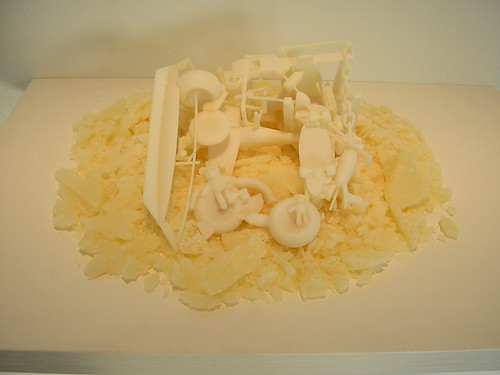
Whitenoise exported with present-day technology shown at "GAMES Kunst und Politik der Spiele", Vienna 2008. Photograph courtesy of MosMax Hax
A competent technology which will enable exporting the architecture of Whitenoise from Second Life into other domains will surely come, although it has to be added that it does seem to be taking it's sweet time coming. Meanwhile the many many facets of MosMax, the avatar population of Whitenoise, is here with us while Hax is already embroiled in new ideas, new play, new visual manifestations.
...
You can teleport to the location of Semiautonomous Puppet Architectonics at Odyssey directly from here.
Sunday, May 10, 2009
Semiautonomous Puppet Architectonics: Second order cybernetics and MosMax Hax

Wednesday, November 26, 2008
“uncharted pages from a voyage of the beagle”
Posted by Alpha Auer
...
"This time I am alone
This time I will not leave"
"I can not remember"
"It is happening again"
"what we thought were offspring are in fact an extension of the two: A way for change, a way to bring us in as a part of the whole."
...
The lines above are whatever little fragments I have been able to catch from the notes of the explorer that float above my head as I stand enraptured watching the toil of Nonnatus Korhonen's doomed creatures as they try to desperately make their way into an overcrowded tank that awaits them at the end of their long journey down a stepped structure resembling an inverted Ziggurat, one surrounded on three levels by circular walkways.

"... In lonely isolation, the avatar Lamarck Zapatero has been standing and observing the constant cycle and recycle of the system that surrounds him. Like his namesake, he is part of a cul-de-sac in a way of thinking about things - though the fragments of knowledge he will come away with are still vital to the picture as a whole. He is also the avatar of an avatar, a representation of Nonnatus Korhonen, one step removed from having his own human.
Falling from one of two ‘egg’ shaped objects at the top of the system, and close to where Zapatero spends his long days of observation, are small monotone creatures that appear to be at the whim of the simulated gravity, like ‘fish out of water’ they bounce and flail their way ever downwards. Their existence is short, as they are propelled from a place purely constructed from numbers (and values assigned to placeholders) into a place describing a possible visual representation of these numbers. As they fall, one of the many possible values that defines them will change ever so slightly, and this change has the potential to be inherited by further creatures as they are thrust into this world of eternal flux, where extremes of parameters are set in stone, but where almost limitless combinations of the interrelations of sites within these extremes give Zapatero the impression of infinite variation (and where the far more complex mind of the human observer is invited to suspend disbelief and observe the origins of complexity arising from these evolving parts.) The potential for inheritance is strengthened through longevity; something the viewer has direct control over, given dedication and perseverance to understanding the system through observation, trial and error..."
Jean-Baptiste Lamarck and Charles Darwin. Two names, two clues, which Korhonen seems to me to have woven into this starkly hermetic piece addressing the emergence and extinction of artificial life: "The Voyage of the Beagle" is the title commonly given to the book written by Charles Darwin published in 1839 as his Journal and Remarks, ideas which Darwin would later develop into his theory of evolution by natural selection. And Jean-Baptiste Lamarck (1744 – 1829) is the author of the first truly cohesive theory of evolution, in which an alchemical complexifying force drove organisms up a ladder of complexity, and a second environmental force adapted them to local environments through "use and disuse" of characteristics, differentiating them from other organisms.
Hermetic as Korhonen's installation is, it did propel me towards my own musings and imaginings, which may or may not reflect the original intentions of the artist: Firstly, it would seem to me that the piece invites the viewer to make connections to Second Order Cybernetics, symbolized in the lone figure of Lamarck Zapatero, the observer of a system who in his turn ends up becoming observed - by me. Leading me to speculate on my own involvement and how I too am observed, in an endless cycle of Droste effects, by others. 
The Theory of Evolution put an end to the Biblical Myth of Creation. But did it also put an end to the mystical explorations surrounding the subject of creation itself? Or did it simply reposition the whole discourse onto the level of abstraction already present in the Kabbalah? And does Korhonen ever so subtly weave these associations into his Ziggurat of generation and destruction? The creatures themselves: I can end their overcrowded agony by pushing a button, something resembling the stopper of an ancient inkwell. A red stopper. Red for Gevurah? The 5th Sefirot on the Kabbalistic Tree of Life? The mighty one of destruction which makes way for new life? And sure enough, when I push the stopper on the "inkwell" the glass tank turns red, and the doomed creatures become extinguished. I have just destroyed artificial life - to make room for its new generations. And isn't it strange that it is me, standing at ground level, who has been endowed with this power rather than the observer Lamarck Zapatero, enthroned God like, high above at the top of the edifice? Which, of course, leads me straight back to Second Order Cybernetics? Is this where I am meant to go?
It is not an easy piece to understand, this work of Korhonen's. However, understand it or not, it dis-settled me into asking some very uneasy questions, while it also embroiled me in a very compelling narrative, a tale of inevitability and destruction, which despite the stark minimalism of the construct makes its presence profoundly felt; especially, I believe, through the rendition of the "creatures" themselves: Brown, soft textured spheres, a few striped tail like protrusions: It is through such stringently used visual means that Korhonen has managed to present us with an artificial life form that we do in fact end up feeling for, that we can thoroughly identify with. A reminder of childhood toys? The long lost eyeless teddy bear that I once had?
"... this incomplete narrative can only become whole through the creative imagination, and speculative mind of the persistent viewer. Suffice is to say this whole system is built upon the shaky foundations of a set of assumptions about artificial life processes that I believe exist in the previously mentioned cul-de-sac. Regardless, shaky foundations are often the starting place for many a fascinating insight or experimental exploration leading to the firmer ground supportive of more persistent sites."
"This time I am alone
This time I will not leave"...
You can teleport to “uncharted pages from a voyage of the beagle” by Nonnatus Korhonen/Andrew Burrell directly from here.