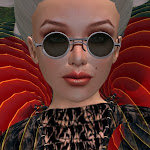
In the garden of Jung's country home in Bollingen stands a large cube-shaped stone inscribed by his own hand with magical and alchemical symbols. In his last revelatory dream prior to his death, Jung saw a huge round stone engraved with the words "And this shall be a sign unto you of Wholeness and Oneness". - THE GNOSIS ARCHIVE by Stephan A. Hoeller
British virtual landscape artist soror Nishi believes that the prim, that basic building tool in Second Life, is akin to prima materia (primal matter), a term used by alchemists to describe the seed of life. Prima materia was originally called Microcosmos to signify the small world from which heaven, earth, fire, water, and all manifestations of life are derived, including birth, death, creation, and even the resurrection. With this in mind, what could be more deserving of a temple, worship, and even a religion in Second Life than the crown of virtual creation... the plywood prim? To that end, she has created a temple and forest to that divine source of life and death: The Temple of the Prim.
The Temple of the Prim as photographed by Lem Skall
On her blog, soror discusses the term Increatum, wherein she describes prima materia as "fertilizing and giving birth to itself," and goes on to draw parallels between it and the basic prim.
Last Friday in conversation, soror explained: “This has been on my mind for well over a year. (The prim) makes itself and therefore is like a god. Gods need temples and the prim is self-replicating like the old gods. I think there's not really much in Prima Materia. It is just empty, but it reflects the psyche. According to Jung, when people speculate about the unknowable, they say more about their own psyche than they do about the unknowable, so the prim is a bit like a mirror."
soror's signature cracked-egg trees are made with prims, as is everything in Second Life
soror went on to say, "Jung was the first (only) person to take alchemy seriously as a description of the transformation of the individual from "normal" to enlightened. He saw a direct link between the "way you make gold from prima materia' and the process of "individuation" (his word). All the chemical processes that the alchemists describe are anthropomorphic, like Mercury is a person… kings and queens. It's all like a fairy story, with characters dying, etc. These relate to dreams: Archetypes (his word) and the land of dreams... is... (should be) SL...?”
"The Prim worship thingy is magic, and magic is what Synchronicity is (also a Jung word). Jung would LOVE SL," shared soror. 
Looking down into the Temple of the Prim
soror Nishi: "I came to Jung through my interest in geometry and the Axiom of Maria: One becomes two, two becomes three...etc. Maria was an old alchemist. Alchemists believed that whereas Christ had redeemed man, no one has redeemed matter, and they saw the search for the Philosophers Stone (the Self) to be an aim higher than Christianity. I got interested in geometry as a sort of universal truth. I was fascinated that it transcends language, in my teens that is."
Alchemists were challenged not only with the vagaries of their science, but also with the ongoing tribulations of securing funding for their incredibly expensive practice. These early scientists resorted to creating a narrative using anthropomorphic symbols to describe chemical reaction processes more impressively and make them comprehensible to the layperson. What they fabricated was nothing short of mythology, imbued with allegories, metaphors and archetypes steeped with rich personalities.
Hundreds of years later and in his early 30s, the founder of analytical psychology, Carl Jung, began working on a manuscript bound in red leather that would contain illustrations and calligraphy by his own hand. In this document – considered the Holy Grail of the Unconscious - he explored his theories on archetypes, collective unconscious (the mystery of the universally unknown), and individuation, or the process of transforming one’s psyche by bringing the personal and collective unconscious into conscious. Each of his archetypes represent an aspect of our deepest, and highest (or darkest), self.
At times, soror's landscaping is reminiscent of Asian paintings
Soror’s Temple of the Prim is also a tribute to Carl Jung, which is especially fitting given the publication this month of that manuscript that he worked on for 16 years. Locked in a bank vault all this time, the Red Book has only been seen by a few people.
Now the Ruben Museum in New York will be displaying the original book in conjunction with a series of events called the Red Book Dialogues, wherein “personalities from many different walks of life will be paired on stage with a psychoanalyst and invited to respond to and interpret a folio from Jung's Red Book as a starting point for a wide ranging conversation.” Those guests include musician and artist David Byrne, graphic designer Stefan Sagmeister, director John Boorman, and philosopher Cornel West.
The Temple of the Prim is on temporary display thanks to Mab MacMoragh's sponsorship and can be visited by teleporting directly from here.
See also:
Tuesday, October 6, 2009
The Temple of the Prim and a tribute to Carl Jung, who surely would have loved Second Life

Saturday, August 1, 2009
The impact of Selavy Oh
Posted by Alpha Auer
By way of an introduction
Anyone who has had the patience to read what I write about will have noticed that I have a few bees in my bonnet to which I keep returning over and over again. One is avatars and identity creation; the other one is the creation of cohesive visual systems over standalone objects/or conversely the presence of a strong system within the standalone object; and the third one is narrative. Now, it is here with this third one that I tend to get into the biggest trouble in that more often than not I end up getting vastly misunderstood: It is inevitably assumed from my lamentably unclear delivery that I am talking about tangible stories with a beginning, a middle and an end - things that are decipherable, that can be conveyed in the spoken language just as well, if not indeed much better, than a visual manifestation. Nothing could be further than the truth - and it is entirely my mistake in that I have really not been at all clear about just what it is exactly that I mean to convey when I say "narrative".
For starters I should probably be using "visual narrative", rather than just "narrative" which does, after all, mean "story". But in any case, here is a quote from Marcel Duchamp, talking about "humor", which does come very close to what I want to convey when I say "narrative" in my hitherto fumbled manner of expression (please note the bold text):
"A great power; humor was a sort of savior so to speak because, before, art was such a serious thing, so pontifical that I was very happy when I discovered that I could introduce humor into it. And that was truly a period of discovery. The discovery of humor was liberation. And not humor in the sense "humorist" of humor, but "humor" humoristic of humor. Humor is something much more profound and more serious and more difficult to define. It's not only about laughing. There's a humor that is black humor which doesn't inspire laughter and which doesn't please at all. Which is a thing in itself, which is a new feeling so to speak, which follows from all sorts of things that we can't analyze with words... ...A large amount of rebellion, a large amount of derision toward the serious word... ...And it's only because of humor that you can leave, that you can free yourself".
And here is yet another quote, this one supplied by Soror Nishi, during a conversation we had going on her blog a while back: "a long, immense and deliberate derangement of the senses" - already suggesting narrative in that in it is embedded the very notion of temporality and process.
So, for me (amongst much else) visual narrative, i.e., the construction of a visual language is primarily a vastly complex set of maybe half verbal and very possibly even entirely non-verbal elements which conglomerate to form "a thing"; a temporality, a process, a visuality in which things are implied, half implied and yes, maybe even not even implied at all. A dark process involving metaphor over description, enigma over clarity. A thing whereby the individual components converge to create a whole larger than the sum total of its parts - a Gestalt.
And no, in no way does visual narrative have to involve recognizable objects, things which are realistic or are endowed with realistic references at least. My own work is of such a kind that a power plant does in fact look like a power plant (well, sort of anyway...) and a gym like a gym (regardless of whether the exercise stations may be placed on steam pipes). It does not mean that this is the type of work which I prefer, which I take to be the sole carrier of the potential of visual narrative. The starkest abstraction can be a powerful conveyor of what I consider to be visual narrative. If anything, indeed probably much more so, since precisely in the very abstraction lies a vast potential for the conveyance of metaphor, of enigma, of process - of the telling of the story that really has no words whereby it can be told...
Which would, of course, bring me to Selavy Oh; an artist whose work I have loved from the very moment in which I set eyes on it.
...
The creation of an identity
I had already assumed that Selavy Oh's choice of name was not a random event, but was closely associated with the famous alter-identity of Marcel Duchamp, Rrose Selavy. And so indeed, the urge to find answers to questions such as "would it be possible to create an identity out of nothing", what exactly "would be needed to create an identity that is separate from your own", and very importantly whether you "would need a history" were what led the human behind the avatar, who incidentally is a computational neuroscientist in Real Life, to the creation of Selavy Oh, whereby a contextual, if not historical, reference to not only Duchamp but to the whole idea of "alter-ego" seems to be implied.
"Impact" and the power of abstraction
The metaverse is teeming with so-called art objects which are meant to interact with the avatar. What is usually meant by that is that something completely ineffectual occurs as I approach or touch the object in question. I say "oh" and move on. I have not changed, nothing fundamental has occurred to me which has brought on "a long, immense and deliberate derangement of the senses". And not only the metaverse obviously: The whole web is a dump site of "interactive" art installations. Very few resonate with me in any kind of meaningful and profound way, they simply do not interact with me, my inner being... 
The Giant Arc, Photograph courtesy of Selavy Oh
So, how is Selavy Oh's work, the kind which does interact with the avatar, different? The keyword here, I believe, would be impact! This is, of course, yet another word hard to pin down into a description in that it could be constituted of different attributes in different cases. In Selavy Oh’s case, at least one of these attributes is scale. So magnificent, so vast, so sublimely endless and yes - ultimately so visually satisfying in its amazingly cohesive system is the huge arc which stretches itself over the virtual sky above the Museum of Hyperformalism (teleport directly from here), and which begins its unutterably sad and yet graceful disintegration and demise upon my touch; that as I watch spellbound, something is in fact changing in me...
...


I am slowly demolishing the cubes...
So absorbing in its complexity, the complementarities of the contrast between the hard edges of the cubes and their soft descent upon my collision, are the nested cubes, which Selavy Oh rezzed for me, thanks to the generous hospitality of Mab MacMoragh, that I spent an entire afternoon and early evening slowly demolishing them.(I am indeed very proud to be able to proclaim that apparently I am the second avatar in metaverse history to have completely done so, the first one being Wizard Gynoid). 
My reward? The magic of having them restructure themselves in a choreography, the enigmatic beauty of which would be very hard to describe in mere words. That is the impact of the abstraction of minimalism when it transcends the ordinary and moves into the realm of the resplendent: You cannot describe it, what it does to you, what it means to you or even how it looks. It is completely intangible and therein lies its huge power. And yes, I dare to say it, again: its ultimate power of narrative - as I define it in "a long, immense and deliberate derangement of the senses"...
...
But does "something" really need to do "something" before it becomes truly "interactive"? The third piece of Selavy Oh's that I wish to talk about after the sky arc and the nested cubes is static: Formes Nocturnes, now no longer in existence - alas. Nothing moves - or at least it did not while I was there. A torrent of bits which has become frozen in a tempest, reminding me of Goethe's famous words that "architecture is frozen music". Interaction is not pushing a button. Or bumping into an object which then goes "squeak" or whatever. Interaction happens in the mind: Something or someone evokes a change in me - interaction has happened.

Formes Nocturnes. Photographs courtesy of Selavy Oh
And with Formes Nocturnes and Goethe's statement I come back full circle to Duchamp, and his pre-occupation with frozen time and space: The strong connection which I felt that the island had to Duchamp's glass painting "The Bride Stripped Bare By Her Bachelors, Even". I was gratified to hear that my instinct was not unfounded, that there had indeed been this connection in Selavy Oh's mind as well. A connection with the temporal fragility of the "Bride" and with happenstance and chance (apparently the glass broke during transportation), as well as the shared obsession that the artist has with Duchamp: "Dureé", temporality and space, reflected throughout the extraordinary output of Selavy Oh.
…
I have been wondering how to end this post and what I think I will do is refer back to an email conversation which Selavy Oh and I have been intermittently conducting over the past week or so, concerning wherein might lie the difference between the creation of cohesive visual systems and visual narrative. One would almost be tempted to say that the difference between a cohesive visual system and visual narrative is a matter of degree. However, ultimately, I suppose the difference lies in the temporal element given that “static” visual work can have a temporal connection/element, be endowed with an attribute of temporality even though it captures only a single instance in time. A cohesive visual system need not necessarily have embedded into the notion of the 4th dimension, whereas visual narrative would. So, in the end, in a way, it is still a matter of degree, I suppose: The output of creative activity (and I would dare to suggest that this would involve the output of all creative activity, regardless of whether it is text, sound, visual or indeed scientific data) relies on the engenderment of systems to come to their full fruition. While textual and audio systems inherently carry the element of temporality, when it comes to static visual systems there would seem to be a distinction, they need not inherently possess this dimension: It is whenever we find that the 4th dimension has been evoked within a static visual system that we can begin to talk about “visual narrative” having begun its magical process. The process of the art of Selavy Oh.
…
Selavy Oh’s Flickr stream from which I have borrowed some of the photos of this post can be viewed here. You can teleport to the giant arc at the Museum of Hyperformalism from here.
Sunday, May 17, 2009
Floating buildings - In Real Life
Posted by Bettina Tizzy
My colleague Alpha Auer and I have this ongoing discussion regarding what, in virtual worlds, is actually Not Possible in Real Life (NPIRL). One concession she makes is the concept of floating islands and buildings in metaversal skies. 
soror Nishi's newest landscaping shop,"lifstean," as photographed by Lem Skall. Teleport directly from here
Still, I was surprised yesterday when Alpha mentioned that folks are already making "floating" buildings. It seems that a company in the Netherlands, Dutch Docklands, designs water-based solutions that make “land from water” by providing large scale "floating" constructions.
As far as I can tell, plans for the construction of a string of floating islands containing hotels, restaurants and a heliport off the shores of Dubai have been shelved due to the economic crisis. It seems that each island was to have been in the shape of a letter, with all of them spelling out a verse that reads in part, "Not everyone who rides a horse is a jockey."
National Public Radio (NPR) did a great piece on the project in April, 2008, and here's another from DE51GN.
It could be argued that space stations, already in use, are in fact, floating buildings. 
Boeing's International Space Station (ISS), slated for completion in 2010, will be about the size of an American football field
All the same, I'll wager that the only floating buildings most of us will ever experience in our lifetimes will be pixelated and very virtual.
Wednesday, March 18, 2009
Soror Nishi: "Your computer screen is stained glass"
Posted by Bettina Tizzy
Every time I teleport to see a new creation by Soror Nishi, I feel the same kind of rush that I used to get when I would open up a fresh and fragrant pack of fruit-flavored Life Savers as a child. In fact, if I could eat prims, I think Soror’s trees would make a righteous summer lunch.
Soror is best known for her electrifying and primordial forests, "ancient trees," and bodacious flowers, but she also makes avatar adornments such as sinewy and curvilinear antlers, and brightly colored jewelry.

All photographs above by Lem Skall
Don't let Soror fool you, and she will, given the chance (she's a kidder, that one). In reality, she's a Brit, but has been known to describe herself as hailing from Harajuku, being the daughter of a flower seller and having a software magnate for a husband. In truth, she is an artist who invades our senses with her bold colors, and paints her textures rather than photograph them.
Soror Nishi
In a notecard that accompanied a recent art show of hers, I read that "Concerned about the diminishing native flora of Second Life®, she set about planting and nurturing the plants that the Lindens had cleared from the land with an over-grazing of goats and the like. Her work in preserving "the Ancient Ones" for future generations is well known, and her recent discoveries of rare orchids have generated much interest." She's like that. It is quite true.
There is nothing more difficult for a truly creative painter than to paint a rose, because before he can do so he has first to forget all the roses that were ever painted. - Henry Matisse
I used to associate Soror's exotic and glowing colors with the Mayan world, where every textile and craft dances in vivid shades, but she enhanced and modernized that view when I spoke with her.
Soror Nishi: I think that light through glass, which is what we are working with… is particularly suited to bright color. If you want earth colors, use oil paint.
Stained glass? Soror Nishi: Yes. The computer screen is a stained glass. It is like television, which is badly used, really. The screen has amazing possibilities, but is best shown off with colors. The Simpsons for example... Virtual worlds have more in common with stained glass than with photography, and (our) failure to recognize this results in poor copies of boring everyday objects, architecture, flora and fauna. These colors belong in Second Life by virtue of the medium we use. The extensive attempts some make to populate this new world with "realistic" copies of the Old World show a colonial tendency to ignore the native culture and superimpose a pre-formed visual style.
Soror Nishi at Hotel Dare
Hotel Dare, conceived and curated by Gattina Dumpling, is a concept space that goes far beyond the typical gallery setting to feature the location-appropriate works of rotating artists who have been given a hotel "room" to do whatever they wish with it. Dare has relocated to the new Poetik sim and Gattina invited Soror to collaborate with CensoredMy Lunt and become a hotel "guest."
Open the typical hotel door to enter Soror and CensoredMy's "room" and find yourself walking through boldly colored tunnels infused with psychedelic particle effects...

... and strange mushrooms that you wouldn't dream of eating unless... well, I do believe that Les Fauves artists would have thought they'd died and gone to heaven.
Waiting at the end of the room is an explanation of what you have just experienced. I'll let you be surprised. Teleport directly to Poetik from here.
You can purchase Soror's landscape art, jewelry and accoutrements at Nishi Beach (teleport directly from here).
Friday, June 20, 2008
These are a few of my favorite things...
The Garden of NPIRL Delights - generously sponsored by Rezzable Productions - is almost over... *sobs* The last day is June 23. There are so many little and big things that I am going to miss.
Collaboration is a powerful thing, and dozens of people made enormous contributions that few people are aware of.
One day before the Garden opened, Ravenelle Zugzwang and Soror Nishi helped me landscape it with their exquisite trees and sculptures. 
Ravenelle's sculptures range from surreal to breathtakingly beautiful, and they lift the landscape here and there 
This photo of one of the many colorful and dreamy trees by soror Nishi by Neon Hammerer
Minutes before the Garden opened to the public, artoo Magneto sent over his phenomenal 3D trees, and elros Tumominen helped me install a few of his flaming sculptures.
I hope Glyph Graves will participate in any project I take on. His flowers! His willingness to work with others! 
The Garden is closing... sigh.
Saturday, June 7, 2008
The Garden
UPDATE (June 24, 2008) - After a spectacular two month run, the Garden of NPIRL Delights - produced by Not Possible in Real Life and sponsored by Rezzable Productions - has ended. Thank you to everyone who made it possible and to all who enjoyed it.
by Alpha Auer (aka Elif Ayiter)
I have been taking walks around the four sims that constitute the Garden of NPIRL Delights, and as I have been looking at the displayed art work it has begun to dawn upon me that Garden itself is the really important thing that is going on here. It transcends its content.
What hits you the moment you land inside is the spontaneity, the gaiety, the total "joie de vivre," of the work that stands here. And the companionship: Newbie builder stands here shoulder to shoulder with seasoned veteran - no competitions, no awards. All equals in one huge playground. With a total freedom that even includes terraforming privileges! In effect, quite different from what would have been par for the course under Real Life conditions.
True, there is a theme: The Bosch triptych. One that certainly gives you plenty of rope to hang yourself with if you choose to do so. And admittedly, some of us have in fact done exactly that: I would be lying if I said that I am perfectly OK with everything that is on display in there. But conversely (and much more importantly) there are pieces in there that had me quite breathless with their energy, their imagination, their narrative ability - and above all else... their individuality. And if that utter freedom of expression had not been fostered in the first place, these art works would simply not have materialized. 
And here is the divine irony (and I love it!): The Garden has achieved cohesiveness, has managed to become bigger than the sum total of its content. This is, of course, precisely the sort of thing that any curator worth his or her salt shoots for - to achieve this kind of Gestalt. Now, I do have this rather wicked theory that in quite a few curated exhibitions in Real Life, certain kinds of artistic output tend to get turned down simply because they go off too much on their own; they are too difficult to categorize and to fit within a mainframe. So, you may end up with this dreary monotony of unindividuated output in rank and file. But hey!!! Who cares? It's a strong theme, forget the individual art work please!
Bettina Tizzy has not forgotten about the individual art work. She has put the individual first, to the point where not everything on display in the Garden passes full muster when viewed with a gimlet eye. That is the chance that you take when you allow full freedom, do not set up tight boundaries, do not shoot for a particular "look" or a "concept." And, am I glad that she did take this chance... What is exquisite more than makes up for what isn't fully up to scratch. But exquisite or not - all is individuated to a truly remarkable degree: Gutsy in its individuality is the phrase that I think that I am looking for.
I think the way that the Garden pulls its manifold content together is by virtue of its landscape. I have to say that I find this landscape and the way it has been conceived of and implemented by Littletoe Bartlett nothing less than inspired. The hills are there for a good practical reason: They function very much as separators between art installations, much as walls in a Real Life gallery space would do. But there is much more going on here, in that the entire landscape transports me directly into one of my favorite worlds, the world of the late Gothic illuminated manuscript.
This is very similar to the detailed, ornate, velvety and yet touchingly naive backdrops of those medieval scenes, that can be glimpsed through narrow windows in front of which wimpled ladies exchange devotional books with chivalrous gentlemen. Didn't the Limbourg brothers paint this very landscape into all of those Books of Hours that they designed for their patron, the Duc de Berry? 
The Apostles going forth to preach from Les Très Riches Heures du duc de Berry
Of course, I have no idea that this was, in fact, the effect that the landscapers of the Garden were after but this is definitely the feeling that the rich, soft ground textures (again by LittleToe Bartlett and Pavig Lok) and the hills and hillocks, all rolling into a gentle sea give me. And then comes the foliage, the trees of artoo Magneto that share the space with those of soror Nishi. The delicate touches of Ravenelle Zugzwang and Bettina herself.
All told, I am very glad to have been part of this show... to have been able to wander inside the Garden of NPIRL Delights as one of its content creators.
Thursday, March 27, 2008
Soror Nishi's forests - like a spring bouquet
I'm a forest fanatic. Brit Soror Nishi makes the most Not Possible IRL forests that I know of, and I've been following her work ever since I discovered it at Burning Life 2007. 
This forest (teleport directly from here), which Soror just completed using Blender, is deliciously colorful and not unlike a spring bouquet. I wonder what it would smell like if she could add that feature? A fresh fruit salad?