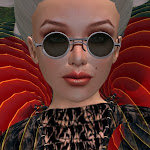
Musician AldoManutio Abruzzo disagrees with me when I say that listening to music in Second Life is Not Possible in Real Life. Aldo, sowwwy, but when was the last time you were able to listen to (and be present at) a live music concert, while simultaneously holding one or more conversations with near and distant friends (in Real Life and/or at some far away point on the grid), without disturbing other listeners or the performer? I rest my case. :D
Fact is, I've been happily surprised with my own experience of music in Second Life. Not only have I discovered a number of new-to-me recorded talents via some wickedly good DJs, including thomTrance OToole and Alec Paragon, but I've also been introduced to several really superb artists through their live, streamed performances.
Granted, and this must be said... I love the thrill of zipping around in my RL car - way too fast, according to the California Highway Patrol which has ticketed me and sent me off to driving school for more than a couple pedal-to-the-metal infractions - while listening to my fave tracks at an exhilirating volume. Please don't hate me for this! I do keep my windows rolled up so as not to inflict my musical tastes on others.
But there is another kind of music that slows your heart rate, calms the mind, and leaves you refreshed. That would be the music of AldoManutio Abruzzo. Listening to his work is not unlike standing at the end of the beach after a storm, looking out over the ocean and wondering about the great questions of life.
Not too long ago I was one of the fortunate people who were present for AldoManutio's well-attended live performance to commemorate the inauguration of Princeton's new Alexander Beach sim - built by our very own Scope Cleaver . It wasn't the first time I've attended AldoManutio's concerts, and it certainly won't be my last, but something about this last one left me in such a peaceful and mellow state that I might as well have spent the hour in a yoga class. 
But getting back to whether AldoManutio's music is NPIRL or not. If it isn't, then why is he so often the choice collaborator for some of the most admired content creators of things that are Not Possible in Real Life, weaving his soundscapes through their works with an aural needle and thread? I asked Aldo this and more.
Bettina Tizzy: Please describe your music, Aldo.
AldoManutio Abruzzo: I improvise my music on the spot. I don't really "hear" the music so much as strive to "listen" to it as I am playing. It isn't until after the fact - during editing - that I truly get to hear what happened during those moments of playing... a touch of Fripp here, a dash of Shankar there, followed by a little Rachmaninoff; or I might throw in an American folk spiritual.
I don't use pre-recorded loops or sequenced synthesized passages in my live performances. My live performances are just that: spontaneous compositions being created on the fly at that moment. I do sometimes improvise upon recognizable themes (Douglas Story was recently shocked to hear me doing variations upon "Greensleeves" but it is, in fact, a venerable lute song and numerous variations have been written .. .I just happened to do some new ones that night.). This is why I try to always record every performance ... I operate from the assumption that people have come to hear music they have never heard before and, unless I record it, will never hear again.
Bettina Tizzy: What was your musical training?
AldoManutio Abruzzo: I began musical studies on the trombone and studying classical guitar in high school. I taught myself to read lute tablature and, as an undergraduate at the University of Texas, began performing Renaissance and Baroque lute music on an original instrument with the Madrigal Singers (under the direction of Morris Beachy) and the Collegium Musicum. I also performed privately with a group of friends. My lute studies culminated with a Master Class with lutenist Paul O'Dette.
Upon hearing "Another Green World" and "Music for Airports" in the 1980's, I was strongly influenced by the work of both Brian Eno and Robert Fripp, but didn't make the move fully into electronic music until the mid-90's when I started working with computer-based synthesis projects. With the development of more affordable looping devices, I began to utilize looping techniques - especially in live performance situations - to develop the layered textured music that I perform here in SL. The Ebow was added to the tools that I use in 2004. 
According to Douglas Story who collaborated with Aldo on the FlowerBall installation: "His music is ethereal, complex, otherworldly, deeply layered, and fascinating. He's up there in the Robert Fripp league... no kidding. However, he refuses to take requests at his concerts. I keep yelling for Smoke On The Water and Freebird, and he never plays either." Teleport directly from here
Bettina Tizzy: Where might people hear your music?
AldoManutio Abruzzo: The main installations that have been deemed as "permanent" are located on the Princeton University sim: Douglas Story and Desdemona Enfield's "Flowerball,", the soundscape that is playing inside of Scope Cleaver's maginificent "Alexander Beach" build and the adjacent sculpture created by Juria Yoshikawa. All three soundscapes are more or less permanently available for listening. The previous installations done with Juria were designed to have a limited presence, but the music from those installations is available either by direct, free download from one of my websites or from the SECONDTune vendors. Almost all of my music is available in one form or another, one world or another. 
Photograph of Alexander Beach by Harper Beresford
Moreover, people might hear my music almost anywhere... they have found my webstream and have been playing it on their properties. Not much I can do (or want to do) about it. There are some SECONDTunes vendor-kiosks scattered about that are selling MP3s of my performances from Second Life, so people can always grab one of those for a few hundred Lindens and listen anytime. Additionally, my music is available on the Cruxy players that can be used in-world. As a "performer", my music is normally heard in venues, but as of 1 November 2007, I am not scheduling any further "regular" performances in the clubs or venues. I will still be performing in Second Life, but they will be very specific, special appearances. 
I find it interesting that several of the artists who have created the most lauded and very Not Possible IRL installations in Second Life, such as this marvel by Juria Yoshikawa found at the Princeton sim, have turned to AldoManutio to incorporate his soundscapes, especially when you consider that he often uses the sounds of nature, such as waves, or thunder.
Bettina Tizzy: Whom would you like to collaborate with?
AldoManutio Abruzzo: I regret not being able to accept the chance to work with Dancoyote Antonelli when the offer was recently made to work on a project with him. Frankly, he is one of the few visual artists with any vision and critical apparatus I have met in Second Life who are attempting to perform at the same level of quality that I am pursuing here. In general, I must say that I am less than sanguine about the quality of what is classified as "art" in Second Life. I can only hope that other visual artists are coming in-world who will raise the overall quality of work.
Bettina Tizzy: What is missing from the sound/music experience in Second Life, both from the musician's and the listener's standpoint?
AldoManutio Abruzzo: In all fairness, I can only address this question from my own perspective as a performer, since I have found it increasingly difficult to enjoy other performances in Second Life. Small audience capacity, stability, and lag are the three single biggest impediments to high quality performance here, as I see it. I could say that the cultivation of an audience that is appreciative of non-"traditional" art music is missing, but that's something that has be developed, one listener at a time, and I do have some hope of that happening as we see more and more traditional classical musicians appearing in here. I think people like Thom Dowd are to be applauded and supported for trying to bring less well-known work in-world.
The capacity to have multiple performers playing in small ensembles would be great. Several brave souls have attempted to perform in small ensembles, by using Voice Chat, but that isn't that promising ... it's bad enough using it for voice.
More venues such as the Alexander Hall on the Princeton sim and Circe Broom's RatePoint Concert Hall (teleport directly from here) are needed to provide venues that don't have pose-balls for dancing and the music can be taken seriously. While she does have comfy cushions that are scripted, Bibi Book's SkyCastle (teleport directly from here) is among my favorite venues for my more "spacey" performances, simply because she has kept the distractions to a minimum and she herself emphasizes the need to support live music (not as presented by DJs, but rather, performers). We need more of that support and attitude.
Wednesday, January 2, 2008
Music in Second Life: A meditation in the hands of AldoManutio Abruzzo

Friday, November 23, 2007
Scope Cleaver's winged superstructure for Princeton - architecture that really soars
In the first rez, you know that Scope Cleaver is a perfectionist. He is also one of a handful of architects and designers who keep setting the bar for all others to follow, and he's only been in Second Life since late January of 2006.
His newest work - this colossal hourglass building on Princeton University's virtual campus - is so airy and open that a good wind would surely lift it and send it flying.
Sitting on Alexander Beach island, the sim-wide creation will be officially unveiled on November 28, and is intended as a gathering place for the Princeton campus community, including students, staff and faculty members. It will be open to the public, except for some special events. Teleport directly from here.
This photo by Harper Beresford
Back when the Not Possible IRL group began, the exceptional quality of Scope Cleaver's work and the sculptural flow of his very original designs made him an ideal candidate for NPIRL, so I hounded the poor man, all the while evangelizing about our mission, until finally I either convinced him to join or he surrendered, I'm still not sure which. At any rate, I am delighted to see that his work is shifting further away from Real Life architecture and opening - way up - to new heights that only the metaverse can afford.
I met up with Scope earlier this week to learn more. 
Scope Cleaver: Everything I have done prior to this was more down to earth, more right-angle architecture. It's difficult to get rid of habits, ways of thinking, culture... and since this medium is still fairly new to me, experimenting is really the most important part of my learning experience here. It was a natural progression... time will help me slowly move away from my old ways of thinking about architecture, humans, and how they interact. I think an important component for all architects in SL is really to listen and be sensitive to feedback.
The island consists of three programmatic areas: The two large buildings that run across the sim on a diagonal, are intended for more formal functions. The building to the south, made up of triangular-shaped glazed sections, is an exhibition and gallery space. The twin building to the north - a more enclosed space - has a partial second level, and is intended as a reconfigurable community center for concerts, theatrical performances, installations, experimental builds, and other functions that arise from the needs of the campus community.
The hourglass shape is flanked by two very white, gleaming sandboxes, which Scope described as "elevated, glorified, clean and (with) some sense of minimalism."
"I thought it important to make whatever the students were building something to be seen and the main theme of this Sim, which is why I elevated both sandboxes like plates," said Scope. I wondered out loud what it will be like to work on the very white sandboxes, and he replied, "I have tried it myself and really like it.:) It gave me ideas on how I should build my own sandbox." 
Only the students and faculty will have building rights here.
Scope doesn't appear to be anybody's acolyte. Consider where he gets his ideas...
Scope Cleaver: I take a lot of inspiration from music, especially of the ambient kind, which is an exploration of space in itself. It guides me and brings up images of structure and rhythm that I have learned to translate into an actual building. There is an audio installation/soundscape called "Mare Aeternum" here by AldoManutio Abruzzo that played into my vision. I get pretty obsessive with ambient music and can listen to it for extended periods of time.
He also quoted Einstein as we discussed his sources for ideas: "Imagination is more important than knowlege."
Next two photos by Harper Beresford
Scope Cleaver: Other than the technical glitches . . . I have learned how to handle large structures better by packaging them to move them around, and I also take more time to evaluate things as a whole. I am tending to be more about the big picture. The direction I'm taking is more open, yet very functional and detailed.
Working with traditional prims - no sculpties or megas for this man - Scope's work is completely seamless and precise. For this building, he relied on Cadroe's Lathe tool, and Filterforge for the textures.
Scope Cleaver: I could not have done this without the open source "Builder's Buddy" (scripted by Newfie Pendragon and available for free on the SL Forum) as well, which lets me handle moving the large structure and *very primmy* buildings around without glitches. 
Scope named Persis Trilling, Princeton's Educational Technologies Center director, when I asked him about collaborators, saying that she'd been extremely patient and understanding.
Persis is someone I actively seek out for her engaging wit and good sense. I like to think of her as a modern day Dorothy Parker (a healthy one, mind you). 
This photo by Harper Beresford
Having retained Scope's architectural services for Princeton several times over - even before work began on the first sim - Persis is clearly a fan of his work: "With this new sim, I had the luxury of allowing Scope to satisfy a few programmatic requirements as he thought best, with very few more suggestions than the functional ones. The result is a remarkably cohesive creation that showcases his great skill with light, texture, color, artisanal craftmanship, with a large helping of drama thrown in. It's a beauty. I love it!" 
Under Persis Trilling's planning and direction, the Princeton campus is a hub of artistic and architectural activity
KK Jewell (aka Kirsten Kiser), an architect, curator and the publisher of arcspace, an online architecture and design magazine that's scoring 16 million hits a month, wrote an excellent piece on Scope's Gallery of the Arts building - also at Princeton - so of course I wanted to get her opinion on his latest work: "It confirms his place among the best in SL. Cantilevers and extrusions, rich textures, light filled interiors... are all characteristic of Cleaver’s architectural vocabulary."
Princeton University's Gallery of the Arts, also by Scope Cleaver
KK added, "I like his architecture language. You always recognize his work. He is unique in that he is really an SL architect; you stop comparing him to RL architects and discover a whole new language...maybe a language of the future...who knows? The more I learn about building in SL and how difficult it really is, the more I admire his work."
I asked Scope about his frequent use of the color orange.
Scope Cleaver: Orange is one of my favorite colors, and it's one of Princeton's official colors. There is never enough orange here! :) I think it really highlights the windows to have some color in them. 
Scope Cleaver: In the summer of 2006, I was doing a building for Telus, and another one for a private client. Back then I had no idea if I should focus on doing prefab work (retail) or custom work. It's still balanced today, as I don't feel comfortable going full time in either direction exclusively. The big difference for me is that by doing custom work I get to interact with people and it's more dynamic than being in my workshop figuring out the next modern chair. I think the most important thing is that it should point to something... it should have a direction, meaning I design a building and I like people to think (it can be so much crazier).
Scope shared with me that he tests how avatars interact with his structures before, during and after their creation. I was particularly interested in this because I've found his office, for example, to be on the perfect virtual scale for my avatar to move around in. While it's very PIRL, you can check it out by teleporting directly here... and try out that 12-prim executive chair. 
Addendum - December 17, 2007
Italian architect Gioacchino Laryukov had been busy attending to Real Life matters for quite some time, so when I saw him in-world, I rushed him over to see Alexander Beach. His impressions struck me as so interesting, that I'm posting them here.
Gioacchino Laryukov: I don't want to address the perfect development, the elegance of the textures, the great functionality or the numerous great details of this Masterpiece. Rather, I want to attempt to expose deeper architecturals concepts that I think have found in this work, a great expression.
THE PLANT AND THE SHAPE
Looking from above, flying over it, the building demonstrates a rational structure; a cross with axis of symmetry is in clear evidence: the two rounded volumes in one sense and the two squared platform connected by two arcs on the other. I mention this simply to make evident the concept of the building: the rational environment in which all the elements take their position and role.
But looking from the usual point of view for a human, with the feet on the ground, we can find a first “counterpoint”: this building shows in all its magnificence, an organic shape; it could be a creature both of the flora and of the fauna; a big flower with wonderful open petals, or an insect, just opening his wings before starting his flight.
And here we can note the distinction between the two axis of symmetry: in one sense there is a front and a back while on the other, the symmetry is perfect. This fact gives to the building a prevalent direction - we needn't say which - that makes it possible to organize the space around it.
OUTSIDE/INSIDE - FULL/EMPTY
And through this direction, the architecture comes into play... first, a play conducted in the definition of the spaces. One half of the building is a closed space with tapered windows; the other is an open space delimited by a light and wonderful succession of triangular glasses. This way the unity of the shape and its balance is preserved while there is a creation of two opposite conditions: the Outside and the Inside.
The first is defined with elegant touches in its shape identical to the closed part so you can really feel that you are in the same “space.” You can see from the Outside that the different parts belong to the same “creature.”
This effect is obtained with a wonderful and organized play of glasses and curtains, fulls and empties in a perfect balance that give to the building its great balance. Take a look to how the panels of the front of the big rooms are dynamically positioned to define the inside, while at the same time, they create a movement of compenetration between the outside and the inside.
In the same way we could speak about light and darks. Like sounds and silences in a symphony, all parts contribute in a dynamical way to the definition of the building in a balance, perfectly achieved.