Posted by Bettina Tizzy
This is a gentle rant brought on by Vanity Fair magazine's twitter: "@VanityFairmag Don't Be Fooled by Avatar's Lame Trailer http://is.gd/2s7YX #Avatar" a couple of hours ago. For like forever, I've been known to say that if I only had access to three magazines to keep up with the state-of-play, smarter, faster, better-informed intelligentsia, I'd pick Vanity Fair, Businessweek, and Utne Reader, and that selection still stands, but it's teetering. Vanity Fair, don't make the same mistake that Chris Anderson and his Wired made in 2006. I forgive you, but hurry up and realize that avatars are ahead of the curve. Like you. In fact, your readers are mostly going to embrace their avatarhood and evangelize about it within the next three years, and that "lame" Avatar trailer and movie are going to have something (if not a lot) to do with it.
~*~
It was 1997 and opening night. I recall whispering in the dark to my companion that if Kate Winslet's aged character "throws that damned necklace into the sea, I'm going to have to leave the theater." And she did. And I did. To this day, I have never seen the ending of James Cameron's Titanic, the all-time highest grossing film at the box office. So yes, I have questioned and even suffered visceral adverse reactions to Cameron's work.
Yesterday, I watched the teaser trailer for Avatar, slated to hit theaters this December. I've spent the better part of the last two years traipsing around virtual worlds as an avatar, so I'll confess that the poor trailer was in trouble even before I hit the "play" button. My overlayed cynical filter was as thick as the bottom of a glass Coke bottle and I fully expected to loathe it.
But I didn't hate it. Turns out that I can hardly wait to see it, and it made me want to learn more about the plot, the script and how and where it was produced. It looks as real as the island of Kauai does, which stands to reason because that's where most of it was shot.
I don't play games in virtual worlds. As Metanomics puts it, I'm all over the serious aspects of three-dimensional persistent, immersive, massively multi-player online "games," such as art, architecture, business and education. I've put up with an awful lot to be an early-adopter avatar, including lag so bad that my "character" couldn't move, umpteen flying penises and banana phones (annoying griefing devices employed by sophomoric idiots), communications so shoddy that my text chat never made it to the person or people I was trying to speak with, and hundreds upon hundreds of *crashes,* to mention only a few of the ways that I have been inconvenienced.
Things are picking up for avatars though and at a high rate of speed. Stability, scalability, tools for user-created content, communication, and collaboration are all vastly improving. The number of choices an avatar has on how to spend a quality hour consistently overwhelms me in much the same way selecting an art film to screen in Manhattan does. And just this week, industry analysts at Piper Jaffray released their forecasts for virtual goods, indicating that 2009 US revenues are expected to hit $621 million (134% over 2008), and $2.5 billion in 2013. Global revenues from virtual goods should exceed $2.2 billion this year, and climb to $6 billion by 2013. I'm old enough to remember when total online (2.0 web-based) revenues were lower than that, and how so many detractors doubted they'd rise significantly for decades. Heh.
Just two days ago I finally got around to downloading the client for the new virtual world Blue Mars that's in private Beta until... sometime real soon now (maybe in a couple of weeks?), and I can only say that I was overcome and dazzled by the life-like graphics, the rolling ocean foam, the exuberant vegetation and shadows that behaved the way real shadows do. In fact, it looked a lot like the trailer for Avatar.
Virtual Space Entertainment is just one of the developers rushing to create content on Blue Mars' gorgeous CryEngine2 platform
So wait, Vanity Fair. Please tell us why the Avatar trailer is lame?
Friday, August 21, 2009
Avatar movie is ahead of the curve, and you usually are, too, Vanity Fair

Saturday, March 22, 2008
Dear Bleeding Edge Corporations (that goes for you, too, Mr. Anderson): Wired was unplugged in SL from day one, while Languagelab.com will endure
Remember the Money sim? Why this sim exists and what it will be used for will be disclosed later in this blogpiece, too.
Even on the day they were birthed, Wired Magazine's Headquarters in Second Life were so tired, they expired
Back in October of 2006, Wired magazine was trumpeting its arrival in Second Life with so ghastly an in-world presence (teleport directly from here), that the only possible conclusion I can reach is that it was a cruel hoax inflicted upon them by metaverse developer Millions of Us. The publication's uninspired virtual headquarters sport hideously unattractive offices with windowless cubicles (gasp!), and its grounds and stage are textured with circuit board green and made out to look like capacitators and a graphics card... 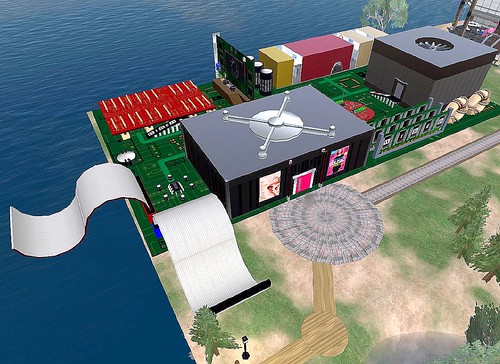
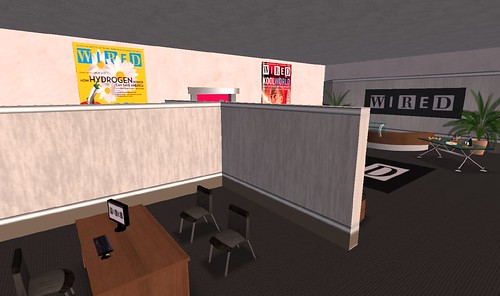
I dropped by this week to confirm its continued existence, and there it was. Even ghost towns get more visitors; its traffic: 33. To put things in context, my Second Life home at Chakryn Forest, which is open to the public (and offers no events, whatsoever), gets a daily average traffic of about 2500.
Wired's "travel guide to Second Life," was issued that same October 2006, and opens with this puerile text: "Taking a trip to the coolest destination on the Web? Our guide tells you where to go, what to do - and how to buy sex organs." Oh yeah. The real head-scratcher is that Wired was nominated for a National Magazine Award for this effort. I assume that this recognition had more to do with the publication's cheeky vision of the tadadada "future," rather than its grasp of the real potential that virtual worlds afford. Certainly history has confirmed as much.
And therein lies the problem that not only Wired magazine, but pretty much every single Real Life corporation that I know of (except Pocky!) has experienced to date as they fiddle around with their Titans-in-pixelated-cubicles (and we'll give you a free baseball cap and t-shirt, too!) approach. Not surprisingly, nine months after their launch in Second Life, Chris Anderson, Wired's editor-in-chief, and his minions were slamming the metaverse, and jumping ship. And like a house of cards, Real World corporations began to flee, one after another.
I'm not saying that Wired magazine isn't smart. I've been a subscriber for years. When you dare to walk beyond the known horizon, you are going to make mistakes, but Wired has often been incredibly right. They - and all the other bleeding edge corporations - were just incredibly wrong in their approach to Second Life.
Enter Edgware Marker and his Languagelab.com
I predict that a pioneering new brand with outsize ideas that's launching now just in Second Life will succeed where all others have failed. I think it will attract customers with exceptionally busy Real Lives who have never played WoW, and never been motivated to dip their toes in virtual worlds before. More often than not, these people will be smart, educated, have six figure salaries, and a vast network of friends and business associates. You don't have to work on Madison Avenue to recognize this demographic as the most desirable client of all.
Moreover, I forecast that Human Resource departments all over the world will soon be ponying up and sending their corporate executives in droves to Second Life to make use of this brand.
And that's not all. Out-of-work actors will quit their waiter/waitress "day jobs" in Hollywood and London and log in to Second Life... not just from 9-to-5, but around the clock... 24/7 (it's 5 o'clock somewhere, you know), and earn a real living. The man behind this enterprise is David Kaskel, a PhD candidate at the Center for Computing in the Humanities at King's College in London.
He's not new to Second Life, either. His avatar, Edgware Marker, rezzed 4/23/2004, has intentionally flown under the radar for the most part, though he is known to a few as a patron of the arts. Interestingly, I asked him last week if he had ever visited Wired's virtual offices. He had not.
His business: Languagelab.com, an immersive, virtual language school, peopled by first rate teachers from around the world, in addition to actors, who make the language come alive through first-hand experiences, coupled with an engaging curriculum.
Back in April, 2007, another publication geared to futurists, MIT's Technology Review, ran the article "A Boon to Second Life Language Schools - New technology will allow high quality audio in a virtual world," by Michael Erard, about David Kaskel's plans for an immersive language learning school in Second Life. The article points out that LanguageLab.com - already operating in Beta mode at the time - was the first language school built around Second Life's integrated voice capabilities. In fact, it even worked with Second Life's VoIP provider, Vivox, before Second Life had contracted Vivox to provide voice.
Today, Edgware Marker and his Languagelab.com own 18 sims, of which 15 are just now going public: Art, Home, Think, Arts, Living, Life, Office, English, Business, Conversation, Events, Jobs, Hotel, Nightlife and Play. This is an enormous investment by Second Life standards, but a modest one if compared against the cost of opening a Real Life language school in just one or two cities. Now consider that students can log in from all over the world... 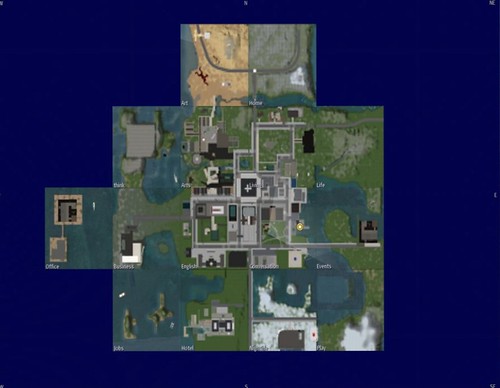
Taken together, 15 of those 18 sims comprise one big modern city, with all of the infrastructure, amenities and services a world traveler might expect to find, including a deluxe hotel, an airport, docks, several restaurants, bars, and cafes, shops, nightclubs...
...art galleries, museums, medical centers, beauty salons, parks, groceries stores, dry cleaners, a casino, a pharmacy, a real estate office, a church, a cemetery, a town hall, a post office, skyscrapers, a car rental company, many offices, a bed & breakfast, a movie theatre, and on and on... 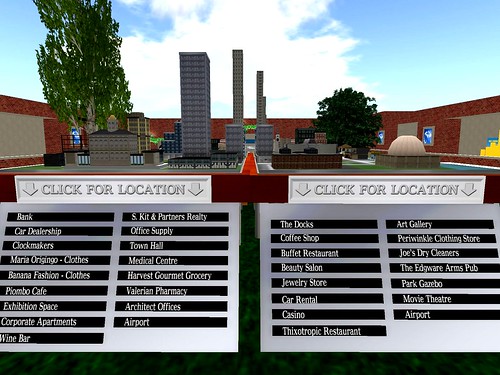
Landmarks can be taken for each location from a miniature model of the city that sits in the reception area of Languagelab.com
"Most of these facilities can already be found throughout the grid, so why not teleport the students here and there, and bring costs down to a bare minimum?" I asked Edgware Marker.
Edgware Marker: My theory is that language learning is accelerated when it is experiential and tied into the students' emotional and functional involvement. In a classroom, there might be an intellectual reason to learn, but in our city, where I have hired actors to play functional roles at specific locations and bring the city alive, we have shifted the emphasis and the student is engaged emotionally and learns differently, much more quickly.
Bettina Tizzy: What will the actors be doing? You will walk into a cafe, and order a coffee?
Edgware Marker: The biggest problem that people have in Second Life is that they see a cafe, and it is empty. In our city, you will ask, "who is in that cafe, and what are they doing?" Our trained actors are fully integrated into the Languagelab social environment. Moreover, the environment (social & physical), has been designed with its own evolution in mind. As the students and actors interact, so too, their roles and functions have been scripted to change not just over the course of an encounter but the days, weeks and months ahead. We have done a lot of research on the effect of the emotional environment on learning. This will be done both through explicit and implicit components of their individual environments. We’ve been looking beyond our 3D (spatial) creativity and building competence. We’re looking to apply the same creativity to some of the temporal aspects of the build (apologies for being a little cryptic on that one).
Edgware Marker: What I can tell you is that our actors will have roles that are rich with narrative and story arcs. Our students will come to know them and their personality traits in much the same way they would in Real Life. We are applying that character identification that you find when you see a film, or read a book or even by watching soap operas. We have already seen that this is a better way to learn a language than in a physical classroom. 
Edgware Marker: At Languagelab, our students are doing it rather than talking about it
Bettina Tizzy: Where are the actors coming from?
Edgware Marker: Our first set of actors are professionals who were already residents in Second Life. We're now going to specific acting communities to hire disabled actors, and bring them into Second Life.
Bettina Tizzy: Back in December, you gave NPIRLers a preview of a mysterious and eerie sim called Money, that had been built by Light Waves, Pavig Lok and LittleToe Bartlett. Will that be a Languagelab.com sim, and if so, how will it be used? It is hardly your everyday type of location. 


Photographs of Money by Arahan Claveau
Edgware Marker: This is a more experimental idea. While it won't open for a while, our plans are to use it as a location for a fast-paced language-learning scenario, where our students will get an accelerated adrenalin rush.
Bettina Tizzy: Only your students will have access to this sim?
Edgware Marker: I'll let you know more about that later.
Bettina Tizzy: What was the evolution of your own understanding that virtual worlds could be used for language learning?
Edgware Marker: I can think of three key moments in this interesting journey. The first was many years ago while playing DAoC regularly with a German guy. I was struck by just how quickly his English fluency improved solely through social interactions in a virtual environment. In one month (of intense play) he went from beginner level to nearly fluent, albeit in an MMO/text based context. Sometime later, I was making rather slow progress with my Italian, even though I was attending one of the leading language schools; but then an hour in a Naples taxi underscored, for me, the real power of a fully immersive environment. It didn’t take much thought to bring those two experiences together. Finally, it has been the result of my own doctoral research on the relationship of people with their (and others’) avatars.
Bettina Tizzy: Your approach to using the virtual platform strikes me as being several steps ahead of everyone else. Are you holding back from even more radical ideas, and would you care to give us a hint as to what those ideas might be?
Edgware Marker: If we are ahead, then it’s the result of nearly three years of highly structured research and experimentation with specific goals in mind. We’re launching now and are well advanced in the development of our gen-2 and even some gen-3 ideas.
Bettina Tizzy: Are their advantages to corporations in establishing a presence now?
Edgware Marker: It’s a question of opportunity and efficiency. Just as the games industry has comprehensively eclipsed the film industry in value (both in terms of money and time spent), so virtual environments will surpass (without replacing) many existing social/commercial interaction media. Being ahead of the curve is simple pragmatism; it takes significant time and resources to gain enough experience to deliver strong enough products and services.
Bettina Tizzy: Other than the classic techie, what other audiences do you think will be the earliest adopters to take up and assimilate in virtual worlds, and therefore your classes?
Edgware Marker: We are finding that adoption is based on the new opportunity it presents. Many of our earliest students were not even in Second Life beforehand, and certainly not your average early-adopter tech-head. They’re attracted by our ability to meet specific needs: Content needs: delivering what they need but can’t get from anywhere else (e.g. native speaker practice in many parts of the world). Access needs: giving them the services and facilities they want when they need them and wherever they are based. Financial needs: providing education at a fraction of the costs of exisiting Real Life alternatives.
Bettina Tizzy: What languages will you be teaching initially and where do you expect to get most of your students?
Edgware Marker: We're going to focus on English at first, and expect that most of our students will be from China or Spain.
Bettina Tizzy: The Languagelab museum has an important collection of Starax's art works. I saw several other artists represented. It's clear that you have already established solid ties with many of the best content creators in Second Life. How long do you think they will have to wait before their services are in high demand and claiming top dollars?
Edgware Marker: Well, for some it has already happened. A small minority are already claiming top dollar. The question should really be how many of the best can claim these rewards. That is a function of the products and services they are supporting generating significant incremental value to their clients. As businesses start to succeed as businesses in Second Life, so the value of strong, creative and reliable support services becomes self evident. It shouldn’t be forgotten though, that Second Life is very much a global marketplace for services. American and European designers, for example, must compete with Chinese, Brazilian or South Africans of tremendous talent and enterprise.