An acquaintance of mine has had several of her storybooks for children published with some success. In fact, she makes a decent living in Los Angeles in this manner and that is quite an accomplishment given that writers and illustrators with ideas for children's books are a dime a dozen. But there is an opportunity created by virtual worlds that intrigues me and I expect will pique the interest of book publishers, too. Eventually... One of these days now.... Seriously! I cannot, for the life of me, understand why they haven't capitalized on this platform already. Certainly animation studios and production houses are beginning to look at virtual world imagery as both a source and a resource (I can tell you that folks from Disney are frequent readers of this blog) and conceptually, I do believe that even a television commercial for a major brand may have been heavily inspired by content created in Second Life®.
Virtual artist Bryn Oh is already considered a master at delivering supremely immersive environments through the use of her sculptures coupled with original prose, poetry and even a play in which the attendees took part. There are simply thousands of us - virtual residents - who have attempted to explain to each other how moved we've felt by what we've experienced through her art via photographs, blogposts and machinima.
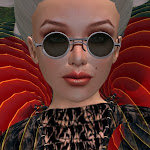
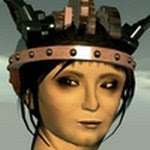
Her newest installation, curated by Tezcatlipoca Bisiani (aka Andrew Sempere) at one of the two IBM art sims in Second Life - Rabbicorn - is a second installment on her dark but moving Daughter of the Gears story. And it really is a story. Instead of turning the pages, we teleport to the next chapter. Instead of gazing upon the illustrations on a 2D page, we walk around the characters and situations. We hear the music, we move in and out of light and shadows. We are right there. But even if you never logged in to Second Life, the potential for the events to unfold in a traditional book is very much there through the use of well executed photography.
German photographer Dil Spitz "DilSpi," instantly agreed to capture some images of Rabbicorn for this blogpost when I approached her, given that she is already a fan of Bryn's work. Dil donates the proceeds of all sales of her images taken in Second Life to organizations that help stalking victims in Real Life. Keep in mind that Rabbicorn is a predominately dark build, so photography in this case was a challenge and Dil respectfully did not tweak the gamma or brightness.
The Machine Poems that follow on this page were written by Bryn for previous installations and not for Rabbicorn, but I thought I'd post them here to give you a taste of her storylines.
Charlatans
All my friends Are charlatans Beetlebots And Videonauts In dark nights With search lights Broken hearts Are useful parts Carry me From the street And love me though I'm obsolete
26 Tines
The laboratory is silent The scientists gone We have seven hours Before the dawn Come to me through the half-light To my jar by the rack Surrender your cord To the adaptor on my back 26 tines At the end of your cable Connect you to me So that we are able To feel emotions drawn Through the cables caress And forget till the dawn Our loneliness
Hardwired
All my dreams Were programmed by you So that they would All come true Fly on the wall Then to the street Robots When obsolete If I could only see you One more time Maybe you would Change your mind Resale hunters With laser beams Take all the parts but My hardwired dreams
If I were to commission the design of a building - whether commercial or residential - I would vastly prefer the opportunity to walk in and around it before brick and mortar were employed, over looking at CAD animations and illustrations, a flat screen, or even a 3D printout. Wouldn't you? It is such an inexpensive step and so basic to our senses (including common sense!). Using virtual worlds to bring blueprints to life is not only possible but a daily reality in Second Life®.
To me, it looks like the body of an acoustic guitar, or maybe a key hole, or perhaps it is a musical note. When I met with him just hours before the Metanomics studio he had created was about to have its public debut, I completely forgot to ask Keystone Bouchard (aka Jon Brouchoud) if he had implemented Feng Shui techniques in the design. My guess is that he did, whether he is aware of it or not. The thing just flows.
Unless you’ve been living under a rock or are very new to Second Life, then you know that the secret sauce over at Metanomics - the talk show that explores the serious uses of virtual worlds – is its community of suits and geeks who are there to mobilize mostly biz and tech ideas through conversation, together with the occasional sprinkling of left brainers, a smattering of educators and hard-core scientists, and a dash of memes. It’s a hale and hearty concoction.
Le Corbusier defined architecture as the “magnificent play of volumes brought together under light”
Keystone and I had been chatting for well over an hour, with just one interruption (he had to step away from the computer to say goodbye to his grandmother who was visiting his Real Life home – a real family man!), when it occurred to him to share with me that he’d been notified minutes before our meeting that his Studio Wikitecture, which he co-founded along with Theory Shaw (aka Ryan Schultz), had just won the Linden Prize: $10,000 USD for developing an “innovative in-world project that improves the way people work, learn and communicate in their daily lives outside of the virtual world.” And that should give you an inkling of the kind of fellow we’re talking about here.
Fast facts about Keystone Bouchard
Architect, urban planner and artist; Master of Architecture, School of Architecture and Urban Planning, University of Wisconsin, Milwaukee.Co-founder of Crescendo Design, a residential design studio located in Madison, Wisconsin (Real Life)
Creator of Autodesk Island, the virtual U.S. House of Representatives, Linden Lab’s Virtual Headquarters, a build-out for a TED conference event, and many other edifices and islands. (Second Life)
Co-founder of Studio Wikitecture, an open group composed of a diverse range of individuals from varying disciplines, interested in exploring the application of an open-source paradigm to the design and production of both real and virtual architecture and urban planning. (Virtual worlds)
Early Keystone Bouchard video, dating back to January 2007
Founder of the ARCH Network, a community resource for architecture and virtual worlds, including consultation, training, virtual design, BIM/CAD model import, and hosted Virtual Project Spaces.
He created the Reflexive Architecture installation, where I first discovered and fell head over heels for virtual architecture.
Keystone began the design process for the Metanomics building in February, and it had its unveiling on May 6, 2009. Here is the transcript of our conversation just before the opening.
Would you say that this was the most complex project you've taken on?
Keystone Bouchard: It wasn't terribly complicated from a functional perspective, since the intended use of the space was very clear. As far as complexity, I would say the Linden Lab HQ 4-sim project I worked on in 2007 while I was working with Clear Ink was quite a bit more so - given the magnitude of different program elements it had to accommodate, and the functional goals were much more difficult to quantify.
The biggest difference, I think, was in openness. The Linden Lab headquarters had to remain confidential, and it was harder to gain access or feedback from most of the people who would actually be using it, whereas with Metanomics, I was able to more fully engage the community of people who will actually end up using this space. Everyone was invited to stop by at any time and provide feedback. I think the incorporation of that feedback ended up making it a much stronger design than I could have come up with on my own
Who was on the Metanomics team to create this space?
Keystone Bouchard: Discord Schism, Metaverse Engineer, and Dusan Writer were the main collaborators. I was responsible for conceptual design, Dusan designed the set, Metaverse Engineer did all of the landscaping and various detail elements, and Discord Schism built out the event partner hub and other detail elements. Joel Savard was the Project Manager. I also did 99% of the construction on the main building shell and most of the texturing.
What was the plan?
Keystone Bouchard: My brief was to provide an event space for Metanomics that would span 2 regions - the set on one (to help resolve lag issues), and audience on the other, and also to provide space to display additional content - material from past shows - and design for the site to scale over time, with additional buildings to be added later. My goal was to design something that everyone could feel comfortable with, and to invite community wide feedback throughout the design process. We had regular community forums, where we solicited feedback, and presented the design's progress.
One of the things I observed before starting this project was that Metanomics can be as much about the back-chat as it is about the show itself. So many people expressing so many different ideas and opinions, yet, they're all coming together at that moment - around this show. I wanted to design something that was a visual metaphor for the coming together of ideas – the coming together of the community - so, the early conceptual designs were very literal. There were lots of building pieces coming together from all different angles - to create the auditorium.
In the final manifestation, that visual metaphor was represented with structural columns, while earlier on it had been more literal. It became a much more subtle expression, as though there are many individual pieces that are working together. None of them could visually support the structure alone.
How was this experience different from designing in Real Life, other than taking backchats into consideration (although nowadays twitter IS the equivalent of backchat in Real Life)?
Keystone Bouchard: It was much easier to express the idea here. In Real Life - conveying a design is a very abstract experience. You're sharing 2D plans, or sketches, and trying to imagine what it will look like - and trying to help the client imagine what it will be like, so, you're always trying to build a portal into that dimension - and show them that world - like from the outside looking in.
That’s similar to how it went down for DB Bailey (aka David Denton, AIA, in Real Life) and his Egyptian client recently. Once the client saw it in Second Life, it was something palpable. He could walk around it. He had a sense of perspective. In Real Life, the best you can do is create an illustration - which is static - and it is only one view. Animations (via CAD) get closer, but they're time consuming and expensive and still very prescriptive. The viewer has no control, and creating that illustration is an 'event.'
So how does the experience compare directly with CAD?
Keystone Bouchard: You decide, at some moment in time, to take a look at what the design will actually look like; whereas here, it’s always there… constantly. You're always in real-time 3D. There's never a moment when you have to stop and say, “Ok, let’s look at it in 3D.” It’s always 3D.
How often do those moments come up in a Real Life situation?
Keystone Bouchard: That's the other part of it. The client only gets to see your progress at bi-weekly meetings. Here, the client can make an appearance at any given moment. And that is just the design process. Some designers might consider that unnerving - but I find it to be invaluable. I like sharing the burden! If I'm stuck on something, I love being able to bounce ideas off of people. It becomes much more efficient because I’m not working in some direction for two weeks and then showing it to the client.
At what point in the design process did you introduce the stretched canvas texture? Did you originally think in terms of canvas? I'm reminded of Franklin Lloyd Wright and also Paul Klee. It seems organic, like a skin.
Keystone Bouchard: Yes, I've always been a fan of the idea of translucent marble that is cut so thin that light can permeate. It is possible to do in real life, but incredibly expensive. The idea with the outer shell was for it to be 'skinnable.' This is just one possible solution, but I hope in the future that it can be re-skinned with other textures: perhaps dynamic, maybe reflexive, or maybe (it) changes color based on concurrency or the mood of the community - like a visual display.
Or seasonal?
Keystone Bouchard: Yes, maybe something about the upcoming show; maybe competitions to design the best skin. Whatever the result, the goal was to make it very flexible.
What was the stickiest point?
Keystone Bouchard: Scale. It is still a challenge. I think the seats are too far away from the set, for example, because I wanted it to feel intimate, yet, it has to accommodate a large and growing audience.
Is that for purposes of the studio cameras? What percentage of the design discussions took the camera into account?
Keystone Bouchard: Camera had a lot to do with it. I was told 'no alpha' early on. I designed an inner shell where the camera is, for the lion's share of the show - with no alpha - so I could get away with having an alpha outer shell.
The spiraling swirls above the building...
Keystone Bouchard: NPIRL ;-) (Not Possible IRL). At one point, the idea was for the build to start very “Real Life” at the base - where it meets the ground - as though there were already this kind of historical archeology - and building over the top of that as it rises in the Z-axis, it becomes increasingly NPRIL. The idea of NPRIL came up dozens of times in design iterations. At one point, I was talking to Scope Cleaver (another virtual architect) about this. I pinged him often during the course of design development, and he said, “Wouldn't it be cool if the building were actually rising up out of the ground - as though the community were a kind of current - and this building was picking up on that, and crystallizing around it?” A brilliant idea, but as I thought about it, it’s more like something that zips around and orbits.
Later in the conversation I learned of Studio Wikitecture's Linden Prize win, and of course, I had to ask about it.
Keystone Bouchard: When we first started brainstorming the idea of applying principles of open source, and Wikipedia-style collaboration to architecture and the built environment, we knew that Second Life was exactly what we needed to make this work. The ability to customize and program elements within this platform was huge. We were able to build the Wiki-tree here, using this platform, and do lots of unique things with it, like being able to tie it in with a website. The diversity and size of the community is requisite in collaboration like this. Also, prims - believe it or not, prims! - are an important part of why Wikitecture works in Second Life. They're granular, so individual parts of the design can be modified, and the building tools are easy to learn.
That's why Second Life became a platform for experimenting with an augmented form of architectural collaboration that I sincerely believe could be an improved design methodology - and a more effective means of harnessing the collective wisdom of communities - the people who actually use architecture and the built environment. Buildings are just too big, and too complicated for a single firm or individual to fully comprehend and, ultimately, the urban fabric is a lot like one vast operating system upon which we run our lives. Linux was developed by many, many people - maybe architecture can be, too.
How radical is this thinking in the architectural community today?
Keystone Bouchard: O'Reilly called it 'Radical Collaboration' - so - I guess it is radical.
There is no other platform that offers this combination of features - the simple building tools, the immersive, realtime, multi-user experience - the ability to program a technology plug-in into it - and more - because of the fact that this combination doesn't really exist in other software applications. There isn't anything quite like it.
About a year ago... at least that is how I recall it... you seemed to be going through a period of real disenchantment with Second Life and virtual worlds. I felt as though you were... disengaging. Is this true and what happened that changed that?
Keystone Bouchard: When I started using Second Life, I was most impressed by what I assumed it was 'about to become' - not necessarily for what it was. I saw it as a tool. A platform. I knew an environment like this could be powerful in architectural and AEC practice, and I couldn't wait until X, Y and Z feature were implemented. I kept saying, “Imagine what this will be like in a few years!” After two years, it started to feel like nothing had changed and nothing was really getting any better, but that's when a kind of transition occurred and I started to think of it more like a place than a tool. It was then when I began to appreciate it for what it is - not for what I hope it will someday be. I think the fact that it has this 'real life' association - the land, the sky, the human avatars - is why we get disappointed with it when it isn't Real Life. We're comparing it with the physical world, when it really is a place, a context, and an environment all its own.
You can teleport to the Metanomics building directly from here.
See also:
New York Times, T-Magazine: "Original Sim" by Sam Lubell - Dec. 2008
Net Art/New Media artist Jon Rafman has been getting rave reviews and first-rate press coverage with the likes of Rhizome and other coveted art outlets as the Kool-Aid Man in Second Life®, offering free guided tours in-world. His dedicated website features a promo video that I guarantee will produce an emotion in Second Life residents, and invites folks to sign up. I first got wind of this video when Paddy Johnson of the art blog Art Fag City twittered “Best Link Ever! Kool Aid Man gives a guided tour of Second Life and it doesn't suck (like most SL art)!”
Unlike every other machinima I have seen that strives so hard to get past the technical challenges to convey the beauty, the love, the horror, the possibilities within, because of, and thanks to our virtual lives, Jon’s is a breezy, often hilarious tour that celebrates the absurdity of our immersiveness. Second Life users will recognize many favorite builds and installations.
WARNING: This video contains a lot of X-rated content.
Jon rezzed in Second Life on 12/10/2006 but used it sporadically until recently. I’ve spent a couple of evenings this week in-world with him and I can tell you that he’s a pleasant, intensely curious, and intelligent fellow. He received his Master of Fine Arts degree from the Art Institute of Chicago, and double majored in philosophy and English. I’d call him spontaneous, easily bored, and a fascinated yet detached explorer. I expect you’ll be as curious as I was to hear what he had to say about this. I sent him some rather open-ended questions via email to see what I’d get back.
Why did you elect to omit music to that video?
Jon Rafman: There is a tendency to use music as a crutch and let the soundtrack manipulate the tone of the work. I want the visual aspects of the video to speak for themselves. The formal qualities of the landscapes should dictate the mood of the piece rather than the soundtrack. Moreover, I always felt like the generic in-world sound effects, like the ominous low-pitched wind that blows across SL, creates a subtler emotional resonance than music.
Kool-Aid Man is on a quest for sublime kitsch in Second Life. Music used inappropriately corrupts the underlying mundanity of my avatar's search.
At certain points in the video there is music; however it's always what was streaming in that sim during the time of capture.
I don't want to assume anything so I have to ask: Are you really going to give guided tours?
Jon Rafman: I like this question. It forces me to ask myself: Where's the "Art" happening in this project? How important is the actual tour-giving process to the Kool-Aid Man in SL? Is the core of the artwork the video and photo collections? Or is it the process of the tour itself and the interaction with people in a virtual world that is the core of my project?
Yes, I'm giving tours. It is not a hoax!
But...
Even if the tours were a hoax and the project existed only conceptually, I'd be cool with that, too. I'm a big fan of work that walks the line between fake and real, ironic and tragic, fiction and documentary.
Do you intend to continue your work in Second Life?
Jon Rafman: I'm currently integrating some videos I've captured in SL into a larger documentary film about professional video gamers. I'm searching for ways to transcend the kitschiness inherent in the SL aesthetic and haven't decided yet on how significant of a role SL will have in the film yet.
I'm also toying with some story ideas for a few Kool-Aid Man in Second Life short video series. There's so much potential with Second Life machinima, but I have yet to see a work of machinima that's truly inspired me. Maybe I haven't looked hard enough though.
What do you want Second Life'rs to know about you most of all?
Jon Rafman: I found an analogy for surfing the web in the act of exploring Second Life as Kool-Aid Man. User-generated realms of Second Life can be viewed as a 3D virtual expression of the Internet’s anarchic psyche. Kool-Aid Man is my alter-ego, a secular icon that resonates with decades come and gone.
I see Kool-Aid Man as a self-conscious professional web surfer “breaking through walls” into various Second Life communities and subcultures. He never fully fits in, but he empathizes with whatever he passes. Like Baudelaire’s Flaneur, wandering the arcades of Fin-du-Siecle Paris, Kool-Aid Man keeps a cool and curious eye, strolling through the virtual world in search for the banal sublime. Kool-Aid Man's motto is best summed up by a line at the beginning of Chris Marker’s Sans Soleil: "I've been round the world several times and now only banality still interests me. On this trip, I've tracked it with the relentlessness of a bounty hunter."
I wondered as I read Jon's response if he was aware that French author, photographer and film director Chris Marker is very active in Second Life. Perhaps there are two bounty hunters then? It is unlikely we'll ever know, given that Marker famously does not take interviews.
Jon Rafman: The Kool-Aid Man in Second Life project is partly an attempt to investigate certain 'outdated' concepts from bygone eras and to reframe them or test them out in distinctly contemporary pop-cultural contexts. I am interested in the disjuncture between earlier uses and my own use and what this reveals about how consciousness has changed over the past decades. Whether a fundamental change has occurred is an open question as the forms of alienation that existed one hundred years ago are present today in mutated forms. But these subtle changes are revealing of what it means to be alive today. What are these subtle changes I mention?
The fragmentation that started with the emergence of mass culture has only intensified. Decentralized global society is epitomized in the World Wide Web. This is not to say that the power of centralized authority has declined or that a new genuine techno-democracy has been achieved. This is far from the case; I’m interested in the ways that self-regulating authority manifests itself from the ground up.
I do think that the task of grasping the present clearly has become more difficult because so much now obscures us from seeing it. I frame my quest for the banal sublime as doomed from the beginning because I am trying to highlight the loss of a certain type of consciousness.
Am I nostalgic for Fin-du-Siècle Paris?:
Yes, my project is a somewhat melancholic attempt at pointing towards the importance of understanding the historical context in the digital age. I can’t deny my nostalgia for earlier modern periods; however I am also aware that the image of the past that I yearn for reveals less about the past and more about an acute lack that exists in the present. And it is this “lack” that I want to point towards.
Jon moved to Montreal from Brooklyn, NY recently. He prefers that I not reveal his in-world name. So what do you think, Second Life residents?
Glyph Graves' latest, largest and certainly most stirring installation had many births. Originally conceived in early spring of 2008, it didn't reach fruition due to his busy schedule and limited prim availability. Since that time, however, he has made a name for himself as a notable sculptor in Second Life®, and today marks the public opening of his Strangers Also Dance, the inaugural show at IBM's brand new art and architecture exhibition space, curated by Tezcatlipoca Bisiani (aka Andrew Sempere, Research Designer at IBM's Center for Social Software).
Glyph is an Australian biologist who's virtual self is best known for kinetic, mostly abstract alpha sculptures that emit musical notes and eerie-to-sweet sounds when triggered by an avatar's proximity, though he is increasingly working with partially inverted solid-textured sculpts.
I've been a fan of Glyph's work for some time now and frequently feature his work on my own sim. This winter I happened upon this video by Todd Vanderlin and shared it with him as it reminded me of the behavior of several of his undulating sculptures and their responsiveness to avatars.
Glyph has since incorporated this thinking and included it in his reactive reeds. I mention this because he is an artist that is unusually receptive to new ideas and, like his sculptural work, acknowledges and rapidly evolves with his environment. This isn't to say that he is malleable or excessively adaptive. Rather, he is acutely aware and sensitive to exploration.
Strangers Also Dance is a remarkably immersive installation based on a poignant story that conjoins our Second Life universe with an alternate reality sweetly suffered by jellyfish that ventured too far from their warm gas giant home, becoming displaced in an environment that they find difficult but make the best of.
Importantly, Glyph approached the design of this build and its narrative beginning with its climatic circumstances. The Second Life ground upon which the adventure begins is suitable for humans (aka avatars) but too cold for these extra-SLterrestials and plants. Even so, the landscape is other-wordly. Obeying the laws of natural selection, a delicate pink creature was unable to keep up with its peers and has crystallized, laying dormant until it is visited, and touched, and therefore warmed by the avatar's body.
The avatar is enveloped by the creature, which begins to whisper to its guest:
Freed Alien Jelly: Nothing that will hurt you little one. Your warmth has freed me from the cold down here. Let me show you something few have ever seen... rest now. In your sleep, strange fragments of dreams of swimming in strange clouds come unbidden. Suddenly you feel disturbed as the hard crystalline surface you rested on melts away, then comforted by a sense of gentle enfolding and warm gratitude.
Delicately, a luminous jellyfish breaks free from the crystal, enclosing the avatar and floating upwards, all the while reassuring its capture that it will be gentle until...
... finally, almost tenderly, it deposits its human prize somewhere new, somewhere quite different, on a strange and wonderfully tropical terrain.
Sit on one of the immense tubes and you are one with this new matrix, downloading information as quickly as the creatures can share it.
The time was a memory past through banded clouds over hot seas we swam
then later,
of cold stars and eternal night we arrived, we stayed too long we could not go back
Released, you begin to explore, learning as you go about their sorrowful plight which they seem to accept with enormous grace. As I listened and absorbed their story, I couldn't help but admire their forbearance. My empathy grew.
"Do you want to know how we felt?" asks Biocrystal darkness. "When we first left the cradle of our world? Remember, our home, always bathed in warm clouds, always immersed in soft light. (Silence) Then dark. (Silence) What light there was, sharp like thorns and cold. (Silence) Enter. And feel."
Technically, there are a number of hallmarks: All sounds throughout the installation are played note by note. The speakers (the green plants) are designed to produce a spatial sense by cascading the notes down prim by prim as well as having them arranged around the sphere. A stereo effect is created by splitting the stereo track into mono components and playing them in opposite prims, which is also swirled by playing the pairs in consecutive prims.
Glyph's cellular automata react to both the avatar touching them and to the state of each of their local neighbors. After they've been touched, the music begins to self-propagate in a repeating pattern, which is different each time.
Since 2006, IBM has played an active role in empowering Second Life content creators with the IBM 6 sandbox which recently doubled in size and is open to all residents on the grid, whether they work for IBM or not. PatriciaAnne Daviau, its manager, has done an admirable job of maintaining a lively and active community there, though I can't help wishing that they didn't force teleports to one central location. It makes it very difficult to share works-in-progress with others who must then go by the coordinates to find their way.
Thanks to Jessica Qin's (aka Craig Becker, CIO Office of Strategic Initiatives) initiative and drive, IBM has moved to advance its presence with the content creation community, and particularly fans of art and architecture, with the launch of the new two-sim IBM Exhibition Space.
4Jetpacks4 was an immersive installation created by Bryn Oh, with the participation of Glyph Graves and Nonnatus Korhonen earlier this year. I was privileged to be one of the group of avatars that were given the tour of the research centre back on March the 6th. I will not talk here about what 4jetpacks was all about. The extraordinary video by Evo Szuyuan above does that far better than I ever could. What I will attempt to do instead is to talk about "immersion" and "presence" as integral parts of virtual world creativity. I know from personal conversations we have had that this is a subject as dear to Bryn Oh's heart as it is to mine, the thing which she puts at the center of her (virtual) creative activity.
I will quote a bit from scientific sources while I try to set up a basic definition of "presence", as a sense of “being there” in a mediated environment (IJsselsteijn, deRidder, Freeman and Avons, 2000). Lombard and Ditton (1997) define it as an illusion of non-mediation in which a user no longer perceives the display medium as a separate entity. A high level of presence will help users remember a virtual environment as more of “a place visited”, rather than “a place seen” (Slater et al., 1999). A success indicator of the attainment of presence is also considered to be the realization of similar behavior patterns in virtual environments to those in the physical realm (Slater and Wilbur, 1997), and even the manifestation of similar physiological responses towards a given event to its approximation in the physical realm (Meehan, 2000).
Various definitions of the term “presence” and their relevance to the immersive virtual experience are discussed by Mantovani and Riva who challenge the notion that experiencing a simulated environment deals with the mere perception of its objective features; instead proclaiming that presence in an environment (real or simulated) means that individuals can perceive themselves, objects, as well as others not only as situated in an external space but as immersed in a socio-cultural web connected through interactions between objects and people, leading us to the paramount importance of the interacting agent within a virtual culture, i.e., the avatar.
And this to me, lies at the very heart of the problem where artistic activity in a virtual world such as Second Life® is involved. Is the goal to be sought the "perception of objects" only? Or could it be that what would set artistic activity in a virtual world as a genre apart, would involve conditions wherein "individuals perceive themselves, objects, as well as others not only as situated in an external space but as immersed in a socio-cultural web connected through interactions between objects and people"? For me, without the shadow of any doubt, it is the latter. And it seems to me that this definition is what 4jetpacks is/was all about as well: That the creation of an immersive experience was the primary intention became obvious to me during Bryn Oh's opening statement where she addressed the importance of "presence" in virtual art. In her terminology the word "presence" is interchanged with "immersion", which does of course add up to very much the same thing. "Viewing" art, i.e., "the mere perception of its objective features" does not seem to overly interest Bryn Oh, and I am so very heartened to observe this in a fellow content creator, and one for whom I have a great deal of respect at that.
Bryn Oh is an exquisite builder. Every texture, every prim, every shape and object placed in perfect proximity, culminating in visual systems that I am awed by over and over again. And a very good thing that this is so: The immersive experience needs that level of concern for perfection to be pulled off with credibility. Creating an immersive experience does not imply that one can get away with shoddy visuality. If anything, it would imply the exact opposite: For us to become fully "present" within the "artwork" involves a level of visual expertise on behalf of the artist whereby perfect cohesion and gestalt are achieved to the extent at which not even a tiny component of the installation appears out of sync, thus distracting us from the immersive experience through its ineptitude or its misplacement within the overall system. Whether the visual gestalt that is meant to bring about "presence" involves high levels of abstraction or realism, opulence or stark minimalism would not be the issue at all by the way: I would seriously doubt whether one would need minutely detailed craftsmanship emulating realism to attain a state of presence. But, I would dare to say that what one would need would be a continuity of visual language - which as any artist worth his or her salt knows is a devil of a thing to pull off.
However, presence needs more than visuality. It also needs narrative. It needs a story or a situation endowed with sufficient power and imagination to pull us in. "Presence in art" needs substantial planning. An observance of fine detail whilst maintaining a firm grip on the whole. In other words, not a thing to be pulled off in one afternoon. Amongst much else, it is visuality, performance, role play, cyberpsychology combined. Bryn Oh has whatever it takes...
In the end, for me, the attainment of "presence" is more than likely to be the thing which will eventually create a "genre" out of the currently rather haphazard conglomeration that is the state of art in virtual worlds today. It really does seem to me that art generated in virtual worlds needs to be contextualized within the broader framework of contemporary art, given a raison d'etre, a property unique onto itself - and the attainment of "presence in art" would be a not too easily imitated attribute of virtual world based artistic activity. 4jetpacks gave me huge hopes in this direction and I am very grateful to Bryn Oh for having given me just that - hope!
...
A video created by Bryn Oh on 4jetpacks ends this post:
Also please read the post by Hamlet Au on NWN talking to Evo Szuyuan about her utterly remarkable SL-video skills and all that is involved in the attainment of the perfect SL-video here.
Posted by Bettina Tizzy All photography and machinima by Suzanne Graves
I have an uncle who handily wins the prize for geekiest person in my personal sphere. The man has two interests in life and one of them is math. One Christmas years ago, as we all gathered round the tree for our gift exchange, my uncle showed up with a manila folder. When his turn came around, he explained that he'd spent the past several months creating art using math equations in his spare time and we could each choose one of his art pieces as our gift. This was my first exposure to the concept of fractals, and I've been indebted to him ever since. Oh, I know... it was such a dorky thing to do (and he is a dork!), but the fact remains, I love geek art.
I figure it has been two years now since I first became aware of an ardent explorer and photographer in Second Life by the name of Suzanne Graves. It must be about a year now since she hung up her traveling hat and began playing with scripts and prims. Random rotations, random locations, generative builds, animated textures, and more. Math-inspired art.
I'm here to tell you that this woman hasn't wasted a moment. Since her Slinky piece and Wireflower back in July, 2008 to date, Suzanne has discovered many more new tricks for making prims behave in arrestingly beautiful ways.
And now she is capturing these kinetic forms in her own machinima...
Viewable temporarily - along with two other sculptures by Suzanne - at Ars Simulacra. Teleport directly from here. Music (c) Bertycox, Album: Synesthetism on jamendo.com
Suzanne calls this sculpture Sphere Balls as a play on words. "The spheres seem to be dancing at the ball," she explained. The piece, which she created quite by accident, consists of three similar sets of black and red spheres containing 200 spheres each that rotate in different directions simultaneously. Each of the three sets are positioned on an invisible/virtual bigger sphere, following a 3D curve on that big sphere.
"The size of each small sphere depends on the curvature of the 3D curve at its location. You may notice that the spheres on the top are smaller. Each "big" set is completed by (and linked to) an invisible prim, which is positioned at the center of the big virtual sphere, and this invisible prim responds to start and stop commands. I could add more commands such as changing the rotation direction, for instance," she added.
"The three sets of 200 spheres are concentric (their invisible prims have the same location), and the set in the middle rotates in an opposite direction relative to the outer and inner sets."
Because Suzanne's work is prim-heavy and script intense, it isn't easily displayed. In fact, I'm often frustrated because I don't know which sim or sandbox she is working in so that I can go and peek. I think it is time someone hosted a sim-wide show of her work. Don't you? Take a look...
Avatar AM Radio unveiled The Red and the Wild to the public yesterday. It is the first such art installation at the Institute for Digital Intermedia Arts, a hybrid art and design studio at Ball State University funded by the Lilly Endowment. AM is a narrative artist who uses prims, Second Life®’s basic in-world creation tools, to paint moody settings that are awash in nostalgia for a time when objects of wood and metal were shaped and crafted in a workshop or barn, and not in some faraway factory in Taiwan. A keen observer of nature, his Plein Air scenes are hyper-real, and always unmistakably American… the wheat fields of Illinois near his current home, and the vast expanses of the Northeast. Those who know, however, realize that there are surreal secrets and surprises tucked away in every AM Radio build.
...
It seems like forever ago; it seems like only yesterday. Matthew Kiddomen, then a member of our working group (NPIRL) and someone who left the grid for good soon after, sent me an IM some 20 months ago inviting me to come at once. “You must see this. It’s incredible,” he said.
It was up in the sky above the IBM sandbox… a wheat field, an old rusty train, a table set with an odd assortment of objects including a violin, some grapes, and a sketch book. Also a quaint garage, an old fashioned gasoline pump, and a shadowbox recreation of Jacques-Louis David's painting The Death of Marat. There, too, was the creator of all this, a rather surprised but nevertheless congenial and very tall gentleman by the name of AM Radio, sporting a long black coat and top hat.
He had bits of straw about him and the air of a chimney sweep. Within five minutes there were many of us there. I recall that I teleportedPavigLok and OrhallaZander, among others. We peppered this man with questions and he answered them all quite obligingly. Yes, he’d created this about a year ago. Yes, it had been up in the sky all that time and no, he owned no land.
Today, even if you are only a minor explorer in Second Life, odds are good that you have ventured onto at least one installation created by AM Radio. You probably own a set of sticks that he has given you. Perhaps you also have one of his dragonflies.
AM and I spent an hour conversing on Saturday, looking back at all that has transpired, and how it has influenced his thinking behind the creation of his newest: The Red and the Wild.
So much has happened to you in the past couple of years.
AM Radio: Huge learning experience. Often people will see me and say, "Oh, you're a person." And I have gotten used to it, but AM Radio really sort of became a brand. People think it’s a bunch of people building. So I have learned a lot, you know, managing that. It really is a careful process. So there is the learning aspect, but really in the last couple years I think the most important thing, the most meaningful thing for me has been the idea that we can participate in these virtual world activities, and have a real impact on the real world… and sometimes it is only vaguely related. Showing up at a concert in Second Life, and someone in Africa gets a cow.
Not long after he rezzedThe Far Away at Dreamworld, AM Radio began to sell plots of wheat to benefit Heifer International with 100% of the proceeds. Heifer is an organization that works to end hunger and poverty by providing livestock and environmentally sound agricultural training to improve the lives of people who struggle daily for dependable sources of food and income. It is best known for allowing people to "purchase" cows ($500US a piece) and other livestock. Today and just 20 months later, the sales of AM’s wheat have raised enough to buy a REAL herd of cows: $7,300 or nearly 15 cows.
Is there any way to know how your fundraising efforts have specifically benefited anyone?
AM Radio: Not specifically, not like the Adopt-a-Child programs you see on late night television. We like the cow metaphor Heifer uses. You know that $500 US is equal to a cow, or $120 a goat, but even then it’s impossible to say. Even if you knew you bought an actual cow because that cow’s milk is bought by other people in that town, trade occurs and neighbors converse, enemies begin to see advantages to understanding their neighbor. It's exponential.
Saturday was World Malaria Day. I recall that you did some fundraising for nets. Have you continued that effort?
AM Radio: Nothingbutnets.net - In 2008 I sold an off-road vehicle and the Lindens from those sales went to Nothingbutnets. That's a great program. Literally one net potentially saves one, or even two lives. For just $10 USD? I mean… come on, how better to spend ten bucks? Two Big Mac meals, or a teenager in Africa has anti-malaria nets at night to sleep in.
Is that vehicle still for sale?
AM Radio: That vehicle is not. You know, that was another thing I learned. Growth can be unpredictable. I had a very kind sim owner offer three sims, plus Princeton, and NMC and everything got complex really quickly, so I went back to my roots with the charity work, focusing on Heifer.
Sometimes it is best to keep the message as simple as possible, is it not?
AM Radio: Yes, exactly. Splitting off was requiring management at levels I am not ready for yet. I need help!
He went on to create The Quiet for Princeton University and Husk for the New Media Consortium (NMC). Then came The Refuge and the Expansion for just one week, a sim-wide version of the wheat field, and today that same installation is three sims large, under the patronage of art collector Alexandar Vargas. Since then, AM has conjured two other acclaimed sims: Beneath the Tree that Died for the University of Kentucky and Waiting for You.
Time-lapse machinima by AM Radio: "This is about 200 minutes of time lapse captured with FRAPS. A visitor with a powerful face-light visits about half way into filming and briefly lights up the center." Music is Artemis
If people wanted to help you, what could they do?
AM Radio: Right now, the easiest thing to do is get the word out. Often people apologize to me, especially at music events hosted on the sims. They say, sorry, “I can't donate right now.” And I totally hear that. But one of the great things about Second Life is that participation alone adds to the momentum. Showing up and being excited inspires those who do have the ability to donate.
How has your view of art in a virtual scenario changed in the past two years?
AM Radio: That Virtual Worlds is a valid art medium. It went from “Oh, this is neat.” To, “Wow, something is happening here,” to “Wow, it's in the New York Times.”
Is this a confirmation? Or did you believe it was less than that before? And how about how you approach your art? Has that changed in any way?
AM Radio: I don't think I thought any less of the medium. I think I paused more on the perception of Second Life by its own users and the Real Life public, and yes, (it) absolutely changed my art process. I think in my Real Life art, I have always been drawn to organic subjects. The fields, the trees, but there was a frustration, having been born in the mid-seventies, and really growing up in a very plasticized and prepackaged, processed world... sunlight, for our generation, is something seen through Plexiglass windows, and my art is a reaction against that. It's looking for more… for the organic. So it was an attempt to tear down the fakery, all that plastic in impossible colors, and awful rugs, and terrible media, like television, but in Second Life, there's almost an acceptance that much of this generation has already been living virtual. Everything is controlled, and marketed, from the music to food, to the computers the cool kids use. And now, here I am in a virtual world, trying to create the organic. I think it is still a search, but almost feels like…(pause) …a responsibility.
The wearable HUD at The Red and the Wild plays a tone and guides your camera to a specific angle when you touch a specific number - Photographs courtesy of NewdollNikolaidis
AM Radio: You know my critics like to peck that I am too close to (Andrew) Wyeth, but why not? Why can't we bring that here? Why can't we make sure we don't forget where we are, that this is all those plasticized windows filtering our sunlight. I can't help but think... you and I both spend so much time in world. How has all this changed your own sense of place? The ability to create your own environment and live in it, and share it?
AM Radio: Let me be careful how I answer that. I don't want to dissuade criticism of my work... but my work is deeply personal. What you see is so much a part of me; these are symbols of my life and events, and my emotions. Yates said “Tread softly because you tread on my dreams...” My sense of space here, I suppose, has become a more elastic version of real life. You know I can place out what I want and I can share things, but people can visit and bring their own emotional baggage, and see what they want, and expand my own understanding of my own memories. It's like having hundreds of people analyzing your dreams and posting their thoughts about them on Flickr... thousands of them.
You mean... that they can affect your own understanding of your creations?
AM Radio: Yes. Some artists…
…prefer not to read the reviews of their works, for whatever reasons. I take it this is not the case with you. How much of what you read/hear/discuss about your work are you absorbing? Is it malleable? Vulnerable?
AM Radio: I think I try to read as much as I can. I think I often do go off on tangents on builds, and I sometimes forget about the bigger picture and mission of Second Life. It's easy when you have access to a sim to just cover the sky when Windlight isn't really jiving with what I am trying to do, but I still find myself challenged by this specific limitation to not be able to easily share settings. What I did was try to make a build that allowed you to easily remove my tinting. You can lower your draw distance a bit and return to the default sky, for example, and also it is a tinting, so the Windlight bleeds through, allowing for the user to work with their list of presets in ways they haven't seen them work before.
sensations by Thea Denja - Taken at "The Red and the Wild"
Your works, all of them, seem to hearken to days - we can only speculate - of your childhood. What we do know is that most people don't live like that anymore. The train that was rusty in The Far Away is new and more of a concept at The Red and the Wild. Are we entering a new era?
AM Radio: Maybe more toy-like at The Red and The Wild. The new sim is inspired by elements of my boyhood. The house itself figured centrally in my life. The other houses I have built were more abstract memories of houses. This one is nearly accurate. In fact, it is odd to see people walking on its porch and not feel like they're trespassing somehow.
AM Radio's train at The Red and the Wild
What age were you?
AM Radio: Oh, I must have been about ten. Does the red abstract burst have a name? Care to explain it?
AM Radio: The sim has the same name (The Red and the Wild). I had been fooling with prims in an abstract way. I had started doing that way back; you might remember the boxes on The Far Away: The Way the Air moves.
I think abstraction fails in a vacuum. I think an abstract painting looks far more interesting when a lady wearing a Packers jacket is fumbling through a museum looking at them, wondering if she should know more.
AM Radio: There is a dialog between the abstract and the real that occurs in any abstract art, and I have had a really difficult time accepting abstract art in virtual worlds because that dialog is often missing. I think (that dialog... that ether for a relationship) most often works when the artist interrupts the abstraction with some inclusion of the avatar... with most avatars based on a very real human form. So, I have been really leery about using Abstraction in Second Life. I use it a lot in Real Life in my collage work. You can find some of those real life works on the new sim.
AM Radio: I had been thinking about these large shapes and not really understanding how I might get away with using them, and be able to explain myself to an art critic, or press, and I was really kind of at a dead end with it, but a friend from Atlanta, a very talented music, film, and 3d artist, sent some music he had been working on. One of the tracks included samples from the movie Breakfast at Tiffany's. At one point in the movie, and in Capote's Novella, Holly, the main character describes her anxieties and her fears as “the mean reds,” and immediately I thought of this large shape, these looming things in our lives that seem to want to tear us down. At the same time, these looming things, these anxieties, inspire us to become who we are, how we behave, how we react to things, how we present our avatar, how we define our virtual spaces.
In fact, in the movie, Holly has created an entire virtual world for herself. Her escape is the commoditized world where money defines what's real, and I thought “Wow, this is really relevant to virtual worlds.” Later in the movie and in the novella, Holly says... "But you can't give your heart to a wild thing: the more you do, the stronger they get. Until they're strong enough to run into the woods. Or fly into a tree. Then the sky. That's how you'll end up, Mr. Bell. If you let yourself love a wild thing. You'll just end up looking at the sky," and suddenly my thoughts on injecting abstract shapes made sense.
I had the courage to say that this abstraction means something, that here is a symbol of something, that we have these abstract parts of ourselves, these fears, these wild things we try to bury, and without them, we don't become who we are. The Red and the Wild really is a comment on that relationship that abstraction and realism are not mutually exclusive. In fact, they rely on one another to even exist. In the end Holly, of course, realizes she's living in a self constructed world, and immediately begins to redefine it.
Teleport to The Red and the Wild directly from here.
...
AM Radio's project, "The Space Between Those Trees," is a finalist for the Linden Prize, which will be awarded to one Second Life Resident or team with $10,000 USD for "an innovative inworld project that improves the way people work, learn and communicate in their daily lives outside of the virtual world."
Join us in our quest to discover the best of Virtual Worlds
Experience - first-hand - the creations, ideas and innovations that are pushing the boundaries of what is real. No, we're not in Kansas anymore! Virtual worlds are where all the disciplines of art and technology combine to make for the most compelling and exciting adventure imaginable.
Blogger Bettina Tizzy
NPIRL founder - Madly, wildly embracing the impossible made possible in Virtual Worlds.
Blogger Alpha Auer
"I need a new clockwork brain!... Indeed, maybe two?"
Show me, I'll show you...
A central goal for us is to collect and distill what's really happening out there and pare down your options to the essence of what's cool, trendsetting and even groundbreaking, always within the context of Not Possible IRL. This is not intended as a calendar of events and our selections are, by necessity, subjective and opinionated. To learn more about the criteria for what is NPIRL, click here. If you'd like to share a landmark, notecard or hot tip of any nature with us, kindly share it with us in-world. We try to always credit the finder, too.
A great place to rez your art and have it critiqued by art critics.
A Glossary of Terms and Abbreviations Commonly Used in this Blog
Cam - The act of zooming and panning one's viewer (camera)
FLART - Flat art in a 3D world (more often than not, imported Real Life paintings and still photography)
HUD (Heads-Up Display) - A visual display of preset options as part of the user interface (UI)
In-world - Being inside or "online" in a virtual world
IRL - In real life
Landmark (LM) - An "address" and shortcut that enables a Second Life® resident to teleport to another place
Linden - An employee of Linden Lab™, the company that owns Second Life®
Linden Lab (LL) - The company that owns Second Life®
Linden or $L - Currency in Second Life®
Mega prim - A very large and useful prim that is not endorsed by Linden Lab, and not scaleable
NPIRL - Not possible in real life
NPISL - Not possible in Second Life®
PIRL - Possible in real life
Prim or Primitive - A 3D object that is manipulated and used as a basic building and creation material
Rez - The action of creation in a virtual world; also the birthdate of an avatar/account
Sim - A simulator and virtual region hosted by a single server CPU
SLT (Second Life® Time) - Local time within Second Life®, which also happens to be Pacific Standard Time because Linden Lab is located in San Francisco, CA
TP or Teleport - Moving from one location to another in a virtual world
Windlight - Sky, water and atmospheric lighting effects in Second Life®