Posted by Bettina Tizzy
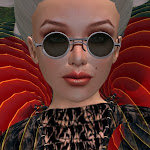
It was very late in my Second Life® when I discovered "false" eyelashes and now I want more. More styles and colors and by all means longer, crazier, hotter ones. Sure, they raise your ARC (Avatar Rendering Cost) a tad, but I'm willing to cut back in other areas if I can have some fantasy springing from my own peepers and basic lashes. Maybe we can persuade Jopsy Pendragon or Darek Deluca to make some with particle effects, or who knows what Cutea Benelli would attach to them... Dollar bills? Miniature scissors? Spiral Walcher would make them glow, of course. It's a pain to get them to fit properly in both lives, but worth it, I tell you, so very worth it.  D.W. Griffith came up with the idea for false eyelashes back in 1916 when he was directing the film Intolerance and wanted actress Seena Owen's lashes to "brush her cheeks."
I was chatting with virtual artist AM Radio who must have been simultaneously searching on the web, because he began to send me one link after another that led to the more than theatrical lashes that Japanese company Shu Uemura makes (check out their Tokyo Lash Bar). Perhaps this is an area where Real Life has trumped us on the fantastical plane and we need to catch up?


All photography via Shu Uemura
Wednesday, July 15, 2009
Fabulous falsies

Monday, April 27, 2009
A Burst of Conversation: AM Radio’s "The Red and the Wild"

Posted by Bettina Tizzy
Avatar AM Radio unveiled The Red and the Wild to the public yesterday. It is the first such art installation at the Institute for Digital Intermedia Arts, a hybrid art and design studio at Ball State University funded by the Lilly Endowment. AM is a narrative artist who uses prims, Second Life®’s basic in-world creation tools, to paint moody settings that are awash in nostalgia for a time when objects of wood and metal were shaped and crafted in a workshop or barn, and not in some faraway factory in Taiwan. A keen observer of nature, his Plein Air scenes are hyper-real, and always unmistakably American… the wheat fields of Illinois near his current home, and the vast expanses of the Northeast. Those who know, however, realize that there are surreal secrets and surprises tucked away in every AM Radio build.
...
It seems like forever ago; it seems like only yesterday. Matthew Kiddomen, then a member of our working group (NPIRL) and someone who left the grid for good soon after, sent me an IM some 20 months ago inviting me to come at once. “You must see this. It’s incredible,” he said.
I Set a Stack of Books by AM Radio
It was up in the sky above the IBM sandbox… a wheat field, an old rusty train, a table set with an odd assortment of objects including a violin, some grapes, and a sketch book. Also a quaint garage, an old fashioned gasoline pump, and a shadowbox recreation of Jacques-Louis David's painting The Death of Marat. There, too, was the creator of all this, a rather surprised but nevertheless congenial and very tall gentleman by the name of AM Radio, sporting a long black coat and top hat.
He had bits of straw about him and the air of a chimney sweep. Within five minutes there were many of us there. I recall that I teleported Pavig Lok and Orhalla Zander, among others. We peppered this man with questions and he answered them all quite obligingly. Yes, he’d created this about a year ago. Yes, it had been up in the sky all that time and no, he owned no land.
Today, even if you are only a minor explorer in Second Life, odds are good that you have ventured onto at least one installation created by AM Radio. You probably own a set of sticks that he has given you. Perhaps you also have one of his dragonflies.


So much has happened to you in the past couple of years.
AM Radio: Huge learning experience. Often people will see me and say, "Oh, you're a person." And I have gotten used to it, but AM Radio really sort of became a brand. People think it’s a bunch of people building. So I have learned a lot, you know, managing that. It really is a careful process. So there is the learning aspect, but really in the last couple years I think the most important thing, the most meaningful thing for me has been the idea that we can participate in these virtual world activities, and have a real impact on the real world… and sometimes it is only vaguely related. Showing up at a concert in Second Life, and someone in Africa gets a cow.
Not long after he rezzed The Far Away at Dreamworld, AM Radio began to sell plots of wheat to benefit Heifer International with 100% of the proceeds. Heifer is an organization that works to end hunger and poverty by providing livestock and environmentally sound agricultural training to improve the lives of people who struggle daily for dependable sources of food and income. It is best known for allowing people to "purchase" cows ($500US a piece) and other livestock. Today and just 20 months later, the sales of AM’s wheat have raised enough to buy a REAL herd of cows: $7,300 or nearly 15 cows.
Is there any way to know how your fundraising efforts have specifically benefited anyone?
AM Radio: Not specifically, not like the Adopt-a-Child programs you see on late night television. We like the cow metaphor Heifer uses. You know that $500 US is equal to a cow, or $120 a goat, but even then it’s impossible to say. Even if you knew you bought an actual cow because that cow’s milk is bought by other people in that town, trade occurs and neighbors converse, enemies begin to see advantages to understanding their neighbor. It's exponential.
Saturday was World Malaria Day. I recall that you did some fundraising for nets. Have you continued that effort?
AM Radio: Nothingbutnets.net - In 2008 I sold an off-road vehicle and the Lindens from those sales went to Nothingbutnets. That's a great program. Literally one net potentially saves one, or even two lives. For just $10 USD? I mean… come on, how better to spend ten bucks? Two Big Mac meals, or a teenager in Africa has anti-malaria nets at night to sleep in.
Is that vehicle still for sale?
AM Radio: That vehicle is not. You know, that was another thing I learned. Growth can be unpredictable. I had a very kind sim owner offer three sims, plus Princeton, and NMC and everything got complex really quickly, so I went back to my roots with the charity work, focusing on Heifer.
AM Radio: Yes, exactly. Splitting off was requiring management at levels I am not ready for yet. I need help!
He went on to create The Quiet for Princeton University and Husk for the New Media Consortium (NMC). Then came The Refuge and the Expansion for just one week, a sim-wide version of the wheat field, and today that same installation is three sims large, under the patronage of art collector Alexandar Vargas. Since then, AM has conjured two other acclaimed sims: Beneath the Tree that Died for the University of Kentucky and Waiting for You.
If people wanted to help you, what could they do?
AM Radio: Right now, the easiest thing to do is get the word out. Often people apologize to me, especially at music events hosted on the sims. They say, sorry, “I can't donate right now.” And I totally hear that. But one of the great things about Second Life is that participation alone adds to the momentum. Showing up and being excited inspires those who do have the ability to donate.
How has your view of art in a virtual scenario changed in the past two years?
AM Radio: That Virtual Worlds is a valid art medium. It went from “Oh, this is neat.” To, “Wow, something is happening here,” to “Wow, it's in the New York Times.”
Is this a confirmation? Or did you believe it was less than that before? And how about how you approach your art? Has that changed in any way?
AM Radio: I don't think I thought any less of the medium. I think I paused more on the perception of Second Life by its own users and the Real Life public, and yes, (it) absolutely changed my art process. I think in my Real Life art, I have always been drawn to organic subjects. The fields, the trees, but there was a frustration, having been born in the mid-seventies, and really growing up in a very plasticized and prepackaged, processed world... sunlight, for our generation, is something seen through Plexiglass windows, and my art is a reaction against that. It's looking for more… for the organic. So it was an attempt to tear down the fakery, all that plastic in impossible colors, and awful rugs, and terrible media, like television, but in Second Life, there's almost an acceptance that much of this generation has already been living virtual. Everything is controlled, and marketed, from the music to food, to the computers the cool kids use. And now, here I am in a virtual world, trying to create the organic. I think it is still a search, but almost feels like…(pause) …a responsibility.


I can't help but think... you and I both spend so much time in world. How has all this changed your own sense of place? The ability to create your own environment and live in it, and share it?
AM Radio: Let me be careful how I answer that. I don't want to dissuade criticism of my work... but my work is deeply personal. What you see is so much a part of me; these are symbols of my life and events, and my emotions. Yates said “Tread softly because you tread on my dreams...” My sense of space here, I suppose, has become a more elastic version of real life. You know I can place out what I want and I can share things, but people can visit and bring their own emotional baggage, and see what they want, and expand my own understanding of my own memories. It's like having hundreds of people analyzing your dreams and posting their thoughts about them on Flickr... thousands of them.
You mean... that they can affect your own understanding of your creations?
AM Radio: Yes. Some artists…
…prefer not to read the reviews of their works, for whatever reasons. I take it this is not the case with you. How much of what you read/hear/discuss about your work are you absorbing? Is it malleable? Vulnerable?
AM Radio: I think I try to read as much as I can. I think I often do go off on tangents on builds, and I sometimes forget about the bigger picture and mission of Second Life. It's easy when you have access to a sim to just cover the sky when Windlight isn't really jiving with what I am trying to do, but I still find myself challenged by this specific limitation to not be able to easily share settings. What I did was try to make a build that allowed you to easily remove my tinting. You can lower your draw distance a bit and return to the default sky, for example, and also it is a tinting, so the Windlight bleeds through, allowing for the user to work with their list of presets in ways they haven't seen them work before.

sensations by Thea Denja - Taken at "The Red and the Wild"
Your works, all of them, seem to hearken to days - we can only speculate - of your childhood. What we do know is that most people don't live like that anymore. The train that was rusty in The Far Away is new and more of a concept at The Red and the Wild. Are we entering a new era?
AM Radio: Maybe more toy-like at The Red and The Wild. The new sim is inspired by elements of my boyhood. The house itself figured centrally in my life. The other houses I have built were more abstract memories of houses. This one is nearly accurate. In fact, it is odd to see people walking on its porch and not feel like they're trespassing somehow.

AM Radio's train at The Red and the Wild
What age were you?
AM Radio: Oh, I must have been about ten.
Does the red abstract burst have a name? Care to explain it?
AM Radio: The sim has the same name (The Red and the Wild). I had been fooling with prims in an abstract way. I had started doing that way back; you might remember the boxes on The Far Away: The Way the Air moves.

The Way the Air Moves, by AM Radio
I think abstraction fails in a vacuum. I think an abstract painting looks far more interesting when a lady wearing a Packers jacket is fumbling through a museum looking at them, wondering if she should know more.

The Speckles in Your Iris, by AM Radio
AM Radio: There is a dialog between the abstract and the real that occurs in any abstract art, and I have had a really difficult time accepting abstract art in virtual worlds because that dialog is often missing. I think (that dialog... that ether for a relationship) most often works when the artist interrupts the abstraction with some inclusion of the avatar... with most avatars based on a very real human form. So, I have been really leery about using Abstraction in Second Life. I use it a lot in Real Life in my collage work. You can find some of those real life works on the new sim.

In fact, in the movie, Holly has created an entire virtual world for herself. Her escape is the commoditized world where money defines what's real, and I thought “Wow, this is really relevant to virtual worlds.” Later in the movie and in the novella, Holly says... "But you can't give your heart to a wild thing: the more you do, the stronger they get. Until they're strong enough to run into the woods. Or fly into a tree. Then the sky. That's how you'll end up, Mr. Bell. If you let yourself love a wild thing. You'll just end up looking at the sky," and suddenly my thoughts on injecting abstract shapes made sense.
I had the courage to say that this abstraction means something, that here is a symbol of something, that we have these abstract parts of ourselves, these fears, these wild things we try to bury, and without them, we don't become who we are. The Red and the Wild really is a comment on that relationship that abstraction and realism are not mutually exclusive. In fact, they rely on one another to even exist. In the end Holly, of course, realizes she's living in a self constructed world, and immediately begins to redefine it.
Saturday, April 11, 2009
A real life "sim"
Posted by Bettina Tizzy
Second Life® artist and creator AM Radio thinks that this aerial image of Venice looks astonishingly like an average parcel rental island, and we agree.  Via Vincent Wilkie and Black Eiffel
By the way, if you haven't already, you may want to drop by AM's Flickr stream and check out the sketches he's been posting. Seeing them helps me to understand how he's "fathered" the Far Away, Husk, the Refuge and the Expansion, and Beneath the Tree that Died, among other installations.
Sunday, December 14, 2008
Catch up: The New York Times on virtual architecture, AM Radio's voice on Arthole Radio, and more
Posted by Bettina Tizzy
It feels like an eternity since I last sat down to blog about the many enchantments and the occasional disappointments that my virtual life affords me. I’ve been caught up for weeks with the physical world of Real Life and moving to Austin from Santa Monica. Last night I unpacked the last box, and may I say… I simply love Austin. It’s good to be home.
Meanwhile, my new co-blogger Alpha Auer has been a miracle of productivity and triumphs. I congratulate myself on my association with her. The metaverse is too eventful so I couldn't very well expect things to stand still during an absence of three weeks, and I’ve especially enjoyed seeing it through her eyes.
Actually, I did do a blogpost about Eshi Otawara’s new Collection, which she unveiled yesterday to instant acclaim. Its immediate success surprised absolutely no one, least of all me. She informs me that all six of the Limited Edition outfits have been snatched up, and sales of everything are so brisk that she has decided to put all of her older styles on sale, 50% off (teleport directly from here).
You simply MUST see the arm pieces on Eshi's Limited Edition Kabuki dress up close, but you will have to know one of the six people who now own it to do so
Anyhow, here's a very quick summary of some of the news items that must be shared asap:
The New York Times eyes virtual architecture
Last Sunday, the New York Times style magazine, known as T, ran one of the most balanced yet favorable articles I've read about content creation in virtual worlds. Original Sim by Sam Lubell delves into architecture in Second Life® - not sex, adultery and MacMansions, for a refreshing change - and several NPIRLers and their works were featured, including Scope Cleaver, Keystone Bouchard and DB Bailey. I was flattered to see the NPIRL blog mentioned as a key source, and took pleasure in seeing Designer Dingson and photographer Lem Skall get their due, as well. Random House has published two beautiful and inspiring books that Sam Lubell authored about architecture in the fair European capitals of London 2000+ and Paris 2000+, and he is the Los Angeles correspondent for Architect's Newspaper.
AM Radio speaks on Arthole Radio
Arthole Radio has launched a one hour weekly program hosted by artist and art history/critical studies professor at the School of Visual Arts in New York, Amy Freelunch (aka Amy Wilson). For one of her inaugural shows, Amy conducted the first-ever voice interview with none other than fine artist AM Radio. I cannot encourage you enough to listen in, and you can do so here. It takes time to load, so be patient.
AM describes how artworks are capable of social interaction in virtual environments, hence the effort he put into creating his singular avatar; why he believes that he needs to be the best and most influential user of his work; and his views on how he is often compared to Andrew Wyeth.
What to do with a paper moon, by AM Radio
During the interview, Amy said something that has stuck with me: that virtual artists are pushing the medium as far as it can go. I agree. This is certainly one of the most compelling arguments I've heard for why Linden Lab needs to throw much more support behind artists.
Alternatives to Second Life
There are two new virtual worlds that I have yet to visit, one of them being Rezzable Productions’ Opensim foray with a test grid featuring a Greenies build. You too can sign up to be a part of the alpha testing.
Truth be known, so far, I’m less than wowed by the alternatives I’ve discovered to Second Life, and my dissatisfaction isn’t just over physics. Marianne McCann has shared with me that Legend City Online has banned kid avatars, and this after its owner, LaLa Legend, responded to me in writing – yep, I’ve got it in black and white - when I asked her if LCO would be welcoming all communities (child avatars, Gor, BDSM) with these words “We welcome people from all walks of life. Of course, we expect everyone that comes to our community to be respectful of each other’s choices. As well as expect that all activities are legal.” Bah! I have heard from a couple of people that LaLa bans folks if they so much as disagree with her on any small thing, too. Is this true? Has this happened to you?
Oh nooooes! Svarga is up for sale
It also broke my heart to learn via Hamlet Au and his New World Notes that Laukosargas Svarog has put Svarga up for sale. The fact that this blog has never covered one of the most NPIRL and extraordinary regions in Second Life is a huge oversight on my part that must be amended.
Yay! Tooter is back
On a happier note, that wicked-good and fun avatar creator Tooter Claxton is back! He’d gone missing since May, save an occasional email, but weeks had gone by since I’d heard from him, so I was overjoyed to see the little blue box pop up, notifying me that my friend was back in-world.
Photographs I take in Second Life still suck
Waaaaa! I'm a blogger, for cripes sake, and photographs are my instruments. Even though I attended Bridie Linden's office hour, blogged about that disappointment here, reopened JIRA #VWR-1641, downloaded the lasted drivers, and tested several clients - both production and RCs, nothing seems to fix this bug that ails all photographs I take in Second Life. Importantly, the same is not true of photographs I take in Legend City Online or Openlife, so I know the problem isn't with my system.
Sunday, November 16, 2008
AM Radio's tree, reloaded
Years ago, Second Life® artist AM Radio created a digital illustration of a dead tree suspended in mid-air that he later realized in 3D for Burning Life, working within the confines imposed by the virtual Playa.
AM's Burning Life contribution, the first "Beneath the Tree that Died"
Now and through January 1, 2009, the University of Kentucky and its curator - an artist and contributor to this blog - Tezcatlipoca Bisiani, have provided him with a 256 square meter canvas on the virtual campus to recreate Beneath the Tree that Died .
The original illustration can be found on one end of a country road, surrounded by a grouping of open umbrellas which are set to "physical" and can therefore be tumbled around like sagebrush by visitors to the installation. Click to see large
AM appreciates a vast expanse that invites solitude; this much I know from visiting each of his virtual art works. The immersive environments he creates are intimate despite the apparent immensity of the space they occupy: panoramic and seemingly endless pastures or meadows surrounded by lines of trees that are far, far away. Nature is the perennial headliner and often one can sense the cycles of life, for while a field of wheat may be waiting to be harvested, the rusty carcass of an old train engine sits exhausted in its midst.
He succeeds where most others fail when it comes to enabling us to suspend belief, for while we never quite forget that we are logged into a virtual environment, the sensation is as close as I've experienced to "inhabiting" a work of art, largely because everything is executed with technical skill, taking the medium as far as it can apparently go; not quite a copy world and yet...
Hyperreal scenes then give way to the surreal as he introduces unexpected elements: violins floating in an icy pond, dozens of hammers suspended in mid-air, animations that make it possible for the visitor to hover gently over - but always near - the mise en scène.
AM has also created the hat and umbrella for the Mary Poppins avatar. This isn't surprising given that his own avatar is somewhat of a male version of the same: seemingly conventional and yet quite extraordinary, as dragonflies cling to him and he is often carrying a load of sticks on his back.
And then there is always a radio. It's the first thing you hear when you arrive at the University of Kentucky's island.
Beneath the Tree that Died
The elements of Beneath the Tree that Died are few, but not spartan. There is the original illustration surrounded by umbrellas on one end of a New England parkway. Further along, a large dead tree with its roots intact is suspended above that same country road, and a 1948 Plymouth is nearly beneath it, not quite aligned with the roadway. In fact it is crossing the line. Something may be amiss.
Turn your media on and you will note that the texture on the ground megaprim is code-generated. An algorithm will begin running in Javascript on your computer. Each person sees a different pattern and the design evolves. Hit Stop and Play and you will see a different design
Just beneath the tree and also on the road, a telegram...
This photograph by AM Radio. Click to see large
When asked what his art meant during a preview of the new show, he replied: "I think it means what you bring to it. Here I have my story. Things that are precious to me. Moments in my life, a tree, a car, the weather station my grandfather always listened to. This is simply me, my most inner thoughts and dreams and feelings. What it means, I suppose is what you bring to it, your own story. Here is a narrative that can only be complete when you view the work and react to it."
Second Life has a one-year old client-side feature called Windlight - a lighting and rendering system - that enables its residents to set atmospheric conditions such as the times of day or night. Several users have created "presets," which make it possible to share specific sky and water palettes with others. Soon after Windlight was introduced, AM created a mustardy preset called Nostalgia that is utilized today by many photographers within virtual worlds. In the past, all of AM's installations have not only invited the use of Windlight, but often benefited from it. Beneath the Tree that Died thrives exceptionally in the default atmospheric setting, or as AM puts it, "It likes the time of day."
This photograph by AM Radio. Visitors can change the color of the car by touching it.
"Beneath the Tree that Died," can be accessed by teleporting here, and touching a red door.
See also:
* At the root of the matter
* AM Radio and Miki Gymnast collaborate - Two distinct art languages converse
* Become practically perfect in every way
* The safety of spaces
* Photo restoration via Second Life
* Second Lifers' love of wheat
* Pixelated wheat buys real cows for families struggling against poverty and hunger
* The wheat field... has a secret
Wednesday, October 22, 2008
Dear Bridie Linden: ...
I know you are busy. So am I. You put many dozens of hours into your work in support of Second Life® a month. So do I. Three notable differences:
1) You get paid.
2) In regards to Second Life, your work is important to the happiness and well-being of users. I respect that. I am trying to work with the system I've been handed by Linden Lab.
3) I'm a paying customer.
Today and at the suggestion of another Linden, I attended your office hours, expressly to discuss something that is affecting my own many hours in Second Life, as well as my ability to promote quality content created in this virtual world. At your request, I waited until the end of your one hour+ "office hours" meeting today to present issues with snapshots taken in Second Life.
As a paying customer, this would be like agreeing to wait on hold for one hour+ to get an answer from technical support from, say, Verizon, or Dell, or my local gas company. Second Life is an ongoing concern, after all, so I don't think that any other comparison would be justified.
[15:03] Bridie Linden: I thought we'd do something a little different today...
[15:04] Bridie Linden: I thought we'd take a look @ issues that have already been imported...
[15:04] Bridie Linden: But are still unresolved
[15:04] Bridie Linden: And see where we're at with them...
[15:04] Bridie Linden: since 1.21 is released
[15:04] Bridie Linden: sound good?
[15:04] Bettina Tizzy: I have one specific issue I'd like to discuss
[15:05] Bettina Tizzy: re: screengrabs
[15:05] Bridie Linden: Bettina, can we save til the end?
[15:05] Bettina Tizzy: sure
ONE HOUR LATER... waiting and listening
[16:00] Bridie Linden: and last one was a dupe
[16:00] Bridie Linden: yay!
[16:00] Squirrel Wood: Woot!
[16:01] Bridie Linden: Thx all, I have to run to next meeting.
[16:01] Squirrel Wood: Have fun! ^^
[16:01] Bettina Tizzy: um
[16:01] Zen Linden: gotta run. catch y'all later
[16:01] Garn Conover: not often we complete the list
[16:01] Cummere Mayo: tc bridie
[16:01] Cummere Mayo: and bug tester are you bambers?
[16:01] Bettina Tizzy: ok
[16:01] Object: Glod Sarts for all!
[16:01] Bridie Linden: Oh shoot, bettina, what was your issue?
[16:01] Kerry Giha: Thanks Birdie
[16:01] Bug Tester thanks you all for your efforts and reminds you to hug a bug today
[16:01] Alexa Linden: thanks all!
[16:01] Object: No more Glod Sarts for you!
[16:01] Cummere Mayo tests bugs not hugs them
[16:01] Bettina Tizzy: AM Radio is using the production client
[16:01] Bridie Linden listens
[16:01] Bettina Tizzy: all his screengrabs are black
[16:02] Bridie Linden: Video card driver, maybe?
[16:02] Bettina Tizzy: my shots in the RC: http://www.flickr.com/sdfhweid=72157608285597087
[16:02] Bettina Tizzy: i can ask him
[16:02] Bridie Linden: search Issue Tracker
[16:02] Bettina Tizzy: oops wrong link
[16:02] Gellan Glenelg: could be related to multiple monitors, or to resolution > screen size
[16:02] Bridie Linden nods
[16:02] Bridie Linden: Gotta run, sorry!
[16:02] Bettina Tizzy: http://www.flickr.com/photos/bettinatizzy/2965616426//
[16:03] Bettina Tizzy: sigh
And that was that. As a courtesy, I presented AM Radio's issue first (he had IM-ed me while I was waiting my turn), and then tried to get mine in within seconds, but you were no longer there to listen.
~*~
AM Radio: JIRA #VWR-7812 exists for your issue, but according to Linden Lab, it is fixed. You may wish to reopen it.
Tears/fractured snapshots: In about 30-40% of my snapshots in the RC to my Hard Drive taken in Windlight, my shots look like some variation of the above. I have reopened JIRA #VWR-1641.
Black vertical lines: The JIRA #VWR-7489 reporting a vertical black line on snapshot to Hard Drive had been closed, which I just reopened. I had already run a search in the JIRA for torn/fractured images.
~*~
Bridie: I'm no JIRA expert, and I can tell that it really helps to know what you are doing before you start opening and reopening issues and so on... which is why I attended your meeting in the first place. Sigh...
Sunday, September 28, 2008
At the root of the matter...
In every culture around the globe, the tree is weighted with heavy symbolism. For some, it is the synthesis of heaven, earth and water. For others, it can symbolize life, the feminine principle, the matrix and knowledge.
AM Radio continues to confound us with his radio-driven mysteries, but the centerpiece this time is yet another tree, albeit a dead one. His "Beneath the tree that died" installation was created using traditional prims (teleport directly from here).

This photo of the telegram than can be found on the table, by AM Radio. Please click to see large
Thanks to sculpties and megaprims, trees and most botanicals in Second Life® resemble their Real Life counterparts more while costing just a few prims.
Cel Edelman's 48 prim trees (each) are still very much alive (teleport directly from here)
Strawberry Holiday's trees that use particle systems for leaves have been delighting us for several months now, but none has come closer to the organic beauty of her new 26 prim Oakey Tree, available here.
Says Strawberry, "Trees and other natural objects offer a portal from the place in your brain that requires the concrete, reality of every day life to a virtual reality where anything can happen. Words can fall like leaves and headlines can wave in the wind like grass."
Wednesday, August 20, 2008
Art 101 redux - Penumbra Carter
I have no idea who Penumbra Carter is, but this is the best summary of art in Second Life® I've seen to date in one video. Who are you, Penumbra and what did you mean by all of this? Please do tell us!
Sunday, August 3, 2008
AM Radio and Miki Gymnast collaborate - Two distinct art languages converse
Today, the Alexandar Gallery marked the opening of The Refuge and the Expansion - a new show spanning two sims - featuring several works we are familiar with and some new things (and great freebies, I might add) by AM Radio (teleport directly from here), and yet a third sim which brings together AM Radio and Miki Gymnast's art in a project that embodies two disciplines and provides us with poetic opposites.
This photograph by AM Radio
We relate to AM and Miki's work in such different ways. His painterly and hyper-real and immersive situations as can be seen at The Far Away, The Quiet and Husk, are so much more than recreations of objects we know and recognize. Rather, he invites us to look through his eyes and gives us emotional and cultural reference points. Chocked full of hidden metaphors, his fields and landscapes invite us to walk through memories, which are not necessarily his own. He is a visual narrator. If you follow his Flickr stream, you will see an actual story unfold that integrates all of his work.
In contrast, Miki is best known for her sharp eye with respect to geometric shapes that spill out of the traditional frame and are often quite Not Possible IRL. Her installations are generated via intricate scripting work and inspired by mathematics, featuring mostly colorful panes of glass in complex, undulating and soaring structures.
The result of their collaboration: a smokey-colored Klein Bottle sits in a tilled field, surrounded by mega prim walls that define the lighting and mood of the scene, (teleport directly from here).

"From a purely academic standpoint, art is a communication and all communication is grounded in some vocabulary," said AM. "I believe that the best abstract art is shown in a context."
What was your interest in placing abstract art here?
AM Radio: It is a contrast, and as a realist I think people tend to write me off somewhat. 'Oh well, AM won't be interested in this or that,' and I don't get an invite or an LM, when in fact, I am very intersted in abstract work. After seven years of art school, I understand the concepts, theory and talent that goes into the work.
"For example, here we have a tilled field and a sky and a horizon... it implies things like gravity and space as we experience them in Real Life," said AM. "When you put something like what Miki does in this space, it literally shows you - as a dialog - all of the rules its breaking. It forces you to think about what the piece is really doing. Like an abstract work seen in Real Life, the context is our personal experiences, the baggage we bring everywhere we go. When you present such a work in a vacuum, the dialog is more muted and guess work... like two people speaking foreign languages, attempting to speak with simple signs."
AM Radio's walls do speak
You've been extra particular about the light qualities here... the walls disinvite play with Windlight...
AM Radio: There are a few points there. First, mega prims are indispensible. The second, we need to be able to share Windlight settings and thirdly, look at the result if both are allowed.
If I understand you correctly, you are giving us a Windlight preset in-world by creating these walls.
AM Radio: I wish I could share this as a windlight setting, but I cannot. For now, the compromise is a megaprim. 
Miki Gymnast
"I want to see this in Real Life," said Miki, "a farm in the mid-west, with such a sphere."
A Master Scripter in addition to being an artist, she explained that the Klein Bottle is a sphere with no outside and no inside. The Klein, in fact, is a one-sided surface - like the Möbius band - but is even more complex since it is closed and has no border and neither an enclosed interior nor exterior. While it is possible in Real Life, it is costly and complicated to produce.
Alexandar Vargas... a patron of the arts
The expansive three sim exhibit was made possible thanks to the generosity of Alexandar Vargas, the owner of the Alexandar Gallery. While several of his sims are dedicated to a permanent display of sculptures in a garden setting, he is taking a more active role in hosting very large installations, such as Madcow Cosmos' recent Tarot deck. I met with him yesterday at The Refuge and the Expansion to learn more.
Alexandar Vargas and AM Radio
What is your opinion of this show?
Alexandar Vargas: I have never seen such talents as AM and Miki. AM is probably the one artist here in Second Life® that has really touched me with his work. The fields he has here take me back home, since I grew up in northern Tennessee and drove through the midwest a lot... lived in Nebraska for a while, too.
You have been an empowering force to artists. How did this happen and when did you get started?
Alexandar Vargas: Probably in January. I received Light Waves' Ballerina as a gift, and began collecting art since then. I decided to place it on Welsh Bay. I think that (virtual) art is as impressive as Real Life art.
Back in January, Alexandar had two sims which he used as his home, but then he began to voraciously acquire art...
Alexandar Vargas: Once I ran out of prims, I moved off my home estate and then took over my brother's sim. He and I both own the Cove... it was the first sim we purchased.
Was it hard to find great art? Or was it hard to choose between the immense selection?
Alexandar Vargas: It was neither difficult to find, nor difficult to choose it. It was more of an issue of having room for it.
And then you got a third sim?
Alexandar Vargas: Yes, each time I ran out of room, I got a new sim. When other artists approached me and I saw art I wasn't aware of... that floored me, to be honest.
How many sims do you have now?
Alexandar Vargas: God... um, six I think, that I use for art. I really enjoy it. Lots of times, I just walk through the sims when I can't sleep. It is important to let others know about virtual art. It is just as valuable and beautiful as art in Real Life, and it is a shame when some don't think so.
Thursday, July 17, 2008
Introducing Eln Alter
AM Radio wrote... "Look up Eln Alter. Check out the house there. Wild." Of course, I did.
Every now and then, a fresh and strikingly original creator hits our radar, so rich with possibilities! Such was the case of Bryn Oh and four Yip, and they certainly haven't disappointed. Notably, Eln rezzed on 11/1/2007. Such work and concepts are unexpected from someone so new to the grid. 
Eln, wearing one of her avatars
Her little house serves as a shop. I'm particularly fond of the stilts that it sits on. 


Inside, more whimsical items, many of them for sale. 
On the ground beneath the house, Eln has also created a "museum," though she hasn't yet decided what it is about. Her vases there are indicative of an intriguing tangent I hope she'll continue to evolve.
Teleport to Eln's shop from here.
Teleport to Eln's Museum from here.
Tuesday, July 15, 2008
Become practically perfect in every way
I'm too supercalifragilisticexpialidocious for myself. 
This photo by AM Radio
Dress: Lapin Paris
Shape, Skin: Posemaster Darkstone
Umbrella, bag, hat (and look for the absynthe!): AM Radio
And... when I fly, my umbrella opens.
From Dark Victoria at Caledon (teleport directly from here).
Tuesday, July 1, 2008
Nabisco's ad agency inspired by Second Life, perhaps?
Nabisco's Wheat Thins Reduced Fat crackers have a new 30 second ad in the United States called, "Come Fly with Me," featuring blissful people flying/floating in the air above a wheat field while Frank Sinatra is belting out that signature song of his. I searched everywhere for a free way to share this ad with you, but struck out. You can see a screen grab of it here.
Hmmm. Seems like a remarkable coincidence, doesn't it? The similarities between this ad and AM Radio's wheat field, better known as The Far Away are eye-brow raising. 
AM Radio's wheat field with flying poseballs has been rezzed publicly in Second Life® since early September 2007
Speaking of The Far Away and wheat, AM told me a couple of days ago that Second Lifers have helped him raise enough money through the sale of his virtual wheat to purchase eight and a half real cows through Heifer International, an organization that works to end hunger and poverty by providing livestock to people around the globe who struggle daily for dependable sources of food and income.
AM's expanded his fundraising efforts beyond cows now to include a pixelated jeep that raises funds for real malaria-preventing mosquito nets - somewhere in the world, a child dies every 30 seconds because of a mosquito bite - which you can read about over at Hamlet Au's New World Notes.
Teleport directly to The Far Away from here.
Monday, June 23, 2008
Think this way! You'll be glad you did
Via AM Radio... joy.
I wish I knew more about the people behind this.
Thursday, June 5, 2008
Dear M Linden - Please help content creators protect our Intellectual Property (and save LL a lot of time and trouble, too)
In an April 25, 2008 interview with Erica Naone in MIT's Technology Review, you agreed that content creation is "definitely the story of Second Life," and given your background in "user-centered design work," I believe you may be receptive to an idea that should be easy to implement and could save everyone a lot of, um... grief, and time.  The Not Possible in Real Life group hereby requests that Linden Lab add a Creative Commons tab in the object editor, as well as a Creative Commons option in the right click pie menu, so that everyone can see, with a simple right mouse click, what the rights are on an object.
While it would not be a panacea, offering this tool would help creators define how people can use their work, beyond the dictates of fair use, but without having to negotiate every single license. It would have no ill effect on the fair use of a work, and copyright law and any other applicable law, would still apply.
As AM Radio pointed out, the issue of copyright protection in Second Life®, "...is just getting goofy. The problems appear to stem from people's inability to comprehend intellectual property law and the fact that it is the responsibility of the infringer to seek and understand the copyright intentions of the creator. It is not the creator's burden to present a copyright declaration in all instances that the work is presented."
He added,"Giving creators the tools to make a copyright declaration in the object editor would relieve them of the burden of chasing down infringers, as well as give them a specific tool set to use in such circumstances. Violations would be clear, infringers would be outcast, and the community would self-police." 
There are four conditions that you can choose to apply to a Creative Commons license:  Attribution: You can use the work but must give credit. This applies in all Creative Commons licenses.
  Noncommercial: You can use the work only if you don't make any money from it.
  No derivative works: You can use the work only without altering or transforming it beyond the provisions of fair use.
  Share alike: You can transform a work as long as you make the resulting work available on the same terms as the original work.
You can use these terms in 6 different combinations.
"Creative Commons doesn't cover all situations, and often times there are violations which are unclear. I cannot copyright wheat as represented on a single cylinder any more than I could copyright the word "wheat." I could attempt a patent for such a thing though. I could, however, copyright a work which uses the idea, such as an entire field of cylinders, in much the same way I can use the word "wheat" in a copyrighted short story. So creators must be educated on the difference or people could chase one another for creating wooden box prims," shared AM.
Info for Residents
Copyright law protects any creative work whether the creator wants that protection or not. No one should use your work without a license, beyond fair use. The Creative Commons tool however, is especially useful if you want to share your work in some way. Would you mind if your work is photographed or filmed, for instance? Some creators object strongly to this, while others welcome the recognition and free promotion. Don't want your work to be shared? Not an issue. Under our proposed scenario, you just wouldn't select and use a Creative Commons license.
Want to learn more? The Creative Commons (CCA) - a non profit organization that "builds tools that help realize the full potential of the commons in the age of digital networks" - will hold its first Creative Commons Technology Summit at Google's offices in Mountain View, California on Wednesday, June 18th. Attendance is free, but space is limited, so register soon if you have an interest.