On Werner Kurosawa, geodesic domes, and Green Phosphor’s novel work in Second Life
Posted by Bettina Tizzy
Years ago, a friend of mine who owned a large manufacturing centre sought to enclose the entire building complex within a geodesic dome, modelled after architect and inventor Buckminster Fuller’s lattice shell structures. His goal was not merely an aesthetic one, for it is said that such domes maximize efficiency in energy use for both heating and cooling, while being structurally strong. Fuller’s maxim: “Doing more with less.” That was my first introduction to the futurist, and I’ve admired many of his ideas ever since. As an irrelevant but nonetheless fascinating aside, virtual world residents who find their schedules unbearably stretched may take an interest in the fact that Fuller practiced Polyphasic sleeping for two years: only two hours a day via very short naps at regular intervals. 
Fuller and Shoji Sadao’s U.S. Pavilion at the ’67 Expo in Montreal – Image courtesy of David Gomez Rosado
Fuller and Shoji Sadao dreamed of placing a climate-controlled geodesic dome over Manhattan – Photo courtesy of NeutralSurface
Buckminster Fuller’s domes were the first thing I thought of when I rezzed at Green Phosphor’s new facility in Second Life®, which is surrounded by an immense – even by SL standards – webbed rotating sphere. The effect is both elegant and highly dramatic.
If you click to enlarge, you will see that the spec at approximately the middle of this image is me, standing on a platform above the dome
Werner Kurosawa, the virtual architect
Created by Belgian architect Werner Kurosawa (aka Werner van Dermeersch), Green Phosphor is among the most handsome and livable virtual corporate campuses that I know of.
It was so not a surprise then when I visited Werner’s website and discovered various videos on Buckminster Fuller and links to the organization that bear the maverick’s name.
“Of course it is a tribute to him because he surpasses the ordinary, which every architect should do to have the right to use the title of architect. On the other hand, it was for my friend and client Tom Barman – lead singer of the Belgian group Deus - who used the “image” of Bucky as a reference to me when he wrote the song “The Architect” in their latest CD (look for the tape recorder on the bottom right).
In addition to his architectural work, Werner creates art installations, “from big to small.” From time to time he collaborates with his friend and composer Serge Verstockt on contemporary classical music and he also teaches Master classes in Art in Antwerp.
His Second Life name, of course, alludes to two of the greatest film directors of all time. He described a scene in Werner Herzog’s latest film, where an upside down image of a waterfall is seen in a drop of rain clinging to a leaf. He loves all films by Akira Kurosawa, but “Ikuru holds a special place in my heart.”
When Werner gets real, his predilections range from the university that Kasua Sejima built in Lausanne, the Lemoine house in Bordeaux by Rem Koolhaas – there’s also a great video about it here, via Gizmodo - which he believes to have been a milestone at that time, and the pyramid of Cheops in Giza.
Given the environmental advantages to the Green Phosphor dome, I expected Werner to answer affirmatively when asked if he considered ecological issues when building virtually. I was mistaken. “I consider environmental issues in Real Life. We would have to stop using computers and the Internet if we were to consider environmental issues in Second Life,” he said.
Most of the people in his life - including his Real Life clients - think he’s wasting his time in Second Life, “but I believe there is a big future ahead for the 3D Internet.”
Certainly the Real Life company Green Phosphor thinks so. “We produce the leading tool for visualizing data within virtual worlds,” said Ben Lindquist, the company’s CEO. “While our tool works in Second Life, Sun's Wonderland, and soon in Forterra's OLIVE, we have only one headquarters - the virtual headquarters that Werner Kurosawa built for us in Second Life.”
In this video, Lindquist explains how the company is using patent-pending technology to implement a virtual laboratory that has the potential of reducing the time and cost spent on drug development by up to 50%.
“I met Ben Lindquist at Brooklyn is Watching. I saw him building his first Graphs there and found them intriguing. When Green Phosphor rented half of the sim and put a prefab house there, I proposed that I would make a unique workplace in exchange for knowledge and a steady place to experiment next to BiW,” explained Werner.

Lindquist seems pleased with the arrangement: “The space that Werner created for us makes me happy when I move around in it; its design is clean yet comfortable; curvy yet solid. He took into consideration how the water in Second Life interacts with surfaces; reflections play upon the virtual cement and the view out into the rest of the sim is always interesting, thanks to the phantom prim structure Werner created to rotate around the entire island.”

So successful, in my view, was Werner’s rendering of Green Phosphor’s look and brand in Second Life, that I asked him if he’d collaborated with the company’s advertising or PR agency to bring it about. “No, but Ben has a nice father, Mark Lindquist, a famous sculptor whom I sometimes meet in Second Life and we have a lot of fun!” replied Werner.
Werner Kurosawa
Still, the people in Werner’s Real Life have a hard time understanding what he finds so compelling about virtual worlds. “People aren’t used to navigating in 3D and run around like flatlanders. I have the same experience with my work in Real Life when the scale gets really big or something is out of the ordinary,” he mused.
And Werner has been known to work on a very grand scale.
In Second Life: Werner's Twisted Tetrahedron Tower - 3,500m high 
In Real Life: Werner's Lightwall installation: 1,2 km across and 16km high. Photos courtesy of Werner Kurosawa
“They have difficulty grasping what is going on and it takes a long time for them to really see it. They aren’t used to flying around or even disconnecting what they are seeing from their bodies, especially when their view gets out of the XY plane. They get disoriented,” he continued. 

Z Apartments at Saturn - Photos courtesy of Werner Kurosawa
Werner explained how, soon after he graduated, he created some installations with plans and models and televised video of those models. “While they couldn’t read the plans and most could not read the models, everyone accepted television as ”real” (which it wasn’t). Perspective drawings where read correctly even when they weren’t drawn right.”
He is primarily interested in perception and perspective: “You have to keep in mind that the view you see in Second Life is calculated as a projection on a 2D surface of a “3D” world based on the same perspective model that was once made 500 years ago with a steady horizon at 1.65m high seen with one static eye. And we know that it isn’t “reality” but until now our society and products are based on that. We have two eyes moving in a moving head on a moving body.”
Werner freely admits that he was disgusted with Second Life after one or two hours the day he rezzed back in January of 2007. Some of his students had recommended it saying that it would really be his thing. He explained: “It was ugly. It had a much lower resolution than the 3D game engines I had used a lot before to do performances. The first engine I hacked was Duke Nukem back in1993. You had to pay for everything, and most avatars didn’t make contact with each other and those who did weren’t interesting at all. I returned many months later and it was more the social community that kept me going and finally introduced it as a tool. I was using the Unreal Engine 3 at that time with a lot more possibilities for 3D rendering.”

Hyperbolic Space - Photos courtesy of Werner Kurosawa
“Then, by meeting some very interesting people from all over the globe, I found I had a reason to stay inside. People started to ask me to sell them things I had made, which was more trouble than it was worth, so I always give my creations away. To this day I haven’t spent a penny in SL. And when you are creative and curious, you can find enough tools to make things yourself or trade with others. I do try to script my own things. SL gave me the need to program, which is also a new evolution in architecture with all the generative architecture going on. I try to learn with a lot of trial and a lot of error, but I do a lot of copy and paste from existing pieces of code wandering on the net. I see it as a tool and my experience with programmers is that they can program but that doesn’t mean they have ideas on what to create.”
So what does Werner wish that he could do the most that he cannot? Turns out he’d like to fly in Real Life... just like he does in Second Life.
You can visit Green Phosphor by teleporting directly from here.
Wednesday, July 8, 2009
Buckminster Fuller would have approved

Wednesday, July 1, 2009
Visualizing God: A virtual art show
Posted by Bettina Tizzy
In "Human Destiny," Le Comte Du Nouy wrote, "Any effort to visualize God reveals a surprising childishness. We can no more conceive Him than we can conceive an electron. Yet many people do not believe in God simply because they cannot visualize him." In fact, many Christians feel that images dishonor God because he is invisible. "No images drawn from visible things will enrich our worship of him," said Gordon R. Lewis.
Be it God, Yahweh, Adonai, Allah, Lord, Elohim or Baal, every faith has its rules and designations and many won't even utter His name. Most Christians prefer, instead, to focus their paint brushes and chisels on Jesus since the story goes that he became incarnate and walked among us. John of Damascus wrote, "The Son is the image alive, natural and perfectly similar of the invisible God; he carries in himself the Father, and is identical with him in everything, except for this single fact, that he derives from him as from his [primary] cause."
This thinking becomes particularly interesting and gets mightily challenged when sacred images are considered from the Not Possible IRL (in virtual worlds) perspective.
When LogLady Loon - founder of Freak Show - named her newest collective "GodArt: My faith, between sacred and profane," I'm sure she knew what she was doing. The woman is inciting us again to explore, with art, our deepest beliefs, and this after her Pornosophy and Freaks vs Beauty Paranoia shows. She asks, "Tell me what you believe."
Given my ongoing interest in 3D art, which I view as the ultimate expression of what is possible in virtual worlds, and my disinterest in waiting what seems like an eternity for 2D images to render in-world, I'd abstained in the past from getting involved with Freak Show which is overwhelming about photography, but I find the GodArt theme irresistible.
I'd like to encourage land owners to help sponsor the show and provide as many prims as possible, thereby enabling more artists to present their works three-dimensionally.
The deadline to enter is Monday, August 31st, and only one work is allowed per participant. For more information, please refer here.
Thursday, April 9, 2009
How can we explain what you are missing?
Posted by Bettina Tizzy
Avatars often grapple with how to demonstrate what it is that appeals to us so much about art, architecture and fashion in Second Life®, to people who will not or cannot log in. It's a dilemma akin to sharing a new color or flavor, because the immersive qualities of the 3D experience cannot be conveyed in words or even via film, given its flatness. So we take photographs. We create machinima. And we talk and talk and blog and twitter. Still, you are left out until you decide to take the plunge and devote sufficient time to learn how to move your camera and your avatar around.
I recently spent a pleasant hour chatting with a journalist about my own appraisal of content creation in virtual worlds, and while I'm an evangelist and like to think myself persuasive, I was unable to secure his interest in joining me to have a look with his own eyes. Still, we'll keep trying, and experienced early adopters that we are (remember when we tried to tell you about something called the Internet?), we know we will win in the end.
In the meantime, despite its 2 dimensional limitations, we'll blog about the experience with you however we can, sharing machinima like this stunner by artist Lyric Lundquist...
Be sure to click the HD button for higher quality transmission
... or Sepp Schimmer's inaugural video, featuring Bryn Oh's Immersiva and GutterBlood Spoonhammer's Error sims.*
Be sure to click the HD button for higher quality transmission
* A sim is a simulator and virtual region hosted by a single server CPU. You real-life folks call it an "island."
Hasta la vista...
Sunday, December 21, 2008
The Animated Canvas: An installation by Feathers Boa
Posted by Alpha Auer
Feathers Boa's installation entitled the Animated Canvas places us in an environment built out of Real Life artist's supplies, large enough to create a space for us to wander around in: Eraser gum steps lead us into a real life studio painting class, complete with paint splattered chairs, the walls and the floor of which have been created out of stretched canvases, drafting templates and painter's palettes. Turn around and you can cross a bent letter stencil bridge into a gallery made up of ornate but empty painting frames, the entry to which is flanked by two huge inkwells. Placed between the frames however are stretched canvas "paintings" consisting largely (but not entirely) of processed and indeed some layered Second Life® photographs - and I have to admit that some of these are what I liked best about the overall installation. There is a finesse, an observation of craftsmanship, composition and harmony of color in these that I found rather sadly lacking in the overall installation. And even more importantly, there is a definite preponderance of mood and narrative in the paintings; again to me, not present in the 3 dimensional work. 

I know from personal experience how very challenging it is to create "3D mood" when working in an environment devoid of the intrinsic "moodmakers" of 3D, i.e., shadows and directional lighting; as Second Life to date still is. However, hard as this may be, it is more than obvious when looking at her paintings that Ms. Boa has the talent, the stamina, as well as the professional expertise to accomplish this and I for one, will certainly be looking forward for her paintings to come alive as 3 dimensional objects in the future.
Feathers Boa's installation, which incidentally can also be participated in through the acquisition of an avatar which turns you into a canvas painting created by Ms. Boa, can be seen at New Carleon, to where you can teleport to directly from here.
Wednesday, July 16, 2008
The Museum of the Globe - 2D gets 3D
Last year, Hidenori Watanave, a Japanese architect in Real Life with an active Second Life®, sat on a jury for something called the Digital Design Competition 2007, and the Grand Prix winner - with a 2D submission - was Museum of the Globe, by Atelier Ten Architects, a Japanese metaverse developer and web services company, not to be confused with the prestigious global environmental design firm Atelier Ten . 
In June, TeaCup, the Japanese free blogging service division of the publicly traded Internet services and web hosting company GMO, provided technical assistance in collaboration with Atelier Ten to take the 2D design and realize it in 3D. The actual construction was realized by Ichiro Furse of Atelier Ten Architects.


Hideroni will be presenting this at the International Electronic Langauge Festival FILE 2008 in Sao Paulo, and at SIGGRAPH2008 in Los Angeles, in August.
I asked Hyperformalist DanCoyote Antonelli (aka DC Spensley) for his opinion of the sim-wide installation.
DanCoyote Antonelli: This is pure Hyperformalism. It is messy in a unique way, but it keeps its overall shape well. It is in between my cubic and cylindrical arrays and Seifert Surface's spore. It is not dirty enough data for me in total, but I think it is a wonderous thing, in some ways related to the shatter sphere. 
Seifert Surface's "Spore" - photo by Bjorlyn Loon
How do you mean "dirty enough?"
Dancoyote Antonelli: I mean the data is perturbed in a way attributable to the artist's hand. There is such a thing to me as "too far removed from the work..." - too distant, and the piece slips out of my range of interest and becomes a photograph of some data and not art. Some imperfection must make it a human work I think. I love the little trees below, too. They reflect well in the water.
Teleport directly from here
Sunday, March 30, 2008
Relief for the 2D man
I just had the pleasure of meeting a delightful 2D individual by the name of Dammit Dawg, as well as the creator of his avatar, Holly Loll. 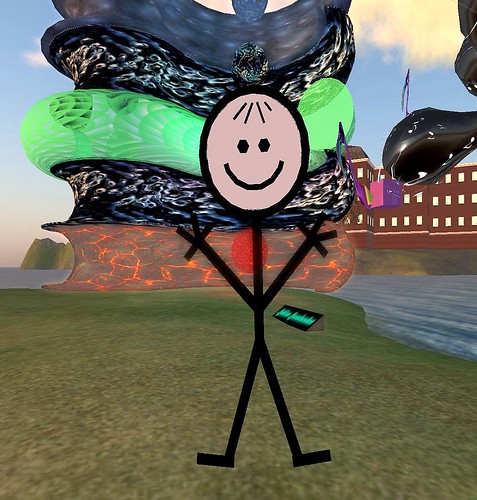
Sadly, Dammit shared with me that "Being born 2D in a 3D world is full of challenges. First, there is the discrimination and instant banning from certain sims to put up with. Second, there is the problem of getting used by 3D avatars as a coat rack or clothes hanger. Third, there is the lack of any 2D office furniture for the 2D man."
The good news is that Holly realized that she couldn't just create 2D peeps and not provide them with some kind of infrastructure, such as a 2D office line. Dammit admits that he was initially skeptical - especially when he saw the first thing she made for him (a paper shredder) - but everything worked out in the end.
You can visit Holly's 2D village for Dammit and others like him - and try out the paper shredder yourself - at a site where fellow hobo Dingle Doigts is sponsoring a build contest, by teleporting here. 
An Easter portrait of the Dammit family
Dammit also informed me that the 2D avatars are a Second Life homage to Matt Feazell who used to draw the mostly underground Cynical Man series. "I loved that cartoon in college (he used to draw them in a nice cafe across the street from where I did my homework at a much grungier and more dangerous cafe in Minneapolis), and would wait every week to read his stuff," said Dammit.