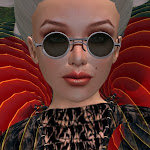
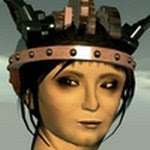
Here is yet another approach to fashion that virtual world designers can expand on... and easily surpass.
Showing posts with label technology. Show all posts
Showing posts with label technology. Show all posts
Tuesday, August 5, 2008
Transformer fashion

Monday, June 9, 2008
Kudos, Studio Wikitecture - Winner of the 2007 AMD Open Architecture Network Challenge's Founders Award
Our very own Keystone Bouchard (aka Jon Brouchard) continues to trailblaze. He and his team at Studio Wikitecture - a group he co-founded on the principles of Web 2.0-based architectural collaboration methodologies - have taken the Open Architecture Network's Founders Award for their entry and design of the Nyaya Tele-Medicine facility in Western Nepal. The goal was to design a wired medical clinic in the Himalayan foothills that will connect 250,000 people to doctors around the world via the Internet.
Why did you decide to enter this when there is no cash award?
Keystone Bouchard: Since the 'Open Architecture Network' mission is all about open sourcing architecture for humanitarian purposes, we thought it would be a perfect opportunity to submit an entry for this competition, composed in the same collaborative and open-source fashion.
The bottom line: this is about connecting architecture and technology with communities in need. As Turk Pipkin points out in this video, the winners don't actually win a prize; rather, they win an opportunity to help change the world.
Here's a time lapse video of Studio Wikitecture's evolving design:
The Wiki-Tree is a version tracking system that - instead of tracking text documents in a linear history like Wikipedia - tracks versions of 3-dimensional models and saves them within a continually evolving 3-dimensional digital tree 'canopy'. Like Wikipedia, this 3D-Wiki allows a loose, self-organized group of contributors to share ideas, edit the contributions of others, and vote on which design iterations should be considered for further refinement.
What's next, Keystone?
Keystone Bouchard: Our top priority, at this point, is to build more awareness of Wikitecture's potential, recruit more 'Wikitects' and find our next project. Ideally, we would like to take on a paid project that will actually be built in Real Life, but we are open to other possibilities as well. We still have a lot to learn, but we have gathered a tremendous amount of qualified and diverse talent within the Wikitecture community from around the world, and are confident we can meet or exceed the level of service offered by a traditional architectural practice model.
We're also hoping to find some investment, financing or sponsorship to help develop the Wikitecture technology into Phase 2. We have a long list of improvements we want to make, but primarily we need to simplify the interface and improve the web-side technology.
The competition was announced at the 2007 TED Conference and launched at the 2007 World Economic Forum in Africa in June.
Friday, April 4, 2008
New vid of that Real Life - Second Life interface
A few days ago I spoke of a novel Real Life interface with Second Life, using a 3-axis accelerometer. Via Komuso Tokugawa, I've learned that Tori Teatime has created a better video to explain what transpires.
You can visit that robot in Second Life (teleport directly from here), but somebody in Real Life needs to be tilting the accelerometer to make it all happen.
Friday, March 28, 2008
New Real Life - Second Life physical interface
Last night, musician and technologist Komuso Tokugawa attended a Second Life-related event at the bar BarTube in Tokyo. While there, he met with several people who are collaborating on a Havok 4 sim owned by Softbank (the company that acquired failing Vodafone and turned it around), to work with prototypes and try out new ideas.
According to Komuso, Tori Teatime and a couple of other people from the Softbank-sponsored sim have developed a mechanism that allows for an interesting new physical interface between Real Life and Second Life.
One person would stand there in the bar tilting a 3-axis accelerometer that was hooked up to a modified client to send control data via chat. 
Now here's where it gets interesting... the accelerometer had a built in tilt sensor, and as he tilted it, so did a box full of avatars - some of them quite large - that was being held by a robot in-world.
You can visit that robot in Second Life (teleport directly from here), but somebody in Real Life needs to be tilting that accelerometer to make it all happen. Now that the Second Life client is opensource, we can expect more of these exciting developments. More pics and info on Komuso's blog.
Komuso, by the way, is the musician and particle master who - together with MoShang Zhao - gave us the real time-Internet/SL music jam SynaesthAsia, undoubtedly one of the best events I've ever attended in Second Life. Here's a great video of it by multi-talented Osprey Therian.
Tuesday, January 15, 2008
Visions of the Future by the BBC - More reasons to take your vitamins and live longer
If you read this blog, then it is a given that you embrace technology and are more than likely both a futurist and a lover of art. That said, I think you are going to like this. I discovered it on Dusan Writer's great read of a blog. Go fix yourself a meal or a drink, sit down and get comfy. Here's some television you are going to enjoy watching. The good news is, it is just the first in a three part documentary by the BBC guided by theoretical physicist and futurist Dr. Michio Kaku. Some Second Life sequences, too...
Saturday, September 15, 2007
Earth Primbee's Machinima - Using virtual environments to benefit Real Life
One of NPIRL's charter members, builder of the much admired Inspire Drive-In and Inspire Space Park, dreamer and machinima maker Earth Primbee, alerted us to two new vids he's created. Here are instances where Second Life's virtual environments accomplish things that would not be possible in real life, but also turn right around to benefit the real world.
NASA CoLab
"It is especially important when considering science and technology to seek the potential as much as the present value in new ideas," said Earth. "So many great things in our lives are a result of ideas born at the edge of "that's impossible" or "that's ridiculous." It is my hope that this video will not only encourage NASA's efforts to harness the power of virtual worlds, but help the world see how it will and does benefit everyone."
"The Narrows" song by Broet
Earth told us that he's been experimenting with using prims as an alternative to traditional lighting instruments in Second Life for some time. He added, "the band Broet knew I loved to create music video style clips. They asked me to throw something together for a show they had coming up in Austin, TX. I decided to push my lighting prims to the limit and really see what I could do. This video is a combination of some of the clips I produced in Second Life that I projected behind the band during the live performance in real life. I thought their song was perfect for the mood of the NASA CoLab video and ties the two examples of the uses of Second Life together."
Subscribe to:
Posts (Atom)