There are hundreds of avatar creators in Second Life, but the mark for the highest quality and detail sans pareil belongs to one person. The last time Kazuhiro Aridian introduced one of these mythological beings, there was a spectacular wave of appreciation. The buzz in the sandbox as Kaz worked... why I've never seen anything like it, before or since.
Now Kaz is finalizing a docile, unguarded and ever so delicate creature... like a sea leaf, or feather, and its name is Seadryke.
Having worked in Maya for the sculpties (71 prims at this point), Kaz is going on to create 30 animations, using Qavimator.
Kazuhiro Aridian: I've made five animations, but I'm only happy with two so far. What's left? The AO, the HUD, and the special animations will be based on about 20-30 particle emitters and an animation that puts him 10 meters underground. 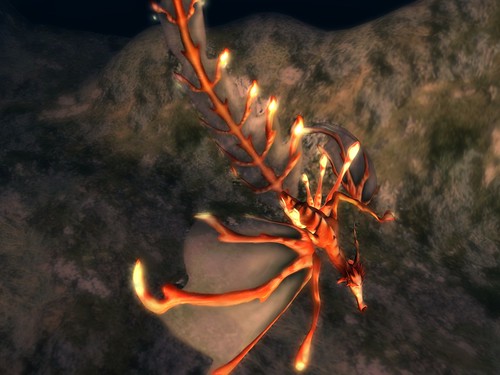
Kazuhiro Aridian: You will push the button, and all the boxes will send out a short burst of "ink," so there's a lot of emitters, and they'll make the shape of the avatar before he hides... kinda like a nightcrawler sort of effect, I guess! He's also going to shoot bubbles and ink out of his mouth, and other animations like that.
Kazuhiro Aridian: I'm further developing the story behind my shoppe. Kaz is a dream explorer. She/he resides within the realm of the Dreaming, and collects these dream beasts. The shoppe is a trading post of dream creatures.
Bettina Tizzy: How do you mean? "dream explorer?"
Kazuhiro Aridian: She wears steampunky sorts of clothes, and has wings made of cogs and clouds.
Sunday, March 16, 2008
Early reveal of Seadryke: Kazuhiro Aridian's newest avatar

Friday, March 14, 2008
Gazira Babeli with a foot (and a show) in both lives: Gazworks
Call her a code-performer, a griefer, a virtual Goddess, an artist and Machinimator... the fact is, Gazira Babeli is all these things and much more.
Gazira's highly interactive "art" is the result of combining images and representational objects of things and concepts we know and are comfortable with, and code that takes liberties with our avatars and our heads. The sum of these elements never fails to challenge the participant's view of their virtual identity and their sense of self in any life. Gazira is also renown for her group participations with the both venerated and despised Second Front, an avatar performance art group in Second Life.
Her work has ingrained itself so profoundly into the cultural mind of Second Life, in fact, that people have taken to referring to things that look like, behave or seem to have been made by Gazira Babeli, as Gazworks.
Tomorrow, Gazira will have a show opening at the fabioparis art gallery in Brescia, Italy. The exhibit will feature her much-celebrated film work, photographic prints of some of her performances, and a 3D object/sculpture: a "hand-made" avatar.

Concurrently, Gazira will host an event on Saturday, March 15th in Second Life at her strangely ingenious and farcical Locusolus sim (teleport directly from here), at 9am SLT, which I plan to attend.
I've written about Gazira Babeli's work before, but this marks the first time I share a conversation I've had with her (at her consent). No text on this flat thing we call the web can adequately convey the sharp wit, the bravado, and the charm that is Gazira, but here is a taste.
Bettina Tizzy: At what point did you understand yourself to be the Gazira Babeli that we know today?
Gazira Babeli: At the first login. When I saw Buster Keaton walking in front of me. I have never used animations to humanize my way of walking... I still walk like Buster Keaton. Maybe-I-am-Buster Keaton!
Bettina Tizzy: As I understand it, you had not done any programming prior to your introduction to Second Life. Is this true?
Gazira Babeli: No, I knew a little C language, and Second Life scripting has a very similar, simplified grammar.
Bettina Tizzy: What kind of griefing did you do, early in your Second Life? Did you mingle with other griefers and are any of them still around?
Gazira Babeli: I didn't consider it griefing. I tried to "interact" with the enviroment and its residents and some of them considered my acts as "griefing." Basically, I was only applying the rule "Your World, Your Imagination," but apparently human imagination is quite an unstable product. I never met any griefers. Could you introduce me to some of them?
Late last year, Gazira participated in a Second Front "Miami Vice" event
Bettina Tizzy: What is the purpose of your artistic "interventions" with our avatars, and what is "Gazwork?"
Gazira Babeli: At the beginning of the Sixties, Philip K. Dick, with his "Perky Pat" dolls, was already thinking about avatars. Literature and theories arrived much earlier than facts, creating superstition and bias. I try to bring back experience to the basic "real fact," by wondering "which kind of body is this in front of me?," "which is his space and where does it end?," "who are the -others-?," "who imagines what?," "what is the difference between all this and spending eight hours working on Microsoft Office?"... and so on. These questions are Gazwork. Is it artistic? Possibly yes. By asking these questions I use instruments and rules of the artistic tradition/convention.
Bettina Tizzy: In your view, what is the distinction between avatars and objects?
Gazira Babeli: I apologize to the animists, but I don't think objects have a soul.
Bettina Tizzy: So, avatars have a soul?
Gazira Babeli: Many souls! Geographical soul, cultural soul, generational soul... feel free to go on. Ask your avatar to use the imagination soul.
Bettina Tizzy: Do you laugh a lot sitting at your keyboard as you perform these interventions?
Gazira Babeli: Yes. I laugh when I perceive intellectual fun; I cry when I see mental pain.
An 88-page catalogue "Gazira Babeli," curated by the Italian art critic Domenico Quaranta, (FPEditions, Brescia, 2008) with texts by Patrick Lichty, Alan Sondheim and Mario Gerosa, will also be presented. 
ZOMG - Philip Rosedale (Philip Linden) is stepping down: Will creativity still rule the roost?
I've just learned from Tayzia Abattoir that Philip Rosedale - known to most of us in Second Life as Philip Linden - is stepping down as CEO to Linden Lab, the company he founded and has led since 2002.
According to Adam Reuters, who got the exclusive story, Linden Lab is actively recruiting for a new CEO. Philip will then become chairman of the Linden Lab board, replacing Mitch Kapor, who will remain on the board.
The biggest news here to Second Life users is that this will surely have an impact on the culture (or counter-culture) and the governance of our virtual world, especially when you consider that Philip abandoned the original concept for what Second Life should be - a combat game, or a simulated environment - after he attended the Real Life annual desert happening Burning Man - and determined that, like Burning Man, Second Life would be "a wonderland of creative projection" - (Quote lifted from "The Making of Second Life," by Wagner James Au).
The bottom line here... the virtual civilization that Philip Linden birthed and has nurtured to date, places creative people at the top of the hierarchy. Will this change, and if so, who (or what) will rise to the top of the food chain?
To be a Giant Snail or to be run over by one - That is tomorrow's question
RacerX Gullwing was patient with me when I started asking him about the Giant Snail Races in Second Life. He just handed me a notecard with the history of the event. At first I thought I was being politely dismissed until I started reading it, and then I realized that this weekly phenomenon has been going on for over three years. That's a lot of explaining he's been doing... so much so that this bunny's name is synonymous with "snail races."
RacerX Gullwing, photographed by Suzanne Graves
The first thing you need to know is that you, too, can become a snail and participate in the "Greatest Race in the Known Universe." This Saturday, March 15th at 2pm SLT, the first of 4 cross-country races to raise money to find a cure for cancer will be held, crossing 45 sims... and the privilege will cost you $250L. It is all part of the official kick-off of the Relay for Life.
Another factor you should consider is that this Saturday - whether you are in the race or not - you run the risk of being bulldozed by dozens of giant snails as they hurl their slimy way across the grid. 
This photograph by RacerX Gullwing
For the uninitiated...
The History of the Giant Snail Races of Second Life by RacerX Gullwing
It all started with a contest called Giant Avatar contest I saw was coming up in a few days back when events were only a few a day and finding them was easy. I went to the sandbox where you could usally work for about 30 minutes at a time between sim crashes, and started attaching prims to my feet, but that didn't make you any taller... just made prims that went into the ground. I thought about it and figured the way I'd have to do this is be in the foot.
I didn't have a clue how to script legs to move and back then movement scripts didn't work on avatars anyway. I narrowed it down a bit to a one footed animal. The shell was maxed out at 30 meters or maybe I just remember it that big. Thing is, I din't have a clue how to see out of that so had to stop a lot and cam outside the shell to see where I was.
It was hilarious. I got to the contest about 20 minutes early and the guy holding it told me to please park off to the side somewhere. I thought he was steering me over there because I had obviously won and he didn't want to discourage the other avatars. Ends up I was the only one that took him up on it - literally - and made a giant avatar. Well I didn't win. 
The current scoreboard at the Giant Snail Races
I was in group called Montmartre Artists and we were trying to get on the most popular places list and come up with an event before camping chairs were invented. I was talking with my good scripting friend and neighbor in Fujin, Catfart Greyson, and he suggested giant snail racing. I put together a better, cuter avatar with blinky eyes that everyone loves and they havent changed much since. We did get into the top 20 a couple times.
The races started on the ground on the stone paths that circled Montmartre. I made all the arrows and things needed for the race, and later, At 8pm on Tuesday nights, I'd go around after the race and shout "the race is over," and all of the signs of the race track would vanish, just leaving the stone path built by May Best, the city streets of Chase Rutherford's Manhattan, and the Hawthorne sim, an Aimee Weber build.

No peanuts and popcorn for sale here... but you'll want what he has to offer, nevertheless
These came to an end mostly because people discovered a trick around the physics in Second Life where, if you can find something to trip over, you can fall a lot faster than anyone can run. Also, once you get into that falling state you can close the chat bar and hold the space bar down and get yourself to glide a long ways. So I moved the race up to the sky onto a perfectly flat surface where there is nothing you can trip over.
At the same time, Seifert Surface was experimenting with a transportation system that used "push" and would throw you across the map. He had set up the flingers at the Future sim, just one sim south of Montmartre and owned by Chase Rutherford. I used his experiments at the new track, and built the course around them. The race stayed in the Future sim as it changed hands to Gus Plisskin, who said it was welcome to stay as long as I wanted to have it there, but the sim slowly filled to capacity and had a lot of scripts going and the flingers stopped working consistently and the sport became more of a luck thing and more of an endurance race.
Produced by Texas Timtam of SLCN.TV, and narrated by Wiz Nordberg, Pyrii Akula, Kiwi Alpha and of course, the Master of Ceremonies himself, RacerX Gullwing
I got Seifert Surface to give me a copy of his experiments and carefully packed it all into a prim and moved it all back to where it started in Montmatre. Also if you go to Snapzilla and search using the key words "snail race" you can see 99 percent of that history there. The snail race is only a few months older than Snapzilla. In fact, the snail races were three years old at the end of november, 2007, and have been held every Saturday since then, except for two or three cancellations a little over a year ago when I was very sick.
Meanwhile, SLCN.TV - the world's first virtual TV network - has been covering (and streaming live) the Giant Snail Races every Saturday since August of 2007. I spoke with SLCN.TV's Texas Timtam to learn more.
Texas Timtam: We just thought they were pretty special and started turning it into a "TV Show." RacerX was agreeable and although it has taken a little bit of time, it is becoming more and more popular. I just think that RacerX is one of the really special people in Second Life. He has such a youthful sense of humor and fun. I just love it on the shows when he laughs.
Bettina Tizzy: Where in the world are the folks from SLCN.TV?
Texas Timtam: We are in Australia and have to get up pretty early on Sundays to do these races. Sometimes we think.... "I JUST WANT TO SLEEP MORE," but I'm always really happy that we don't.
Bettina Tizzy: So what time do you start working?
Texas Timtam: Depends on the Daylight Savings situation. It *was* a 6:00 am start (= 11:00am SLT) until last week. Now it's 5:00am, and when we switch off of Australia's DST it will be 4:00 am!!!! Boo hoo I say! Darn this planet thing for being so big and round.
Bettina Tizzy: Thank you so much for making this abbreviated video and posting it on YouTube. The still pics do not do the races justice, and the commentary is almost as hilarious as the race itself.
Texas Timtam: Wiz Nordberg is a funny guy. Never use the words garlic, butter, or salt in the shows!
Bettina Tizzy: How long are the races on Saturdays?
Texas Timtam: There are beginner training classes at 9:30am, and the races start at 11:00. They usually go for about an hour and 15 minutes. Be sure to see the new Alice in Wonderland course.
To participate in tomorrow's Relay for Life race, contact RacerX Gullwing directly and pick up your Giant Snail avatar at Montmartre by teleporting here, which also happens to be the official headquarters for the Giant Snail Races.
Thursday, March 13, 2008
Dr. Ruth Ballard: Virtual worlds and their tools can be used for science
On January 27th of this year, the Not Possible in Real Life (NPIRL) group launched an initiative to identify and extend invitations to people we admire and whom we believe would derive pleasure in discovering the creation and communication tools available to them in the 3D virtual world known as Second Life. There is certainly a very appreciative - and growing - audience waiting for them. It is our hope that they will take us up on our shout out and make the pilgrimage to check it out. Today, I welcome this introduction to Dr. Ruth Ballard by guest blogger and NPIRLer Bjorlyn Loon.
by Bjorlyn Loon
When geneticist Ruth Ballard went on vacation to Africa, she had no idea she would come home with a DNA database as a souvenir. On a climb of Mount Kilimanjaro in 2001, Ballard found herself wondering whether the Tanzanian population had been adequately tested for DNA, so she took home samples from the native porters assisting on her journey.
Upon her return to the United States, Ballard contacted the Tanzanian government in Dar es Salaam to request permission to conduct more extensive studies of the many tribes in the nation. To her surprise, the government approved her application to begin testing the Maasai, but with a catch: officials asked that Ballard begin the process of mapping the country's entire population of more than 30 million people, and also that she train Tanzanians in the forensic techniques required to use the database effectively.
Dr. Ruth Ballard in the company of Maasais
While Americans tend to think of forensic genetics in terms of crime scene investigations, the focus in many nations is on establishing paternity. In areas where people transit between remote rural villages and the cities, children and spouses may be left behind. To obtain means of support for dependents, the establishment of a full map of genetic markers for a population and subsequent forensic DNA testing of individuals enables governments to identify a child's natural parents.
This humanitarian goal has provided a focus for Ruth's efforts. She returns to Africa during the summers on "saliva safaris" to collect DNA samples that reflect the great human genetic and cultural diversity of the subcontinent.
But the challenge of training African scientists has proved to be more difficult.
While Ballard has developed a forensic biology concentration for undergraduates at California State University Sacramento (CSUS) (where she serves as an Associate Professor for the Department of Biological Sciences), it is difficult to provide the same kind of experimental experience to people on another continent.
Fortunately, Ballard's efforts have coincided with a proliferation of forensic and genetic science opportunities in Second Life. The CSI:NY programs (teleport directly from here) as well as islands such as Genome (teleport directly from here) in the SciLands archipelago would seem to offer a ready-made training ground for Real Life scientists. 
Photograph courtesy of CSUS
A true explorer, Professor Ballard seems like a natural to introduce to our virtual world, and involving her colleagues in Africa to Second Life would be an added joy.
Like artists, scientists are benefiting from the opportunity to use Second Life as a distance-spanning collaborative workspace and educational tool. Just a couple of notable examples:
* Dr. Bob Amme and Jeff Corbin of the Science School islands are constructing a model nuclear reactor to teach students from Denver University how to manage nuclear waste. Via a $200,000 grant from the Nuclear Regulatory Commission, the Second Life installation will engage students in virtual nuclear experimentation, sans the real-life risks of radioactive contamination and terrorist exploitation.
* In February, NASA streamed their Next Generation Exploration Conference into Second Life. Over four days, Second Life residents literally sat at the table to offer ideas and expertise as an integral part of conference working groups. The program is designed to give a boost to potential lunar entrepreneurs in anticipation of setting foot on the moon in the coming decade.
But much of science is still in the dark about the value of virtual worlds. I hope that Professor Ballard will be the first of many scientists recruited by NPIRL.
You can hear Ruth Ballard's story on KXPR's Insight, the Sacramento National Public Radio affiliate, here.
Wednesday, March 12, 2008
Yoa Ogee's "high tech life forms" for peace... and smiles
Within three days of rezzing (1/26/2007), a Canada-based German named Yoa Ogee made his first avatar. Today, his avatars are already wildly popular with the NPIRL crowd; I myself purchased at least 15 of them within minutes of being alerted to their existence by artist and scripter Miki Gymnast.
Bettina Tizzy: So, it was avatars from the start, was it?
Yoa Ogee: I started to build avatars because I wanted to be an alien and have tentacles.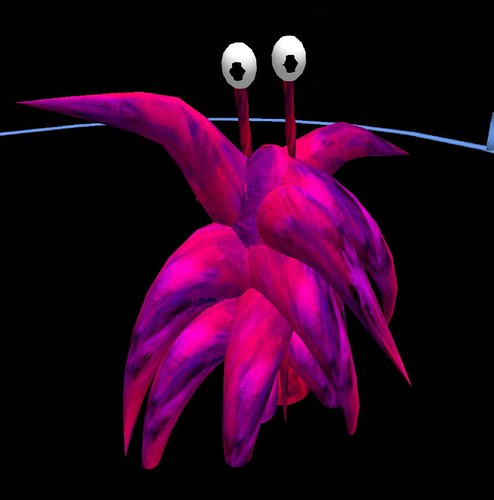
Yoa Ogee - Three days old and already "in the pink"
Bettina Tizzy: Pink tentacles, even! Your inspiration?
Yoa Ogee: ... my favourite colour, yes, my inspiration, like all of my avatars.
Bettina Tizzy: And then... this went so well, that ... you just kept making avatars? Never wanted to make houses or other things?
Yoa Ogee: I have so much to do with avatar ideas... I (also) have a list with ideas for houses and stuff like that ^^
Bettina Tizzy: Many of your avatars are sculptural. You are the first that I know of to do this. What were you thinking that led you to make avatars that didn't look like living things?
Yoa Ogee: They are alive. What humans declare as abstract, I declare as high tech life forms. 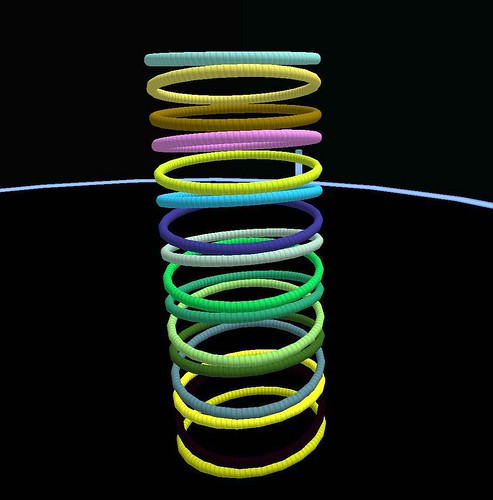
This was Yoa's first "art" avatar. The colors on the bands cycle continuously
Bettina Tizzy: The scripting for the "Tricky" avatar is very complex. I have shown it to scripters and they were impressed.
Yoa Ogee: I don't script. I use freebies or purchased scripts and combine them with animations and lots of ideas to create new effects. Animations are made by me.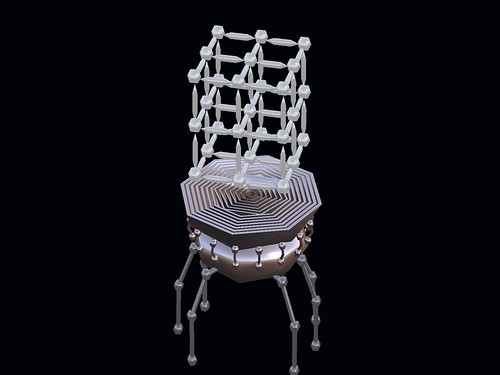
"Tricky" displays a continuous series of geometric gymnastics on its shiny pedestal
Bettina Tizzy: What is the name of the tiny avatar that is 7mm tall?
Yoa Ogee: Shichi - the name of the number 7 in Japanese.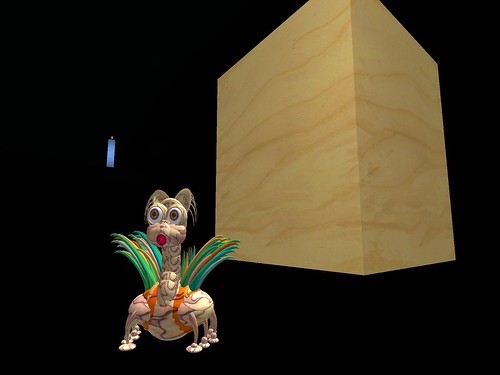
Shichi is 7mm tall and is shown here next to a standard box prim
Bettina Tizzy: Where does the rest of the body go... and why is it necessary to use invisiprims or whatever it is that you do?
Yoa Ogee: Often, I use invisible prims, but sometimes a good animation can cause the same effect. It was challenging to learn all about animations and now I love it! Some of my avatars are not that good for dancing, but some of them are better for dancing than human bodies :) Invisible prims are useful because it is not possible to shrink the standard avatar that much.
Bettina Tizzy: Someone mentioned that smaller avatars are accomplished by folding the avatar body underground. Is this true?
Yoa Ogee: Yes, I do that, too, with animations, and this way I can shrink it down to 40-50cm.
Bettina Tizzy: Thank you for that explanation. I was just very curious.
Yoa Ogee: Curiosity is one of my favourite feelings.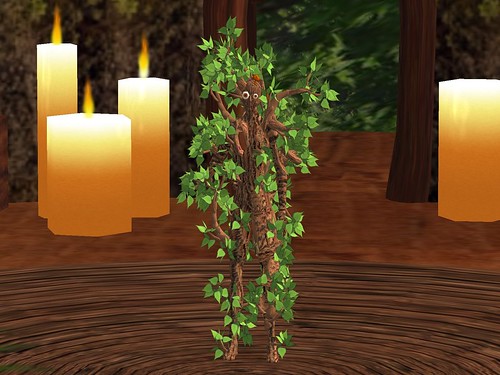
The lower photograph is a close up of a few details on the head of the tree avatar.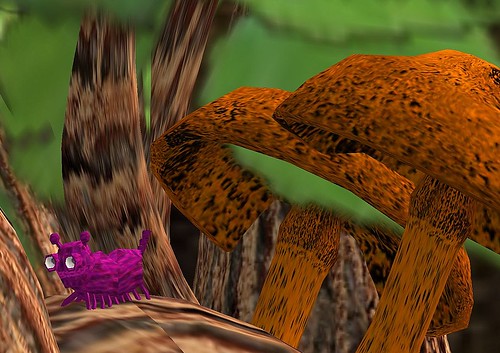
Bettina Tizzy: I see that 100% of the proceeds from your sales goes to the World's Greatest Smile.
Yoa Ogee: They do, because peace is what I have been most interested in all my life. It is an international peace project dedicated to friendly communication, and is supported by 14 Nobel Laureates, as well as many other people from 131 countries. The goal is to motivate people to communicate in a more friendly and effective way and to give them the resources to do so. We develop games for children, too, to teach them teamwork in a playful way. 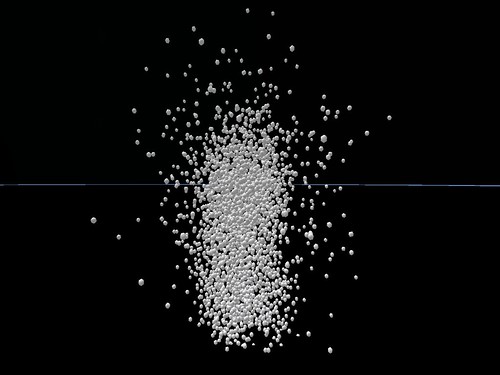
Bettina Tizzy: Now you make avatars that look like art. Do you find any inspiration in the work of artists in Second Life?
Yoa Ogee: Not really. I'm mainly interested in astrobiology, and that's the basis of my creations. It is about life on other planets and wherever life can be in the universe.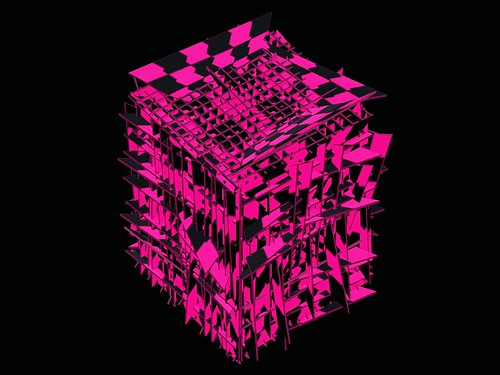
Bettina Tizzy: Do you take a scientific approach, or a science fiction approach to this, or both? Extraterrestrials that look like art... this does not sound so unfriendly.
Yoa Ogee: The scientific approach. I have always been interested in astrobiology, because I tried to find a way to think about humankind in other ways.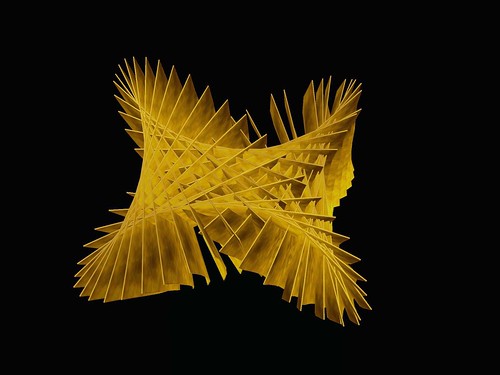
Yoa's "Gold Leaf" avatar undulates gently as you move
Bettina Tizzy: You also make avatars that have all kinds of details.
Yoa Ogee: I love details! I love especially the hidden details, those which you have to discover. This avatar is full of them, too, including a hidden treasure chest.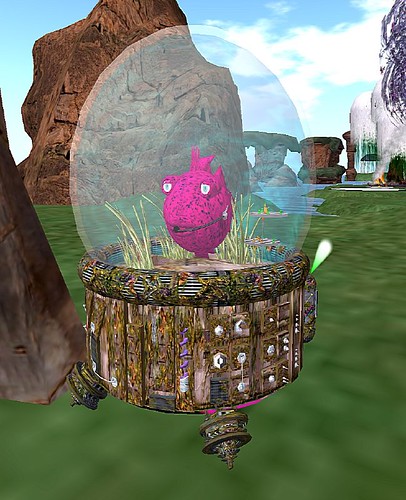
Yoa Ogee: I need bubbles^^ (At this point, gentle bubbles began to rise around the fish)
Bettina Tizzy: I see your fish has a mic, too. It sings?
Yoa Ogee: I have to talk to humans, and sometimes I am a karaoke fish (under the shower).
Bettina Tizzy: ...that plays chess.
Yoa Ogee: Yes, the starfishes on the ground play much better than me.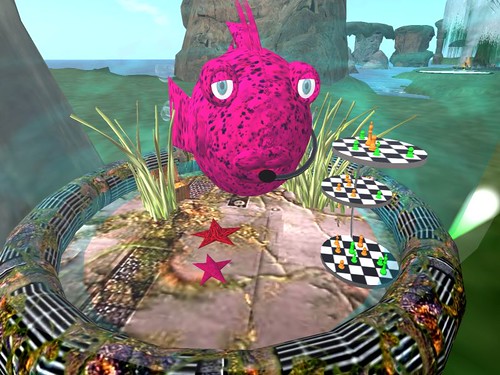
Bettina Tizzy: Your prices are very low. Are you more interested in distribution than in making money?
Yoa Ogee: Our avatars should enhance tolerance and should be available for everybody. I know as an alien: humans are a very cute and friendly species... sometimes they just forgot it.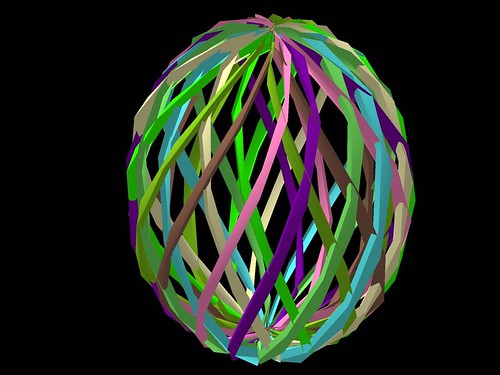
Yoa and his Real Life fiance, Yeti Bing, have a busy store, which you can teleport to directly from here.
Tuesday, March 11, 2008
Live-action manga-style Machinima begs the question: What else are we missing???
There's a noisy revolution going on over at the :sick: sims (teleport directly from here) and I've been stone deaf to it. That is, until today when Machinimator Masami Kuramoto introduced me to a whole scene... I mean this is just the tip of a gigantic iceberg that's been sitting over there; more like roaring over there... my gawd, here's a video that was added to youtube in June, 2007... and there are 13 others! After watching like the fourth vid, I shook my head and asked myself, "how did I miss it all?"
Take this manga inspired live-action superhero flick. It's loaded with tokusatsu and monsters, and it even has subtitles, for crying out loud. I googled it to see if anyone else in our English language world had uncovered this gem... and only one person had, that I could tell. Yep. That would be Torley Linden. We gotta listen to Torley more.
The intro credits feature a lot of English jibberish... but the real film begins at 1:17 minutes.
The main person behind this and other:sick: stuff: mk curtiz. More on him real soon, and the other people who surely deserve credit but I don't know any better.
So... what else are we missing 'cause we don't speak Japanese?
Monday, March 10, 2008
Virtual lessons in virtual dance choreography - A historical first
Mixed reality history was made late last week when DanCoyote Antonelli (aka DC Spensley) held the first Real Life "SkyDancer Seminar" for University of Calfornia San Diego (UCSD) undergraduate students. At the invitation of Ars Virtua curator Rubaiyat Shatner who is also Virtual Environments instructor at UCSD, DanCoyote trained over a dozen students to fly in a basic choreographic pattern inside the first ZeroG SkyDancer stage that had its debut two years ago. 
The current ZeroG SkyDancers stage
Rubaiyat teaches the class virtually from San Jose, California. The class is in San Diego, California and DanCoyote is in San Francisco, California. Assisting DanCoyote were assistant director Anhinga Chaika and training director Buffy Beale. The students were skeptical at first about this new art form but soon gained a healthy respect for the challenges SkyDancers face at every performance.
That original SkyDancer stage - in addition to a significant collection of DC Spensley/DanCoyote's Second Life art work - are on display at an exibit curated by Michael Van Horn at the Frye Art Museum in Seattle, as a result of the museum's sponsorship of a virtual arts exhibition at Seattle's Bumbershoots Festival 2006 where a ZeroG SkyDancers performance was projected to a huge crowd of Real Life audience members. 
The first ZeroG Skydancers stage
Photography courtesy of DanCoyote Antonelli
Sunday, March 9, 2008
Chris Marker and his presence in Second Life, via the Museum für Gestaltung Zürich
Chris Marker is a much celebrated and admired French author, photographer, film director, multimedia artist and documentarist. His "La Jetée" - a masterpiece which inspired the 1995 Academy Award-nominated science fiction film "Twelve Monkeys" - and "Sans Soleil," among other seminal works, made cinematic history in voice, text and associative media practices.
This is part one of La Jetée, by Chris Marker (1963). Both La Jetée and Sans Soleil have been re-released via restored high-definition digital transfers and are available through the Criterion Collection
Born in 1921, Chris is one of the most profiled figures in media history, and yet, he does not grant interviews or allow himself to be photographed. In fact, when he is asked for a photograph, he provides an image of a cat, instead. This legendary denial would suggest that he was destined to become an avatar. Indeed... this Tuesday, that is exactly what will happen. 
On Tuesday, March 11th, at 11am SLT / 19:00 CET, and in conjunction with a Real Life exhibtion in Zurich, Switzerland at the Museum für Gestaltung, Chris will be present at an "ouvroir" that was commissioned by the museum, and created by MosMax Hax (teleport directly from here). Chris will play with his own work, in the company of his longtime guide, Monsieur Guillame, a cat and a furry entity in Second Life. 
Monsieur Guillame
If you do not know Chris Marker's works, I heartily recommend that you conduct a bit of research and learn more about this man's artistic legacy. You might then agree that this is an event of great import, and understand, too, the presence of the whale on the sim, as well as numerous other objects.
In addition to his films, the exhibit also showcases several of Chris' powerful portraits of Simone Signoret, Akira Kurosawa, Salvador Dalí and Fidel Castro... further evidence of his obsession for staring back at his subejcts.
Curators: Chris Marker, Margarete Jahrmann, Max Moswitzer
In Real Life:
Chris Marker. A Farewell to Movies
March 12, 2008 - June 29,2008
at the at the Museum für Gestaltung Zürich
Mathematical Sunday with Seifert Surface
Ah, Seifert Surface! Every encounter with that postdoctoral mathematician is enlightening. Take today for example...
Bettina Tizzy: How are things at xyz? Teleport directly to Seifert's new sim, xyz, from here.
Seifert Surface: Just made a sculpty thing which is the graph of the function xyz = 1.
It is 24 prims all told. It would be 12 except that plane sculpties are "one sided," so Seifert needed twice as many.
Of course, I had to ask Seifert for a simplified explanation...
Seifert Surface: You have coordinates for points in space, x,y,z. You can ask, what are the points x,y,z so that xyz = 1? That is, you multiply them together and get 1 so, eg: if x, y and z are all 1, it satisfies the equation. 1,1,1 is on my graph, so is 1,-1,-1
Bettina Tizzy: But we are at 500mts, so how do you get 1?
Seifert Surface: Ah, yes, true. The center of this thing is assumed to be 0,0,0 for purposes of the thing, and it goes out to 8 and -8 in each direction... otherwise you wouldn't be able to see any of it. You know like the graph of y = x^2? If you see it on a computer screen, then the origin is not at the bottom left corner of the screen, and the scale is not 1 unit to 1 meter. You can scale and move the graph somewhere else, and it's still the graph of y=x^2. Same thing here. This is just a 3D version of a normal graph.
Bettina Tizzy: What applications can this be given?
Seifert Surface: Well, learning about functions. Unfortunately, it's a real pain to make something like this at present... something that you could use to quickly graph things would be very useful for teaching. You could have an extension to prims, in the same vein as for sculpties. With sculpties, you send a texture to encode the data of the shape. Instead, you could send the mathematical formula for the shape. Then we'd be in business and, of course, animated stuff would work well, too.
Bettina Tizzy: What is this shield item?
Seifert Surface: A prototype for the larger piece. I had a smaller range on the graph before, but it looks better with more. That one goes from 0 to 2. The big one is 0 to 8.
Bettina Tizzy: Fits better than a glove! More like skin.
Seifert Surface: Should be the exact same function. It fits!
It's a Madcow (Cosmos) Madhouse!
For one week only and until March 15th, Callipygian Christensen is hosting a sim-wide exhibition of Madcow Cosmos' work. A full sim! Even so, we'll probably never see a complete retrospective of his work. For one thing, Madcow doesn't skimp on prims, ever, and... he can whip up a 1200 prim creation in a day or two... no problem! 
As Madcow put it, "Included (in this show) are some of my favorite high prim beauties," as well as a number of pieces that have never been exhibited before. "I'm happy to get them out of my inventory and breathing fresh air."
The centerpiece sculpture will be changed a few times during the week, and Madcow will be present for two "Meet the artist" sessions:
+ Monday, March 10 at 1pm SLT for the Euro crowd
+ Friday, March 14 at 7pm SLT
Both sessions will be followed by fireworks. Teleport directly from here.