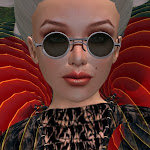
Koinup's Avatar Art contest has just concluded and the winners have been announced in each of the three categories: surreal/Not Possible in Real Life; post-modern/traditional and kitsch; and realistic-pop art. The contest was open to photography taken in all virtual worlds.
It was my pleasure to judge the surreal/Not Possible in Real Life category, and the winner is Winter Wardhani with this image. 
While there were hundreds of photographs to choose from, I selected Winter's image because she strayed away from the "beautiful human" look and did something entirely different, and fun. You can view all of the entries here.
The winning photographs are on display at the Museo del Metaverso.
Sunday, December 14, 2008
Winner of Koinup's Avatar Art contest - NPIRL category

Paw Boots...
Posted by Alpha Auer... ;-)
Only the other day I was talking about the lamentable absence of paw boots in Real Life, right? In the meantime I have been informed that apparently some enterprising Real Life designer out there seems to have made something along these lines but in my humble view it wouldn't really add up to much beyond being a sad substitute to the "real" thing...
So, here they are - all of my lovely little beauties...
My Ninja Cat boots are somewhat on the cruel side but, I give you my most solemn assurance that I try not to use those nasty little sticks too excessively and then only on the most objectionable avatars!
Admittedly the Grunge Camp Paw kickers are ever so slightly butch but nonetheless a great favorite whenever I need to climb the Black Mountain at Syncretia to check on all those leaky water pipes...
These Hobo Paw boots have a slight flaw around the ankles so I conceal them with some very lovely, not to mention thoroughly elegant, barbed wire neko leg warmers! They really do think of every little eventuality these neko designers don't they? I imagine the barbed wire would come in very handy at keeping those bothersome rodents trying to climb up ones calves at bay! No?
Yeti paw boots! We pose for these together with my furry sister: Two silly school girls in black and white outfits. Mine is a sailor's costume and she is a striped bunny! Teeeee heeeee....
For the more demanding neko, these jewel studded boots come in a range of fur options for toes, all in the same box. A must have for all of those dressier occasions!
Sakuradawn Lei's name is a byword for high quality paw boots in the metaverse, most of them leaving paw prints as you walk! Unfortunately the loveliest ones are designed for feral furries and thus one needs to have the appropriate leg shape to really be able to wear them - which we, vain, silly, fashion victim women obviously do not have. However, necessity is indeed the mother of all invention, so my furry sister was certainly not going to be put off by a minor little hindrance such as a leg shape! She merely replaced the upper part of the Myth boots with another boot part - and Bob's your uncle! My Trailmix ones are actually designed for human legs so all I had to do was walk around leaving some wonderful feline paw prints. Never one to be outdone, Furry Incognita follows suit with her own - and oh what an utterly lovely mess we have made!
...
Credits:
Ninja Cat Boots: Emily Lelouch
Grunge Camp Paw Kickers: Thomus Keen
Barbed wire leg warmers: Minde Mills
Hobo Paw Boots: Blume Boucher
LouRoo Yeti Paw Boots: LouRoo Rau
Jewel Neko Boots: 7ommy Gunes
Trailmix and Myth boots: Sakuradawn Lei
(Please click on the names to obtain teleport locations!)
Friday, December 12, 2008
Exhibiting Art in Virtual Spaces
Posted by Alpha Auer, with a very big thank you to the curator of Avatrait, Stephen Venkman who alerted us to the opening of Avatrait Island.
The new island of Avatrait was launched back at the end of November, so I am somewhat late in posting this piece. However, I wanted to give the matter some thought prior to doing so. I also co-authored a paper for an academic conference on virtual architecture in the interim, and that too has made me hold off and gather all of my thoughts on the subject. I also have to add a disclaimer here and state that I am not an architect but an artist/designer/Second Life® builder, so all of what I write on the subject is based upon mere gut instinct and a general knowledge of architectural concerns as far as they touch upon the basic design considerations common to all visual art and design practices.

What I saw at Avatrait is extremely well conceived, well designed, meticulously modeled and textured; tasteful, functional, user friendly Real Life architecture, which in many ways reminded me of the work of Eero Saarinen (particularly the convex white pavilion shown above), who is possibly my favorite architect of the 20th century. Thus, likening architectural output to Saarinen's is not a compliment I pay lightly and here I do so. Indeed I cannot find fault with the work and were these buildings to be found anywhere in Real Life they would doubtless be the pride of whichever municipality it was that they were constructed in. In fact so pristine are they, that they gave me a strong sense of being in a walkthrough presentation modeled in AutoCad, which a high caliber architectural firm had prepared for a high budget, high maintenance client. So the architects Corbett Howard and Prad Prathivi have done the project proud in many ways.
Then, why am I not completely won over? I believe the answer is already concealed in the word "Real Life" stated twice in the paragraph above. The fact that the structures are rezzed upon huge flipped sculpty rock cones may be an attempt at taking into account the affordances of the virtual, but it is not enough: I am of the tendency to believe that what constitutes the manifestation of the "virtual" in architecture has more to do with imagination than material. Thus, the sculpty rocks may not be possible in Real Life as such, however I suspect that the intention behind them is. While the peripheral pavilions have been rezed by Corbett Howard, the spheroid main exhibition hall is a build by Prad Prathivi - and it is particularly this central edifice that for me is problematic in terms of its virtual attributes. But all in all, none of these buildings seem to leave much to the imagination, do not carry concealed surprises, nothing about them is unexpected. They are very much what they are: Beautiful and functional constructs; built out of brick, mortar and marble, rezzed upon a mini archipelago of islets. The fact that the islands themselves are floating rocks is then neither here nor there.
...
Ouvroir, the Second Life annex of the Gestaltungsmuseum Zurich, dedicated to the work of Chris Marker, was built by MosMax Hax in the spring of 2008. Avatrait island has propelled me towards a comparative examination between Ouvroir and Avatrait: It is not only the fact that both sims are dedicated to the display of (predominantly 2 dimensional) art work or that at both places the central constructs are spherical, which are leading me to this comparison. Indeed it is not the similarities but the differences that seem to me to be decisive here: While Ouvroir is every bit as well conceived, well designed and well built as Avatrait Island (much to his credit Mr. Hax has refrained from using Real Life building textures, thereby greatly heightening the virtual "feel" of the construct); the huge addition that the artist/architect has managed to bring into his work at Ouvroir is the usage of the imaginative element as a design component, particularly in the navigation system of the building. 
While at Avatrait you walk up and down highly predictable staircases complete with banisters around the stairwell, at Ouvroir your only way of seeing the exhibit, which is spread out over a number of floors is by "falling down" to the next level through the designated phantom segments marked out in a semi transparent red. And to come back to the banisters at Avatrait: Why? Are the directors of Avatrait concerned about falling avatars creating liability issues? Health and safety regulations? Really, why?
While at Avatrait all that is there to see is plainly visible almost at first sight, Ouvroir is concealed, revealing itself bit by bit to its visitors. While Avatrait is complete as it is (I cannot for the life of me imagine how a single prim could be rezzed next to what is already there without becoming a major disruption of the whole system); Ouvroir allows for emergence and indeed seems to steadily be growing through the interventions of the members of its group who are continuously rezzing additions to the sim. And such is the mastery of the core red sphere which houses the actual Chris Marker collection at Ouvroir, that every addition seems to fit in, seems to be able to weave its way into the overall design tapestry. In short, while Avatrait is an endeavor to be admired respectfully and from a distance, Ouvroir invites you to be imaginative, to become involved and to play. Both are 3D, you can walk into both of them to an equal degree, but in a very bizarre kind of way Ouvroir is immersive while Avatrait remains aloof.
Keystone Bouchard needs to be taken very much to heart when he states that "architectural fabric created is still largely driven by very literal parallels to the physical world. This happens for good reason, as we have learned to visually organize the world around us, real or virtual, based on familiar cues and patterns. A roof may not need to protect us from the elements in virtual space, but it organizes a space. Even though you can fly, a ramp is still a strong way finding mechanism. While we import these visual cues from physical reality with good cause, I think we also need to consider the native, inherent characteristics of this environment and build a new language of virtual architecture based on those characteristics". Bouchard, is of course, referring to the dynamic element in virtual architecture in this text, to what he continues in the next line to describe as "virtual architecture has the capacity to become far more dynamic; behaving more like a liquid than a static and passive artifact".
I am going to do something quite improper here and use this quote out of the original context in which Bouchard has intended it. In other words, I will make it suit my own needs. Does a building need to be coded and dynamic to become virtual? Or is it more the underlying intention of usage, the very spirit in which it has been conceived of that really makes the difference between what is possible and not possible in Real Life? 
Emergent interventions at Ouvroir: This infovis-like structure featuring a selection of photographs by Chris Marker was rezed in close proximity to the red sphere by Ouvroir group member Lucien Bookmite. Photograph courtesy of Barbara Binder.
Both buildings make usage of Real Life architectural metaphor, such as floors and ceilings and ramps, for the purposes of way finding. And as a construct Ouvroir is as static as Avatrait is. And yet as far as I can see, there is a huge difference and to me that difference lies in the ultimate approach of the architect, the spirit in which the whole enterprise has been undertaken: The one that emphasizes imagination and play over realism. Involvement over spectatorship. Intervention over consumption. Making a noteworthy immersive virtual experience out of Ouvroir and a beautiful receptacle for art work out of Avatrait Island. Thus, to each his due...
You can teleport to Avatrait Island from here, and to Ouvroir from here. You can see a collection of larger sized photographs of Ouvroir here and Avatrait Island here.
Thursday, December 11, 2008
Feisty, radical and rich with culture: Eshi Otawara's upcoming Collection
Posted by Bettina Tizzy
If Akira Kurosawa were alive today, I do believe he'd hire Eshi Otawara to costume his next film. I am also quite certain that Yves Saint Laurent would have swooned at the sight of her next Collection. At least Lagerfeld is still around but he'd better hurry up or maybe Galanos will snatch her up.
One year ago, Eshi’s much celebrated fishhook dress caused such a prodigious pandemonium on the grid that a cult following sprung from it. Seven months later, that same dress - in a black Limited Edition - sold at auction for $460,000L.
This Saturday at 1pm SLT, Eshi will present her Winter/Spring Collection, featuring the first Limited Edition dress under her new Eshi Otawara label, but like everything that has to do with Eshi, that’s not half of the story. It just seems to me that everything she does… even the most mundane things, are standouts.
Allow me to illustrate what I mean… Early last month, I TP’ed Eshi into the shop of a well-known and successful clothing designer to show her a hat I’d been chatting about in IM. We were both quite surprised to find ourselves alone in the mega emporium, which is usually swarming with shoppers.
Right then and there and much to my utter thrill and horror, Eshi donned the KABUKI dress she’d been working on... This is THE dress that will have a limited release: five copies only and each will be sold for $50,000L.
Well, she could have knocked me over with a feather; I’d have thrown a sheet over her if it had been physically possible. I was simply horrified with the possibility that someone might teleport in and see it before its proper unveiling. I was thrilled because the dress was unlike anything I’d ever seen in my real or virtual life, and it was so very appealing. I mean, it can be done in Real Life, but I don’t think it has. And the accessories! It is the sort of garment you’d expect of one of the fashion greats: super inventive and beautifully realized… and smart! And sensual.
Of course, I did the only thing any reasonable woman would do under similar circumstances. I promptly begged her to allow me to be a model at the show where this thing of beauty would be released in the wild.
Lucky for me and unfortunately for her, she accepted, so there I’ll be this Saturday, most assuredly making a fool of myself, but the reward will be as rich as a chocolate mousse, hehe. Wild horses will not be able to tear her Collection from my avatar body.
Oh… Eshi did give me a photograph of this dress, but I’ve elected not to publish it. It’s a great pic, but it still doesn’t do the outfit justice. You’ll simply have to be there to see this and the other extraordinary fashions – even for Eshi! - for yourself. I'll give you a couple of hints though. Think Japanese. Think punk.
BOSL Theatre - Saturday, December 13, 2008; 1pm SLT
Teleport to the East Entrance from here; teleport to the West Entrance from here.
Wednesday, December 10, 2008
Les oreils très NPIRL...
Posted by Alpha Auer ;-)
Today, dear aficionado of all things great and small that are NPIRL, we shall be considering ears that could not possibly happen in Real Life. And who better than me, a full fledged, card carrying neko, to lead you down this intricate lane of Second Life® body parts?
...

aoimizuno Meili's output is certainly no stranger to this blog. Not only were her NPIRL eyes featured in a post dedicated to eyes alone, but we have also looked at a small selection of her truly magnificent avatar attachments here. So, here are some wonderful lightbulb neko ears (above) and the octopus ears (below). Both can be seen in-world at her shop LPP, to where you can teleport directly from here.
...
Again, a big favorite of mine, on whom I have posted only recently, Thomus Keen has such a magnificent pair of mechanical steampunk neko ears that I truly could not resist in adding them in here as well: These have the most naturalistic cat ear twitch that you can possibly imagine and furthermore come with a texture menu which lets you choose between various industrial textures - the badlands texture shown here being my favorite. These beauties can be admired at Keen's wonder shop Steam Powered Nuts, to where you can teleport directly from here.
...
Jamie Clementine's Hybrid Elite ears are not neko ears in the absolute truest sense of the word, being much too large and too rounded to be true cat ears - thus, a true hybrid indeed. Umm? Rabbit, donkey and just a sprinkling of feline maybe? Wonderful! And you can get them by teleporting directly from here.
...
Sinthoras Braveheart is a delightful person who basically got fed up with paying exorbitant prices for all of his neko needs (I know just how he feels) and proceeded to create his own. These great puffy neko ears with earrings come in many different colors. And as for the price? Well, you will just have to find out by clicking right here.
...
And finally, let it never be said that, while we are on the subject of ears, the NPIRL blog is going to refrain from making mention of the inherent attribute of the Second Life appearance palette which will let you create your own completely impossible in Real Life ears with just a few dab handed flips of its sliders. Here I have just conjured my very own Dr. Spock elf ears which I have suplemented with a freebie elven ear attachment by Terry Toland, available from here.
...
Sunday, December 7, 2008
Hard to believe but... I seem to have made it into the Hall of Fame of Data Visualization!
Posted by Alpha Auer
Blowing one's own horn is really not such a terribly cool thing to do but this occasion does seem to justify the act:
I wear many different hats, which sometimes converge and at other times do not. While, here in Second Life® I am incorrigible Alpha, heavily into tails, ears and all manner of nonsensical playful activity, in a parallel universe I am actually a design researcher in the field of data visualization; collaborating with a computer scientist and an architect in work that has even brought us an IBM award last year; not to mention that I also supervise some long suffering PhD students who exert good brain power on little conundrums such as how best to visualize heterogeneous data sets of one million plus nodes. (One of the cute little critters even had the audacity to leave a comment at the very location of my current glory, totally taking the piss... grrrr ;-)
So, how do the hats converge? Well, if there were such a thing as paw boots in Real Life, I would most definitely be the first in line to get a pair, and moreover I have been known to trample on many a tender academic toe with my lovely Doc Maartens during somber occasions such as faculty board meetings and the like (alas)...
The web portal Visual Complexity is the one indisputable Mecca of data visualization, the place where everyone connected to the data visualization field dreams of having their output posted at. And mine seems to have gotten in! I did not apply, they must have found me, which makes the whole thing even better!


The Bridge Project is not part of my collaborative research in data vis but a solo venture, undertaken as part of PhD work at the Planetary Collegium (as I said, I like to wear many hats ;-). Indeed, I am not really sure that the Bridge Project can even be termed as proper data visualization since it only contains some hundred nodes, which is a laughably small number in terms of a data vis study worth its salt. Instead the Bridge is a free fall artistic project which I created with VRML. I presented it both as creative work and as a theoretical study at numerous conferences, including the Siggraph Sketches Program in 2005 and the EuroGraphics Computational Aesthetics Conference of the same year. Both very nice, both very prestigious - but this Visual Complexity add-in is most certainly the cherry on the icing and I want to share with all the world.
You can download and view the project from here. Oh and, it is absolutely NPIRL of course: You have to fly in VRML to be able to look at it... ;-).
Saturday, December 6, 2008
The Mythological Avatars of June Dion
Posted by Alpha Auer
I am continuing with the thematic survey of the oh so very Not Possible in Real Life avatars and fashions of June Dion - this time with a selection from her many mythological avatars.
...

Above Egyptian mother goddess Isis and sun god Ra, below war goddess feline Bastet and death god canine Anubis.
The Lord and Lady of Deer...
The Dark Elf
The male Midgardsormr according to Norse mythology is the sea serpent, whose tail encircles the earth while Nidhogg is the is the she dragon who eats the roots of the World Tree, Yggdrasill.
...
You can teleport to the Bare Rose Tokyo directly from here. You can view more and larger images of the Bare Rose mythological avatars here.
Friday, December 5, 2008
Tainted Hearth: Just like as if it had evolved over centuries...
Posted by Alpha Auer
I have been coming to the conclusion that I write far more enthusiastically when I do not directly contact the designers of a virtual build, but leave myself open to my own musings and impressions of the place. In the case of Tainted Hearth, this may be leading me to certain errors in identifying the names and functions of all parties involved in the design process and if this is indeed the case, I stand very much corrected. As far as I have been able to ascertain, this island has been created by AzA Zymurgy and Lacey Mertel, through a skillful collection and subsequent weaving together of objet trouvé into a strongly integrated design system - an approach that I have adopted at Syncretia myself and one that I wholeheartedly applaud and find highly appropriate for metaverse creativity. Again, I may be completely mistaken in this assumption, and if so, my sincerest apologies to the creator(s) of Tainted Hearth.
One of the things that struck me from the first moment of setting foot at Tainted Hearth is the very subtle way in which this island seems to carry layers of history: When observed from a History of Architecture perspective it is quite startling to see that some of the buildings seem to belong to far earlier periods than others: Thus while the art gallery, located on its own individual islet is in a modernist industrial style, some of the buildings atop the hill seem to date back to the early 20th century and yet others seem to go back to earlier stylistic periods, all the way back to the central European late Gothic tradition which is exemplified in the "cathedral", with its very own gargoyle perched on the roof, in a vastly exaggerated and humorous rendition of the manner in which I have seen them perched atop Gothic buildings in Prague. And isn't this precisely how cities grow? Don't we have this conglomeration of architectural styles in most, if not all, urban centers throughout the globe? It is this very clever replication/re-interpretation of emergent historical architectural growth that for me has set Tainted Hearth apart from the vast majority of themed sims that I see all over Second Life®. By and large, for me, themed sims do not work all too well: This usually has to do with the fact that whatever theme it is that has been implemented tends to become superimposed onto the entire sim, creating an air of artificiality, of over deliberation, of over-design and ultimately of uniformity. Now, I am not even sure if it would be appropriate to categorize Tainted Hearth as a themed sim, so vast are the differences in architectural periods and styles manifest in the building work, however if one were to do so, it is most certainly a themed sim that works!
Reminiscent of the Black Towers of Prague maybe?
The modernist/industrial art gallery foregrounded to a conglomeration of historic architectural styles.
In a "real" city, the conglomeration of styles usually ends up creating a cohesive Gestalt with the aid of environmental factors, such as the atmospheric pollution which with the passage of time tends to paint the discrepant surfaces into a more or less uniform hue. Another catalyst of Gestalt in civic architecture is also, of course, the indigenous vegetation and climate of a particular location. And just so, at Tainted Hearth the same thing seems to have happened: Scattered throughout the island is the Sculpty Tree of Despair by Seph Da Silva, (of which I have quite a few rezzed at Syncretia as well ;-), one of the most dramatic and beautifully textured trees that I have ever come across in Second Life. And taking the concept even further, the designers of the island seem to have taken their cue for terrain texturing from Da Silva's trees as well, creating a strangely burnt out, aged looking carpet of vegetation throughout the island. And even the terraforming seems to have followed Da Silva's theme of despair and corrosion. And then finally complementing this ecological framework is the architecture itself, which while discrepant stylistically, manages to convince us that it has been subjected to the same climatic elements over an extended period of time, resulting in a soft blending of texture and hue.
But ultimately, when all is said done, it is the actual content of the place, the conveyance of a subliminal convoluted narrative, reminiscent of Central European fairy tales, compounded by a sense of the ominous, indeed almost the uncanny, that makes Tainted Hearth a definite must see of NPIRL virtual sim building.
You can teleport to Tainted Hearth directly from here. You can see larger and more photos of Tainted Hearth here.
Thursday, December 4, 2008
Evo Szuyuan's video document of Adam Ramona's immersive installation "17 Unsung Songs"
Posted by Bettina Tizzy
A hermit by his own admission, Australian Adam Ramona (aka Adam Nash) makes translucent jeweled sculptures in virtual environments that interact with and whisper to their visitors, and sometimes even sing to them. The tunes are generally mellifluous, but occasionally they are sad or downright chilling. Some of his interactive mixed reality pieces occupy and depend on both Real and virtual spaces to fully blossom, such as Babelswarm, which he co-created with Mashup Islander and Justin Clemens and produced with a $20,000 (Aus Dollars) grant from the Australia Council for the Arts.
Adam has had me waiting with baited breath for months now to share a gorgeous new installation of his - and a favorite of mine - but in the meantime, I was happy to learn today that videographer and editer Evo Szuyuan (aka Brigit Lichtenegger) has created a machinima in which she has documented his Seventeen Unsung Songs, a sprawling installation curated by Sugar Seville that has endured for over a year on the East of Odyssey sim in Second Life®.
Here are parts 1 and 2 of Evo's video: 17 Unsung Songs, featuring cameo roles by a number of well-known Second Life artists and presented separately because of YouTube length limitations. The video was shown at the premiere of Queensland’s National New Media Art Award Exhibition.
You can still visit Seventeen Unsung Songs by teleporting directly from here.
Wednesday, December 3, 2008
The case of the mysterious blooded bandage wings...
Posted by Alpha Auer
Last year, at some location which, alas, I no longer seem to be able to recall, I bought something which touches me so deeply to just look at that I hardly ever wear it in public. I put them on when I am all by myself, on days when I feel particularly reclusive and never for too long even then: They simply make me too sad. My beloved blooded bandage wings. So, it really is more than just a little strange that I am posting about something so very private in as public a place as this. However, with good reason:
Cyia Kanami: She is the creator of these wings and she seems to be lost. I had this idea that I would like to check on her, see what else she might have created over this past year and... She is no longer there! There is no store location in her Picks or her Classified's. No such name exists in any of the better known online metaverse shops either and neither does she seem to have a current blog. And then, in her profile she says:
"... If any of ya ever known what it's like to have your guts turned inside out, your heart ripped to shreads, your soul dipped in burning hot tar, and your brain ground through a meat grinder, ya know how I've felt for the past 5 months..."
I did send her an instant message - to which predictably enough, I got no response. So, has anyone seen or heard from Cyia Kanami? Does anyone know this person or have any idea where she might be? If she is still in Second Life® even?
Since the full name of the wings in my inventory carries the suffix BLD I also teleported to a location called BLD wings (and you can also, directly from here), in the hopes of locating Cyia's work, however that place seems to be owned by another person entirely: Beliria Lumley, a fine NPIRL designer in her own right, who could well merit a post of her own in the future. But as for Cyia? No sign...
Cyia? Are you out there? Are you ok?
Tuesday, December 2, 2008
Reflexive Architecture by Keystone Bouchard at 2nd Live
Posted by Alpha Auer
I shall take the huge liberty of quoting the text from Keystone Bouchard's notecard related to his project at 2nd Live more or less in its entirety, with few omissions and no additions from me, since I feel that I cannot present this more cohesively than the architect himself:
"The Project: In physical reality, the architectural shell is a relatively static and motionless artifact. The occupant plays a passive role, observing but rarely impacting its composition. Winston Churchill's statement, 'We shape our buildings and afterwards, our buildings shape us,' illustrates this point well. However, in a virtual environment, the architecture is capable of transcending the limitations of static buildings, and can become as fluid and dynamic as the communities of people it hopes to serve. The topic of this installation, 'Reflexive Architecture' is just one vector suggesting the emergence of a new language of virtual architecture, free from the habit of pure physical replication.
I believe we can shape our virtual buildings, and afterwards we keep shaping them...

The Theory: There is a polarizing tension emerging between virtual architecture primarily focused on replicating elements of physical reality, in contrast with architecture that explores purely virtual concepts not possible in any other medium. In an environment where avatars are free to create anything they can imagine, the vast majority of the architectural fabric created is still largely driven by very literal parallels to the physical world. This happens for good reason, as we have learned to visually organize the world around us, real or virtual, based on familiar cues and patterns. A roof may not need to protect us from the elements in virtual space, but it organizes a space. Even though you can fly, a ramp is still a strong wayfinding mechanism.

(It did my graphic designer's heart good to see such beautiful and refined usage of typography within such an apt context. A.A ;-)
While we import these visual cues from physical reality with good cause, I think we also need to consider the native, inherent characteristics of this environment and build a new language of virtual architecture based on those characteristics. New architectural technologies such as steel, glass, elevators, and electricity have traditionally challenged architects and designers to explore new and unprecedented forms of architectural creation. The same will be true of virtual environments. What can we do in virtual space that could never have been done before?
In examining the differences between real and virtual environments, it becomes clear that physical architecture is relatively static and unchanging, whereas virtual architecture has the capacity to become far more dynamic; behaving more like a liquid than a static and passive artifact. I believe this seemingly simple distinction could serve as a core ingredient and driving force behind a new language of virtual architecture. In this way, the idea of reflexive architecture is not a new language of virtual design, but only a simple diagram that exists within a much larger community-wide exploration of dynamic new forms of virtual architecture.
Many thanks to the 2nd Live series, and to Drifter Rhodes for his time and energy setting this all up. Also, many thanks to Annabelle Fanshaw and Vicki Brandenburg for all of their outstanding work with the reflexive landscape architecture!"
More about Jon Brouchoud / Keystone Bouchard can be found here. More about the concepts behind this project can be found at these links:
http://archsl.wordpress.com/2008/10/28/
http://archsl.wordpress.com/2007/07/18/
http://archsl.wordpress.com/2007/08/15/
...
This very beautiful as well as thought provoking structure can be seen by teleporting directly from here. Larger sizes of the photos I took can be viewed here.
Subscribe to:
Posts (Atom)