Posted by Alpha Auer
Cybernetics
Cybernetics is the interdisciplinary study of regulatory systems, closely related to control theory and systems theory. Both in its origins and in its evolution in the second-half of the 20th century, cybernetics has been pronounced to be equally applicable to physical and social systems; preeminent whenever the system under scrutiny is involved in a closed signal loop: An action by the system in an environment causes some change to that environment and in it's turn that change is manifest to the system via information / feedback that causes the system to adapt to the new environmental conditions. Ergo, the system changes its behavior.
Cybernetic theory uses high level concepts such as order, organization, complexity, hierarchy, structure, information and control, investigating how these are manifested in systems of different types; allowing us to ask questions such as whether complexity tends to increase with time? How do the components differ from or connect to each other? How does the one transform into the other?
According to Cybernetic law, systems rely on feedback loops whereby outputs are fed back into the system as inputs, increasing or decreasing effects. While input can be defined as the result of the environment's influence on the system, output is constituted by the influence of the system on the environment. In every feedback loop information about the result of a transformation or an action is sent back to the system in the form of input data. If these new data facilitate and accelerate the transformation in the same direction as the preceding results, they are positive feedback - their effects are cumulative. If the new data produce a result in the opposite direction to previous results, they are negative feedback - their effects stabilize the system. In the first case there is exponential growth or decline; in the second there is maintenance of the equilibrium.
Yet another key concept in cybernetics revolves around control, which includes two subsystems: "the controller", and "the controlled", in perpetual interaction with one another. The controller may change the state of the controlled system in any way, including the destruction of it. A whole new twist is brought into the mix however, as soon as the word "observer" is substituted for the word "controller": In quantum mechanics the observer and the observed cannot be separated, and the result of observations will depend on their interaction. Thus the observer too is a cybernetic system, trying to construct a model of another cybernetic system. To understand this process, we need a "cybernetics of cybernetics", i.e. a "meta" or "second-order" cybernetics. Thus, second order cybernetics emphasizes autonomy, self-organization, cognition, and the role of the observer/controller in modeling a system, recognizing the observed system as an agent in its own right, interacting with another agent, i.e. the observer. This creates a closed system wherein the effect of the environment is minimized and the feedback loop takes input and output from within the system itself. Thus, self-organization is a process of evolution where the development of new, complex structures takes place primarily in and through the system itself, leading us to autopoiesis (self-production), the process by which a system recursively produces its own network of physical components, thus continuously regenerating its essential organization in the face of wear and tear.
MosMax Hax, "the system"
I have to say that I am approaching all of this with the utmost of care: These are heady, sexy concepts and terms which I have seen tossed around, alas all too often and often all too carelessly, during many an art paper/presentation that I have sat through wondering how they could possibly be related to what was under discussion on the table. Well yes, of course... Anything and everything under the sun does after all operate under cybernetic laws. We are all systems, relating to other systems and our environments, operating under the ceaseless give and take of feedback loops. So yes! Everything can indeed be related to cybernetics. However, shouldn't there be something peculiarly, if not downright dramatically pertinent to the matter at hand before the names of the likes of Pask, Varela and Maturana can even be evoked?
It seems to me that the artist Max Moswitzer/MosMax Hax justifies the analogy. And on two levels at that: Cybernetics as well as second order cybernetics.
Semiautonomous Puppet Architectonics, at Odyssey. Photograph courtesy of MosMax Hax
The precursors of the oeuvre of Whitenoise are already present in the very early video output of Moswitzer, who says that "of course in those days I was not so concerned about concepts". I would disagree on that: Yes, of course, nowhere near the level of sophistication in terms of the visual language of today. Nowhere near as coherent. Nonetheless, in the videos "Transformator"(1991) and "Die Ästhetik der Dekonstruktion" (1989) the seed of what is articulated today is already present. This is the cybernetic system of Max Moswitzer, a system influenced by a feedback loop between itself and it's environment. This system makes it's progression over the next two decades, picking up momentum on it's way, resulting in ever more startling manifestations such as the extraordinary collaborative project Nybble Engine of 2003 until it finds it's way into Second Life® in 2007. And it is here, in Second Life, that it undergoes the extraordinary transformation of folding into itself, merging with the law of second order cybernetics: A system in which the artist becomes the output, the observer, the observed, the controller and the controlled. The system that is MosMax Hax.
Semiautonomous Puppet Architectonics, at Odyssey. Photograph courtesy of MosMax Hax
I have had the privilege of being there during the development of Whitenoise, from the initial assembly of it's architectural infra-structure, originally at Klein and then later on at the archipelago of the Synthetic University (of which my island Syncretia is a part of), to the embodiment of it's population: The many avatars, manifesting as the multiple selves and facets of one individual. Never, throughout his extraordinary journey of self-observation, of the creation of a self-organizational system fragmenting itself into ever more inter-reliant and complex parts, have I seen MosMax become heavy handed with words, definitions and explanations. Never have I heard him pontificate or get pompous: All has come about naturally, spontaneously, through "play"; through the invention of games for which more and more "selves" seemed to be needed: Some communal, in which other autonomous "humans" also participated; but more often than not (and particularly over the past year) private, personal, solitary, "autopoietic" games involving multiple manifestations of the "one" human; games of which I was nonetheless aware given that I was in geographical proximity both on the Synthetic archipelago as well as at Klein during this time.
As far as I can tell, it is this constellation of highly individuated "player" alt avatars that has led to the rezzing of the many specialized non-player/actor alt avatars (which seem to me to be quite distinct from MosMax's individuated multiple selves in their functions). And it is these non-player alt avatars that are now gathered at Odyssey as the manifestation of an emergent, self-organizational system, one of whose components is the artist MosMax Hax. A complex architecture - a machine almost. A machine of boats, trucks and teddy bears in motion. A closer look however, reveals that this machine is operated through slender avatar limbs to which the components of the system are attached. Avatars and prims become one integrated whole, a complex self-organizational closed system; quite complete as a distinct entity, separated from the audience surrounding it through the impact of sheer differentiation presented in it's visual Gestalt. And very much in the center of it all is the creator, the observer, the one who in his turn becomes observed - affecting the outcome of the journey, given that after all, "Semiautonomous Puppet Architectonics" is only one stop in the long journey of Whitenoise. A visual manifestation of second order cybernetics par excellence, I would dare to suggest...

Semiautonomous Puppet Architectonics, at Odyssey. Photographs courtesy of MosMax Hax
MosMax Hax: An intellectual, an artist whose inner ruminations find expression not in the (oftentimes) lamentable inadequacy if not indeed downright banality of the spoken word but in a coherent/individuated visual language which winds itself like a red thread across decades of output, adapting itself from medium to medium, from environment to environment. It's current residence is in the virtual world of Second Life. Will it always be here? Given that Max Moswitzer would be unable to fragment his Real Life body as the visual manifestation of his psychic assemblage, the embodiment of second order cybernetics which I have tried to describe above, relies on "the avatar" for the realization of the autopoietic structure involved. Thus the "population" of Whitenoise is indeed something utterly "not possible in Real Life" and as such would appear to be destined to stay in the virtual realm. But as far the underlying virtually "physical" architecture of Whitenoise itself, I seriously doubt that Second Life is it's final location. A long curriculum vitae of significant achievements and recognition prior to his entry into Second Life, coupled with the substance of the output presented in Second Life since 2007, suggest that Moswitzer/Hax is a formidable visual artist of his generation; one whose work is certainly not limited to Second Life alone. Thus exporting his output from one domain into another (i.e., from the "virtual" to the "physical"); endowing it with the universality which is it's due, would be very much the next step. And this is a quest which he is actively pursuing, alas, to date with far from satisfactory results.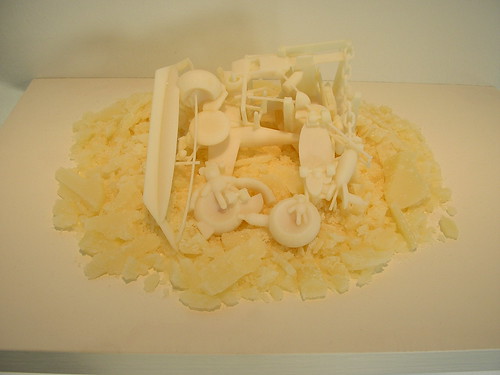
Whitenoise exported with present-day technology shown at "GAMES Kunst und Politik der Spiele", Vienna 2008. Photograph courtesy of MosMax Hax
A competent technology which will enable exporting the architecture of Whitenoise from Second Life into other domains will surely come, although it has to be added that it does seem to be taking it's sweet time coming. Meanwhile the many many facets of MosMax, the avatar population of Whitenoise, is here with us while Hax is already embroiled in new ideas, new play, new visual manifestations.
...
You can teleport to the location of Semiautonomous Puppet Architectonics at Odyssey directly from here.
Sunday, May 10, 2009
Semiautonomous Puppet Architectonics: Second order cybernetics and MosMax Hax

Saturday, May 9, 2009
Second Life content creators save lives, one net (and one eyeball) at a time
Posted by Bettina Tizzy
Cutea Benelli and Blotto Epsilon, co-creators of the ultra fabulous Bogon Flux (which is no longer rezzed, but just you wait! More news on that front), together with avatar creator Barney Boomslang, have released the strange eyestem thingie for sale, and it is to benefit nothingbutnets.net, the organization that saves lives by preventing malaria, a leading killer of children in Africa. 
Even if you aren't buying, why not drop a few Lindens on their vendor?
Here's your Executive Summary, busy people: Ten dollars from every purchase will send a net and save a life of a child in Africa.
Teleport NOW directly from here or donate directly to their effort here!
I am a cyborg
Posted by Bettina Tizzy
I am human. I am a machine. I am post-human. I am organic. I am synthetic. I am a better human. 
I am the future. I am a series of devices and mechanisms and integrated circuits. I am also made of flesh. 
I'm in the zone when I wear this avatar. Or is my avatar, any avatar, already my cyborg? In "The Cyborg's Dilemma: Progressive Embodiment in Virtual Environments," Frank Biocca asks how the sense of physical presence and our changing representations of the body in virtual environments affect our minds. As we drive and watch our avatars, embody them, are we not already part human, part machine?

This incredible avatar was created by Justen Jigsaw. Teleport to his shop directly from here.
Friday, May 8, 2009
Comet Morigi's Mt. XXYYZZ
Posted by Bettina Tizzy
UPDATE: I'm delighted that Comet Morigi has translated this blogpost to Japanese, which you can read on her own blog here.
It is not unheard of. People often anchor prims onto sims in a way that they extend well beyond the sim's "borders." But I gasped this morning when I caught sight of Japanese land artist Comet Morigi's super-colossal latest at Brooklyn is Watching (BiW): Mt. XXYYZZ. 
Using a total of 4 prims, Comet surrounded the sim that BiW sits on - Popcha - with mountainous terrain on all sides. In fact, this installation is so large in scope that I was unable to photograph it in its entirety to my satisfaction. 
She used a terrain scanner-to-sculpty to create a 1024m x 1024m x 256m mega prim and added a 1024m x 1024m water-coloring panel. "Only two mega prims, and their anchor prims for a total of 4 prims," she explained to me.
While Comet's art work is nearly always gigantic in size, Mt. XXYYZZ seems to impress visitors to BiW more than most. Still, Comet seems to be taking all the fuss in stride. "Technically, it's not so rare in-world." Perhaps not technically, though her execution is superb, but visually, this piece of extraordinary size and power is a feat.
Teleport directly from here.
See also: Land Art in Second Life: A historical perspective and an introduction to virtual artist Comet Morigi
Thursday, May 7, 2009
Chortle, chuckle, grin and guffaw - Smile, you are NOT on Candid Camera, you are in SL + Your homework assignment
Posted by Bettina Tizzy
Fun! Where did it go, oldbies? The more we chat about our Second Life® experiences, the more I hear that you are too busy wheelin' & dealin' or providing customer service or rushing on a build, and too too busy to laugh it up anymore.
Well here's a first in what I hope will be many installments and refreshers on how to stop taking your Second Life so seriously while doing something inane and delightful. Remember how good it used to feel? Remember the first time you saw that jello avatar? Remember when you floated on a giant mushroom in the sky with a bunch of friends, with tears in your eyes from all the giggles and snickers and snorts? Remember????? A few days ago, artist and Hotel Dare curator Gattina Dumpling encouraged me to do just that when I commented on her shot of Rachel Breaker as Bacon Blingtard. "Bettina! We need to blingtard you! It is the most fun you can have; totally makes you see how most of SL lives, and is truly amusing for a total of about 3.8 minutes! Set your torso slider to 100 and get some bad freebie hair and orange skin!" Have I done it yet? Nope. But I need to. Does that count?
Speaking of Rachel Breaker - who's profile reads "I can do anything I want, and so can you," this woman seriously knows how to whoop it up.
The real Rachel Breaker
It's reflected in her creations such as the Blinkin' Wonka Chimney Hat...
...and her AMAZINGTOPHAT!
Teleport to Rachel's shop directly from here, and yes, it really is inside that mound :D Touch the door to get in.
She might not be in as she is given to sneakin' next door to her friend Daniel Luchador's shop...
On Flickr, Trilby Button writes, "Just a silly little video of Lette (Ponnier) and I having lots of absurd fun in the Fotoscope sim, where just about anything can happen if you choose to float in space. We were eventually killed by the Big Giant Head (what is he from??)."
Photographers Squishypaint Aabye and Korgi Lerwick created Fotoscope for photographers. The island has a variety of locations created with photoshoots in mind, as well as two galleries and a professional studio with hundreds of poses, lights, backdrops. What interested me though, was this bit of folly in the sky that's featured in Trilby's machinima: The Freefall Fotosphere.
Teleport directly from here and look for the local teleporter.
So kids, your homework assignment for this week is... have AT LEAST one break a day lasting a minimum of 3.8 minutes (per Gattina's prescription) of simple, stupid fun. I'm going to practice what a preach, too.
Wednesday, May 6, 2009
Something wicked good this way comes, and it is happening today
Posted by Bettina Tizzy
All those survey numbers and spreadsheets are beginning to register what most Residents of the bustling city that is our Second Life® already know firsthand: Virtual worlds for more than games are popping with potential for the serious stuff… business, education, science, and the arts. The naysayers are still out there, Twittering about how they don’t even have enough time for their first life, etc., etc., but they are off-world. They aren’t here to witness how this 3D world is getting stickier than molasses.
While the Real World is staggering in a recession economy, this virtual world is humming merrily to the tune of $120M in user-to-user transactions during the 1st Quarter of 2009, up 65% from the same quarter last year. Moreover, according to a recent in-world business study, 20% of Second Life’s businesses earn all their income in Second Life, with approximately 2,000 full time businesses in operation.
At the very heart of this bubbling stew is an organization called Metanomics that explores the serious uses of virtual worlds in the company of tout le monde: the executives, educators and artists that are making it all happen. It’s a virtual talk show. It’s a forum for hundreds of conversations going on simultaneously at a dizzying rate of speed, both in voice and in text chat. In fact, I defy you to attend any of these sessions without perceiving… without recognizing that something really important is going on: potential and yes, even success.
The new set and studio for Metanomics - Photo by Keystone Bouchard
Something wicked good this way comes today, and it’s big. For as long as I can recall (and I rezzed in January of 2007), the leadership of Linden Lab, the company that owns and operates the platform of Second Life - and governs it, too – has gone into hiding whenever the Residents of the world they created convene. But changes are afoot, and the citizens have been in agreement lately… dare I say it? Linden Lab is starting to step out. The Lindens are actually becoming involved with, and becoming a part of the Second Life community.
Oh, they still infuriate us with unsurprising regularity over one thing or another, but I can’t begin to tell you how welcome their participation is. The more we communicate, the better things get… and stickier… and more fun. And successful.
So it is with mild astonishment that I find myself typing the following words: Today, May 6th at 1:00pm SLT, a real first… M Linden (aka Mark Kingdon, CEO of Linden Lab), will join host Beyers Sellers (aka Robert Bloomfield) for the kick-off of Metanomics' new season at its sparkling new studio and set created by acclaimed award winner and architect Keystone Bouchard (much more on that structure soon).
Something wicked good this way comes, indeed.
Teleport to it directly from here.
Monday, May 4, 2009
Lordfly Digeridoo trips the light fantastic with dynamic shadows + His pros and cons
Posted by Bettina Tizzy
He's been a Resident of Second Life® for nearly six years (rezzed on July 21, 2003), so it's saying something when virtual architect, builder and podcaster Lordfly Digeridoo takes such pleasure in playing with dynamic shadows, expected to hit our optional viewer any day now. Just look at him cut a rug!
Lordfly: "Dynamic per-pixel shadows, spotlights, and the ability to project textures onto arbitrary surfaces"
Want to do a little Alpha-testing yourself? Pick up KirstenLee Cinquetti's S17 viewer sporting a very thoughtful single-click installation feature for the non-nerds amongst us, but have a look at her blogpost and the ensuing discussion in comments before you tinker under the hood.
"So what, in your view, are the pros and cons of dynamic shadows?" I asked Lordfly, and this is what he said:
Pros: More realistic depiction of the simulation allows less uncanny-valley moments (brain automatically searches for depth and shading cues, adding this in greatly enhances realism), graphics engine takes another step towards keeping up with other major engines (we're now finally at Unreal Tournament... 2004).
Cons: More forum drama, people ragequitting over no support on their 5-year old laptops, content creator confusion over whether to build for the lowest common denominator or not (hint: baked shadows look fine, generally, even with dynamic shadows over them).
Torley amplifies my awesome 3X over
Posted by Bettina Tizzy
Torley Linden - Linden Lab's Resident Enlightenment Manager just keeps contributing to the quality of my Second Life® and my Real Life. In the span of just 24 hours, the man has dropped three jewels onto my lap.
For starters, I came across this video he created to demonstrate how funtastically cool Vectorpark's new Flash game, Windosill is.
The physics are perfection!
Then, I'd been looking for just the right music for a little machinima I was making, and discovered this treasure-trove of Torley's original compositions and improvisations, all of them downloadable MP3s.
Finally, to demonstrate a bug he'd encountered on Twitter, @Torley created this video using Jing, a nifty and effective freebie screen capture program.
In fact, anytime I follow Torley's cookie crumbs (and they are all over the Internet), I come away smarter, cuter and better equipped to meet the challenges in both of my lives.
Like springtime blossoms, art is thriving at Brooklyn is Watching
Try as I might, I can't keep up with all the new artists and artwork on display at Second Life®s acclaimed art critique Mecca, Brooklyn is Watching (BiW) (teleport directly from here).
I dropped in yesterday and the place was bursting at the seams with mega sculptures. From left to right: That big brownish thing looming in the sky by DanCoyote Antonelli; like a burst of champagne fizzies, Juria Yoshikawa's piece invites you to drink it in; and a new artist discovery for me, Werner Kurosawa's rockin' spinning-prim sphere. 
Not in this photo but well worth checking out, Oberon Omnura's kinetic forest.
Never heard of Brooklyn is Watching? Here's the 101, plus info on how you - and your art - can be a part of it.
Bryn Oh pokes fun at da boys
Artist Bryn Oh has discovered machinima, and we never know what she's going to do next!
Saturday, May 2, 2009
Mobilize your personal static electricity for a hands-free 3D gestural interface
Posted by a totally wowed Bettina Tizzy
Students at Northeastern University in Boston have created an interactive interface that harnesses electrostatics to give you 3D control just by waving your hand in front of a computer. No camera, no markers, no physical controllers: it recognizes xyz coordinates, and even works with modeling and music programs. As you move your hand in three-dimensional space, the information is transmitted to the computer.
3D Computer Interface from Free Flow on Vimeo.
Peter Kirn of Create Digital Motion contacted a member of the student team, Justin Schunick, to learn more. Per Justin: "The interface uses an array of copper electrodes to sense a certain change in the electric field created by the device. The black material covering the electrodes shows how the interface can be hidden beneath surfaces to create a completely invisible interface. It is simple black felt you can buy at any fabric store. The total cost of this prototype was around $60.00 USD."
Speaking for myself, and considering my fitness level after nearly 2 1/2 years of participating in virtual worlds, I would welcome any technology that encourages whole body movement while working in 3D environments.
You can read the original story about this exciting development here.