Our very own Keystone Bouchard (aka Jon Brouchard) continues to trailblaze. He and his team at Studio Wikitecture - a group he co-founded on the principles of Web 2.0-based architectural collaboration methodologies - have taken the Open Architecture Network's Founders Award for their entry and design of the Nyaya Tele-Medicine facility in Western Nepal. The goal was to design a wired medical clinic in the Himalayan foothills that will connect 250,000 people to doctors around the world via the Internet.
Why did you decide to enter this when there is no cash award?
Keystone Bouchard: Since the 'Open Architecture Network' mission is all about open sourcing architecture for humanitarian purposes, we thought it would be a perfect opportunity to submit an entry for this competition, composed in the same collaborative and open-source fashion.
The bottom line: this is about connecting architecture and technology with communities in need. As Turk Pipkin points out in this video, the winners don't actually win a prize; rather, they win an opportunity to help change the world.
Here's a time lapse video of Studio Wikitecture's evolving design:
The Wiki-Tree is a version tracking system that - instead of tracking text documents in a linear history like Wikipedia - tracks versions of 3-dimensional models and saves them within a continually evolving 3-dimensional digital tree 'canopy'. Like Wikipedia, this 3D-Wiki allows a loose, self-organized group of contributors to share ideas, edit the contributions of others, and vote on which design iterations should be considered for further refinement.
What's next, Keystone?
Keystone Bouchard: Our top priority, at this point, is to build more awareness of Wikitecture's potential, recruit more 'Wikitects' and find our next project. Ideally, we would like to take on a paid project that will actually be built in Real Life, but we are open to other possibilities as well. We still have a lot to learn, but we have gathered a tremendous amount of qualified and diverse talent within the Wikitecture community from around the world, and are confident we can meet or exceed the level of service offered by a traditional architectural practice model.
We're also hoping to find some investment, financing or sponsorship to help develop the Wikitecture technology into Phase 2. We have a long list of improvements we want to make, but primarily we need to simplify the interface and improve the web-side technology.
The competition was announced at the 2007 TED Conference and launched at the 2007 World Economic Forum in Africa in June.
Monday, June 9, 2008
Kudos, Studio Wikitecture - Winner of the 2007 AMD Open Architecture Network Challenge's Founders Award

Sunday, June 8, 2008
Gorgeous prim abuse at the FRI
A prim is a basic building block that is used to create (build) anything and everything in the virtual world of Second Life®. Prim torture (or abuse), as terrible as that may sound, is the ability to change that building block's attributes mid-stream to wield unusual shapes.
It isn't often that a venue and a temporary art show mesh together well. More often than not, something is "off," whether it's the architecture, the colors, or how the art is framed or positioned. 
A happier circumstance could not be found in this regard, than the current show featuring Gore Suntzu's kinetic art at the Fashion Research Institute's (FRI) Castle Queen Pea building by Lily Lioncourt (teleport directly from here). 
Like jewels encrusting themselves on the arabesque structure, they accentuate the archways and Moorish ceilings. 


The pulsating qualities of Gore's "prim abuse" sculpty sculpture can be better appreciated in this video by Iridescent Coronet.
Gore's show ends June 15th.
Florence Babenco's "Twin Sisters"

Twin Sisters
Florence Babenco generally takes some 50 photographs of a subject in Second Life®, and then looks among them for those that "talk to my eyes." Photoshop is the medium where she transforms what she sees. "It is an aesthetic... original and finished work," she says.
Saturday, June 7, 2008
The Garden
UPDATE (June 24, 2008) - After a spectacular two month run, the Garden of NPIRL Delights - produced by Not Possible in Real Life and sponsored by Rezzable Productions - has ended. Thank you to everyone who made it possible and to all who enjoyed it.
by Alpha Auer (aka Elif Ayiter)
I have been taking walks around the four sims that constitute the Garden of NPIRL Delights, and as I have been looking at the displayed art work it has begun to dawn upon me that Garden itself is the really important thing that is going on here. It transcends its content.
What hits you the moment you land inside is the spontaneity, the gaiety, the total "joie de vivre," of the work that stands here. And the companionship: Newbie builder stands here shoulder to shoulder with seasoned veteran - no competitions, no awards. All equals in one huge playground. With a total freedom that even includes terraforming privileges! In effect, quite different from what would have been par for the course under Real Life conditions.
True, there is a theme: The Bosch triptych. One that certainly gives you plenty of rope to hang yourself with if you choose to do so. And admittedly, some of us have in fact done exactly that: I would be lying if I said that I am perfectly OK with everything that is on display in there. But conversely (and much more importantly) there are pieces in there that had me quite breathless with their energy, their imagination, their narrative ability - and above all else... their individuality. And if that utter freedom of expression had not been fostered in the first place, these art works would simply not have materialized. 
And here is the divine irony (and I love it!): The Garden has achieved cohesiveness, has managed to become bigger than the sum total of its content. This is, of course, precisely the sort of thing that any curator worth his or her salt shoots for - to achieve this kind of Gestalt. Now, I do have this rather wicked theory that in quite a few curated exhibitions in Real Life, certain kinds of artistic output tend to get turned down simply because they go off too much on their own; they are too difficult to categorize and to fit within a mainframe. So, you may end up with this dreary monotony of unindividuated output in rank and file. But hey!!! Who cares? It's a strong theme, forget the individual art work please!
Bettina Tizzy has not forgotten about the individual art work. She has put the individual first, to the point where not everything on display in the Garden passes full muster when viewed with a gimlet eye. That is the chance that you take when you allow full freedom, do not set up tight boundaries, do not shoot for a particular "look" or a "concept." And, am I glad that she did take this chance... What is exquisite more than makes up for what isn't fully up to scratch. But exquisite or not - all is individuated to a truly remarkable degree: Gutsy in its individuality is the phrase that I think that I am looking for.
I think the way that the Garden pulls its manifold content together is by virtue of its landscape. I have to say that I find this landscape and the way it has been conceived of and implemented by Littletoe Bartlett nothing less than inspired. The hills are there for a good practical reason: They function very much as separators between art installations, much as walls in a Real Life gallery space would do. But there is much more going on here, in that the entire landscape transports me directly into one of my favorite worlds, the world of the late Gothic illuminated manuscript.
This is very similar to the detailed, ornate, velvety and yet touchingly naive backdrops of those medieval scenes, that can be glimpsed through narrow windows in front of which wimpled ladies exchange devotional books with chivalrous gentlemen. Didn't the Limbourg brothers paint this very landscape into all of those Books of Hours that they designed for their patron, the Duc de Berry? 
The Apostles going forth to preach from Les Très Riches Heures du duc de Berry
Of course, I have no idea that this was, in fact, the effect that the landscapers of the Garden were after but this is definitely the feeling that the rich, soft ground textures (again by LittleToe Bartlett and Pavig Lok) and the hills and hillocks, all rolling into a gentle sea give me. And then comes the foliage, the trees of artoo Magneto that share the space with those of soror Nishi. The delicate touches of Ravenelle Zugzwang and Bettina herself.
All told, I am very glad to have been part of this show... to have been able to wander inside the Garden of NPIRL Delights as one of its content creators.
Thursday, June 5, 2008
He's a spoke in Chouchou's wheel, and more
Back in February, and in full-blown discovery mode, the first object I right-clicked at Chouchou's jewel box of a club - Islamey - had been created by a Japanese fellow by the name of Yuki Aabye. And so had the next, and the next... It seems that Yuki has often worked alongside juliet Heberle to make spaces like Islamey and the new Chouchou sim (teleport directly from here).
Yuki is also known for his shimmering pixielights and butterflies and furniture (teleport directly from here), but his photography is growing more compelling every day. Click either to see large. 
By Чuкi Ааьчё - Strange vegetation 
By Чuкi Ааьчё - A way to fly, or as he puts it, "me and me"
Dear M Linden - Please help content creators protect our Intellectual Property (and save LL a lot of time and trouble, too)
In an April 25, 2008 interview with Erica Naone in MIT's Technology Review, you agreed that content creation is "definitely the story of Second Life," and given your background in "user-centered design work," I believe you may be receptive to an idea that should be easy to implement and could save everyone a lot of, um... grief, and time.  The Not Possible in Real Life group hereby requests that Linden Lab add a Creative Commons tab in the object editor, as well as a Creative Commons option in the right click pie menu, so that everyone can see, with a simple right mouse click, what the rights are on an object.
While it would not be a panacea, offering this tool would help creators define how people can use their work, beyond the dictates of fair use, but without having to negotiate every single license. It would have no ill effect on the fair use of a work, and copyright law and any other applicable law, would still apply.
As AM Radio pointed out, the issue of copyright protection in Second Life®, "...is just getting goofy. The problems appear to stem from people's inability to comprehend intellectual property law and the fact that it is the responsibility of the infringer to seek and understand the copyright intentions of the creator. It is not the creator's burden to present a copyright declaration in all instances that the work is presented."
He added,"Giving creators the tools to make a copyright declaration in the object editor would relieve them of the burden of chasing down infringers, as well as give them a specific tool set to use in such circumstances. Violations would be clear, infringers would be outcast, and the community would self-police." 
There are four conditions that you can choose to apply to a Creative Commons license:  Attribution: You can use the work but must give credit. This applies in all Creative Commons licenses.
 Noncommercial: You can use the work only if you don't make any money from it.
 No derivative works: You can use the work only without altering or transforming it beyond the provisions of fair use.
 Share alike: You can transform a work as long as you make the resulting work available on the same terms as the original work.
You can use these terms in 6 different combinations.
"Creative Commons doesn't cover all situations, and often times there are violations which are unclear. I cannot copyright wheat as represented on a single cylinder any more than I could copyright the word "wheat." I could attempt a patent for such a thing though. I could, however, copyright a work which uses the idea, such as an entire field of cylinders, in much the same way I can use the word "wheat" in a copyrighted short story. So creators must be educated on the difference or people could chase one another for creating wooden box prims," shared AM.
Info for Residents
Copyright law protects any creative work whether the creator wants that protection or not. No one should use your work without a license, beyond fair use. The Creative Commons tool however, is especially useful if you want to share your work in some way. Would you mind if your work is photographed or filmed, for instance? Some creators object strongly to this, while others welcome the recognition and free promotion. Don't want your work to be shared? Not an issue. Under our proposed scenario, you just wouldn't select and use a Creative Commons license.
Want to learn more? The Creative Commons (CCA) - a non profit organization that "builds tools that help realize the full potential of the commons in the age of digital networks" - will hold its first Creative Commons Technology Summit at Google's offices in Mountain View, California on Wednesday, June 18th. Attendance is free, but space is limited, so register soon if you have an interest.
Wednesday, June 4, 2008
The curved and narrow

Rivet, by Grace Loudon. Teleport from here. 
Stairway, by Prad Prathivi. Teleport from here.
Tuesday, June 3, 2008
A most extraordinary building in Second Life
Among other things, you might say that Scope Cleaver's newest building looks like a rainbow colored Chambered Nautilus, or a prized Wurlitzer jukebox. You might remark on its open roof, or how it throws off light beams. But it is a foregone conclusion that you will not say that you have ever seen any other building like it before. In any life. Fact is, if you want to acquaint yourself with typical architecture in Second Life®, do not teleport here. 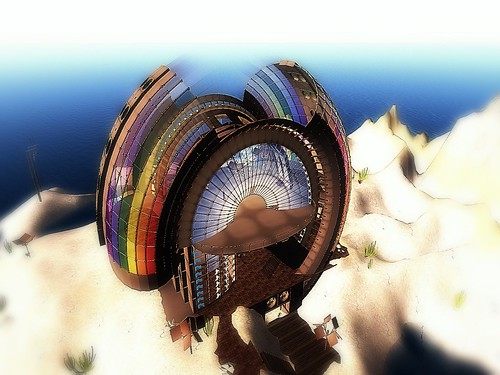
Princeton commissioned the creation of this pixelated building, which it subsequently named Diversity
I met with Scope in March to see how the building was progressing, and then followed that up with an interview this weekend.
This is so very different for you!
Scope Cleaver: Yes, the materials are pretty different... lots of adobe, woods and brass. A combination I haven't used before in Second Life. The goal was to create a building that would be environmentally friendly in Real Life, so I introduced wind turbines and the use of energy-conscious materials.
Well, we can set examples in-world for off-world construction. Have you ever seen a structure that combines these materials?
Scope Cleaver: Not in the same mix, no. I've seen wood and adobe together before, of course, but not with brass and colored glass. Maybe this has been done in the steampunk sims, though I don't know. First time I dare use so much color. 
Tell me about the evolution of your thought process regarding design.
Scope Cleaver: I started designing in Second Life as a way to see where the tools would bring me and learn about its limitations, and more importantly how those limitations and constraints could help me find a new perspective and ways of expression.
I think a defining trait in my thinking about design in Second Life is to take it seriously as an object of study and research. There is a complex web of variables that inspires design in the study of culture, how avatars interact, the economy, people's sense of space and privacy, language (because yes, that too is evolving in it's own way), technology, meaning and values. I believe (that) trying to be sensitive to it all - on a global scale - helps shape how I would like to evolve with architecture in Second Life.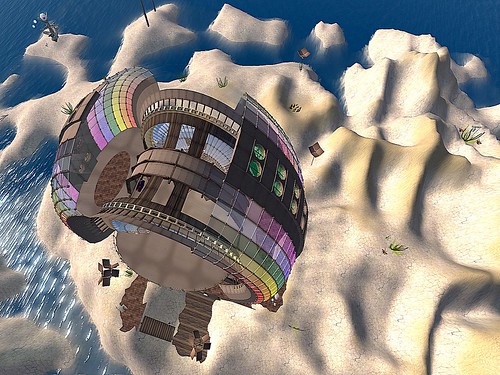
Hmmm, though the terraforming by Poid Mahovlich is overrated
Your work is becoming more NPIRL (Not Possible in Real Life) all the time. Did NPIRL have any influence on you in this regard?
Scope Cleaver: I don't really have imperatives before making a design on whether it should be possible or translate in Real Life or not. I am not sure it's the right way to compare things for many reasons, one of which is, it isn't clear in our still incomplete physics what is and isn't possible in Real Life.
What if we find in 20 years that X is indeed possible in Real Life after all? Should it change the value of a piece in Second Life? Also, in Second Life, I may have seen buildings that defy the law of gravity, but I have yet to see any that defy the laws of logic. So what does it mean exactly to be impossible IRL? And what does it teach us about RL/SL? If we really put our minds to it, could we come up with something we thought was impossible, yet manage to make it in Real Life? Where there is no doubt, is that Second Life does reveal to me new possibilities on a daily basis. In this sense, many inspiring creators in the group have left me in constant amazement.
Artist and architect Santiago Calatrava's planned "Obelisco" for Madrid would certainly add strength to Scope's argument
What were your biggest challenges in creating this building and how did you go about tackling them?
Scope Cleaver: Well, I'll attempt to gracefully avoid talking about prim management... But one interesting challenge was to figure out how I would bring together elements which are usually seen together in a different aesthetic repertoire. I am talking here about materials, colors and the general tone of the building. I used simple trial and error methods and experimented with many different iterations, until I was happy with it. There was a bit of wrestling with myself, and some exploring and learning was in order, since this departs from my usual style. It's never easy to face the unknown.
What are your plans for the future?
Scope Cleaver: I have a few smaller artistic projects along with a custom residence on my plate for the immediate future. For the long term, I plan to live long enough to witness a revolution in how we think about designs as sentient entities; more on that in a few years...
What would you like to be doing that you have not had the opportunity to do yet?
Scope Cleaver: I have been very lucky to get plenty of opportunities from clients to realize things with very few constraints. I guess one thing I would like is design a space for a think tank or research center focused on the future of virtual worlds and artificial intelligence.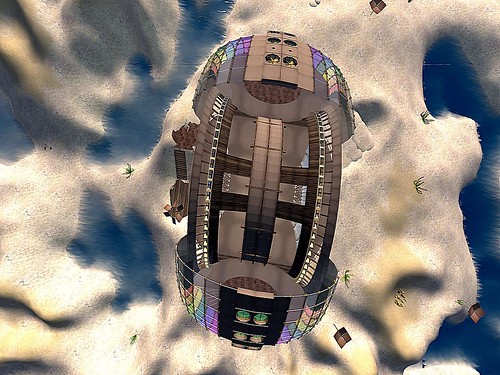
What are a couple of the biggest differences between designing for Real Life and Second Life...
Scope Cleaver: There is the obvious, like deterioration, the likelihood of a civil lawsuit and the order of magnitude involved in the program and timetables, and plenty of details about manufacturing processes and the cost involved in items that are designed for mass production. If you strip to the essentials though, I tend to notice there are more similarities than differences.
Which creators in Second Life inspire you and why?
Scope Cleaver: There are way too many to list. I have the utmost admiration and get inspiration from Seifert Surface for his expertise and wise words: "sometimes magic doesn't work." We share a passion for mathematics and art. Keystone Bouchard, for his constantly evolving insights about architecture, interactivity and collaboration.
Lately, from AldoManutio Abruzzo whose music inspires elegance and expanses of space. Lem Skall, for his amazing photography and sense of composition... a true Second Life explorer. DB Bailey, for his ability to carve space and make abstractions tangible. Patch Thibaud for his efficiency and the ease in implementing a design. The people who come to see me build, for their gems of comments and quirks, and many others... 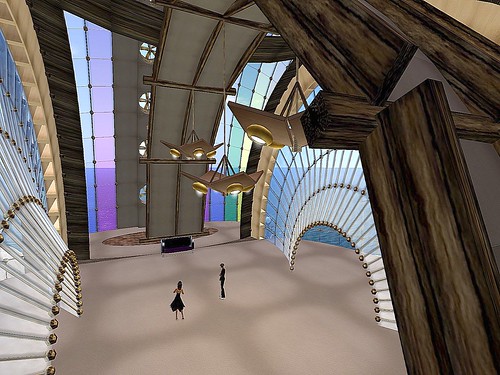
One of the differences between Real Life architecture and Second Life architecture is that it is so much easier to sell virtual duplicates of a work, much like lithographs or prints. This places Second Life architecture in a saleabilty category that is similar to commercial art in Real Life. Do you agree?
Scope Cleaver: I see this as a fact so it's difficult to disagree with it. I do both. I have some of my buildings for sale and others I do custom, although my work is mostly custom. I think there is a future for both. Putting aside the philosophical issue of the value of the many versus the unique, there certainly is a demand for both. The reason I prefer custom is because it feels much more personal, and you get to interact on the creative level with the client throughout the project. That said, it would make more business sense to focus entirely on selling duplicates, which in Second Life we call "prefabs".
See also: Scope Cleaver's winged superstructure
Monday, June 2, 2008
The birds by Nonnatus Korhonen
Photography by Kean Kelly
They are other-wordly and a bit unsettling, in a cute sort of way. They reside where giant strawberries are found. Flocks of them chase visitors, but they won't allow themselves to be caught. They are the birds by Sydney-based Nonnatus Korhonen (aka Andrew Burrell), created for the Garden of NPIRL Delights (teleport directly from here). 
Kean waits for them to come to her 
Kean works to establish trust in them
Ashanti LeShelle's surreal imagery continues to delight
She is clever and creative, but she is also flawless in her execution of fanciful images that invite fresh thinking. Ashanti LeShelle's work has already graced these pages here and here, but this is the first time we introduce you to her pig series. You can click on the photographs to see them larger. 
"Floating"
Stopover
"Alien"
Sunday, June 1, 2008
The safety of spaces
He has challenged our idea of place since the beginning with the Far Away... a field of wheat, grey skies, a rusty old train, a table... but in our pixelated reality it is a comforting riddle that has gripped the imagination of tens of thousands of its visitors. Now, AM Radio, degreed in Fine Arts and living in the Chicago area, has unveiled two new installations: Husk, on a sim sponsored by the New Media Consortium, and The Quiet, sponsored by Princeton University. It gives me great pleasure to introduce you to his new Machinima featuring - and weaving together - all three places, with music by Torley Linden.
I learned today that AM seeks to inspire viewers to create and define their own narratives of experience as evidenced within the Flickr groups (see below) that are dedicated to each of the installations.
He shared the following quote with me from John A. Jalke's "The Visual Elements of Landscape":
A view, as a complex set of objects (a kind of place itself), can be categorized to basic components. These components include: (1) extent of view or the distance over which sight is effective; (2) foreground-middleground-background discontinuities or the existence of multiple horizons; (3) enframement by which the sight is bounded; (4) focal points that serve as attention getters; and (5) sense of security implicit in focal points that imply refuge. Effective views contain prospects that enable viewers to survey considerable distances over several successive horizons.
AM Radio: At once, you can read these ideas to mean that safe havens are, in fact, tactical positions, or more simply, great hiding places. Refuge implies safety. The way in which a place can imply safety is via its tactical position in a landscape. Comfort can be specifically constructed into a new unfamiliar space via it's ability to supply a visual advantage. The visual advantage allows the user to remain in a place while monitoring all entry points, as well as to plan an escape should the refuge fail. The design of the space should also imply the possible exploration of further, unseen spaces.
AM's work seeks to show that ideas of landscape and tourism are as pervasive in 3d virtual spaces as they are in real life. By creating a framework of traditional, and recognizable experiences based in realism, the artist can begin to manipulate the rules our souls would wish to prohibit. Rules such as gravity.
AM Radio: Realism in virtual spaces declares a universal language, upon which abstractions can be created. By transporting the user into a safe place by using rich visuals steeped in nostalgia and familiarity, these spaces calm the user into accepting what would seem to be impossible and dreamlike situations. The viewer is then free to form ideas and to make emotional associations upon the implied meanings of objects and symbols within the sims, rather than wondering if and how they should. The viewer subsequently and confidently shares those ideas and emotions with their fellow virtual travelers via images, dialog and stories.
Flickr groups about these three installations:
The Far Away (teleport directly from here)
The Quiet (teleport directly from here)
Husk (teleport directly from here)