Saturday, May 23, 2009

A sculptural installation that has attained A State of Grace

Posted by Bettina Tizzy

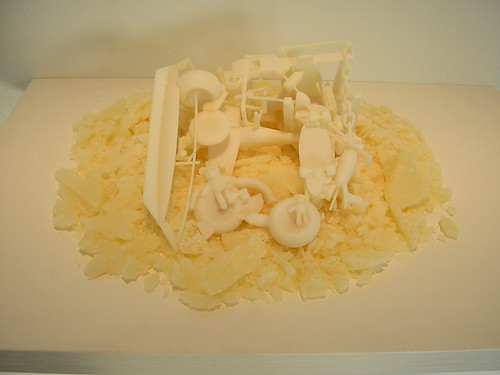
Glyph Graves' latest, largest and certainly most stirring installation had many births. Originally conceived in early spring of 2008, it didn't reach fruition due to his busy schedule and limited prim availability. Since that time, however, he has made a name for himself as a notable sculptor in Second Life®, and today marks the public opening of his Strangers Also Dance, the inaugural show at IBM's brand new art and architecture exhibition space, curated by Tezcatlipoca Bisiani (aka Andrew Sempere, Research Designer at IBM's Center for Social Software).

Glyph is an Australian biologist who's virtual self is best known for kinetic, mostly abstract alpha sculptures that emit musical notes and eerie-to-sweet sounds when triggered by an avatar's proximity, though he is increasingly working with partially inverted solid-textured sculpts.

I've been a fan of Glyph's work for some time now and
frequently feature his work on my own sim. This winter I happened upon this video by Todd Vanderlin and shared it with him as it reminded me of the behavior of several of his undulating sculptures and their responsiveness to avatars.

Scary Vines from vanderlin on Vimeo.


Glyph has since incorporated this thinking and included it in his reactive reeds. I mention this because he is an artist that is unusually receptive to new ideas and, like his sculptural work, acknowledges and rapidly evolves with his environment. This isn't to say that he is malleable or excessively adaptive. Rather, he is acutely aware and sensitive to exploration.

Strangers Also Dance is a remarkably immersive installation based on a poignant story that conjoins our Second Life universe with an alternate reality sweetly suffered by jellyfish that ventured too far from their warm gas giant home, becoming displaced in an environment that they find difficult but make the best of.

Importantly, Glyph approached the design of this build and its narrative beginning with its climatic circumstances. The Second Life ground upon which the adventure begins is suitable for humans (aka avatars) but too cold for these extra-SLterrestials and plants. Even so, the landscape is other-wordly. Obeying the laws of natural selection, a delicate pink creature was unable to keep up with its peers and has crystallized, laying dormant until it is visited, and touched, and therefore warmed by the avatar's body.


The avatar is enveloped by the creature, which begins to whisper to its guest:

Freed Alien Jelly: Nothing that will hurt you little one. Your warmth has freed me from the cold down here. Let me show you something few have ever seen... rest now. In your sleep, strange fragments of dreams of swimming in strange clouds come unbidden. Suddenly you feel disturbed as the hard crystalline surface you rested on melts away, then comforted by a sense of gentle enfolding and warm gratitude.

Delicately, a luminous jellyfish breaks free from the crystal, enclosing the avatar and floating upwards, all the while reassuring its capture that it will be gentle until...


... finally, almost tenderly, it deposits its human prize somewhere new, somewhere quite different, on a strange and wonderfully tropical terrain.


Sit on one of the immense tubes and you are one with this new matrix, downloading information as quickly as the creatures can share it.


The time was a memory past
through banded clouds
over hot seas
we swam

then later,

of cold stars and eternal night
we arrived,
we stayed too long
we could not go back


Released, you begin to explore, learning as you go about their sorrowful plight which they seem to accept with enormous grace. As I listened and absorbed their story, I couldn't help but admire their forbearance. My empathy grew.


"Do you want to know how we felt?" asks Biocrystal darkness. "When we first left the cradle of our world? Remember, our home, always bathed in warm clouds, always immersed in soft light. (Silence) Then dark. (Silence) What light there was, sharp like thorns and cold. (Silence) Enter. And feel."


Technically, there are a number of hallmarks: All sounds throughout the installation are played note by note. The speakers (the green plants) are designed to produce a spatial sense by cascading the notes down prim by prim as well as having them arranged around the sphere. A stereo effect is created by splitting the stereo track into mono components and playing them in opposite prims, which is also swirled by playing the pairs in consecutive prims.

Glyph's cellular automata react to both the avatar touching them and to the state of each of their local neighbors. After they've been touched, the music begins to self-propagate in a repeating pattern, which is different each time.

Since 2006, IBM has played an active role in empowering Second Life content creators with the IBM 6 sandbox which recently doubled in size and is open to all residents on the grid, whether they work for IBM or not. PatriciaAnne Daviau, its manager, has done an admirable job of maintaining a lively and active community there, though I can't help wishing that they didn't force teleports to one central location. It makes it very difficult to share works-in-progress with others who must then go by the coordinates to find their way.

Thanks to Jessica Qin's (aka Craig Becker, CIO Office of Strategic Initiatives) initiative and drive, IBM has moved to advance its presence with the content creation community, and particularly fans of art and architecture, with the launch of the new two-sim IBM Exhibition Space.

Teleport directly from here.

Thursday, May 21, 2009

NPIRL fashion sometimes obeys the laws of geometry and thrift

Posted by Bettina Tizzy

While both the Spring and Summer catwalks for 2009 featured fashion with a geometric - even architectural – construction, Alpha Auer (aka Elif Ayiter) kicked that up a notch under her label Alpha Tribe. What’s more, whether she is aware of it or not, she’s in tune with the global economic mood. During the great Depression, a popular maxim was "Use it up, wear it out, make it do or do without:" To create her latest outfit, Deagu, Alpha Auer recycled a poster she had designed for an invitational exhibition at the Daegu Culture and Arts Center in Daegu, Korea in 2006.

On her blog Strange Pixels, Grady Echegaray seemed to be invoking the Gods when she composed her post about Daegu: "I can feel them. They are coming again. Sweeping in over the shoulder of Orion."


Daegu, as modded, modeled and photographed by Grady Echegaray


The Deagu headdress, as modded, modeled and photographed by Grady Echegaray

To obtain your own Daegu outfit teleport directly from here.

Wednesday, May 20, 2009

Ever wish you could search for objects in your inventory by the creator's name?

Wizard Gynoid has created a new JIRA issue that I can really get behind: #MISC-2717 suggests that the "Creator" field be added to the SQL query in the Inventory "Search" field.

How many times have I wished for this? If you feel the same way, please vote!

Don't know how to vote? Easy peasy!
1) Go to this link.
2) Sign in with your first and last name (so I would sign in: Bettina Tizzy)
3) Your password is the same as your avatar's password.
4) Look in the lower right hand margin for the word "Voting" and click on the link to Vote.

Voila!

Monday, May 18, 2009

Don't let your virtual creations die with you - Will your Work Day

December 29, 2009 Update:

I've decided to expand this concept to ALL digital creations. I'm going to need your help to get the word out. Bloggers, website creators, media, tech geeks and geekas... Will you help me? Please contact me at bettinatizzy (at) gmail dot com and we'll mobilize together!


~*~

German, Dutch, Spanish, French, Portuguese and Italian translations of this information are available here


Dear fellow Residents of Second Life®:

About three weeks ago, virtual artist Vanfarel Kupfer died. Had he not left copies of most of his work (no trans, no mod) with his virtual girl friend, Native Aeon, his only legacy would be what is currently rezzed today.

Avatars in Second Life devote thousands of hours to creating content, and all that work is LOST when they die. Yes, even if they backed up that work by giving it to an alt. Even if they gave their account password to someone. When you die and unless you have taken appropriate measures, no one, not even Linden Lab, can legally access your work. It is simply lost forever.

According to Linden Lab, the correct and only procedure for "willing" one's creations - or for that matter, any Second Life assets - is indicated here.

I propose that we mark this day, May 18th, as Will your Work Day, to encourage content creators to consider their situation and act on it annually.


The goal would be to celebrate Van's art and remind people to either give copies of their work to one or more avatars (not their alts) whom they trust, or add them to their Real Life will.

Also beginning today and for one week - and working with his beloved Native Aeon - Vanfarel Kupfer's work will be exhibited at four locations: his former home sim, EnLuminaria, the Crescent Moon Museum, the Blackwater Gallery, and Chakryn Forest. Understandably, Native is still very much in mourning over her loss, and when I asked her how I could help, she stated that her greatest wish is that Vanfarel's work become known throughout the grid. So be it. Native: Sachez que nous sommes de tout coeur à vos côtés.

Please share this message with your fellow residents and help to get the word out. You will find numerous translations of this letter here, prepared by the following individuals who generously volunteered their time: Lano Ling, Osiris LeShelle, elros Tuominen, Tonjampae Amat and Gore Suntzu. Tell your community in your own way, in your own words.

I leave you with the colorful, dreamy work of Vanfarel Kupfer in a video by Jurin Juran. May he rest in peace.

Here's to enduring great virtual content!
Bettina


The art of Vanfarel Kupfer, as part of Will your Work Day
Machinima by Jurin Juran

Sunday, May 17, 2009

Art Box - A new way to become the art in Second Life®


Now you, too, can be a part of Banksy's "Pulp Fiction," complete with a banana gun


Posted by Bettina Tizzy

This is the second piece in a new ongoing series on how and where to regain our "fun," in Second Life®, when so many of us are hard at work and living two full lives.

A summer rite of passage for many Southern California residents is to attend the Pageant of the Masters at the Festival of the Arts in Laguna Beach. The show is the presentation of a series of recreations of works of art brought to life as living pictures or "tableaux vivants" using heavily made-up and costumed people to portray anything from human figures to a piece of Wedgewood china.

Tickets cost anywhere between $20 to $50 and then you must drive there (traffic is a nightmare), park (another nightmare) and devote at least 45 minutes to walking to the venue and finding seating. I'd recommend doing this once in your lifetime, but even though it's impeccably realized, I must admit that it actually gets a tad boring after 20 minutes, let alone an hour. Once I got over the shock of how perfectly they had recreated an image, my mind began to stray towards thoughts of dinner and the guaranteed traffic jam home.

Much more fun is to be had simply by logging in to Second Life and spending an hour or two with friends hopping from one virtual destination to another, turning our avatars into art.

This notion of becoming part of the art piece is not new in Second Life, as we have seen with AM Radio's Death of Marat, and Robbie Dingo's staggeringly beautiful Starry Night video (do NOT miss this if you haven't seen it already). Then there was yet another virtual Starry Night created by Tr3ssis, and of course, the delightful and surreal freebies that four Yip was giving away when we first discovered her.

Thanks to a fellow by the name of Frankie Rockett and his Art Box, there is a new way to become a living part of classic or contemporary paintings. Art Box employs Holodeck technology to rez a series of famous illustrated, painted or photographed backdrops on demand, and then makes a number of props available to you, including clothes, a sandwich, a banana gun and what not, to complete your "picture."


"Son of SL Man" by Frankie Rockett

You may have seen this machinima of Frankie's that takes place in his 3D recreation of Edward Hopper's "Nighthawks"...


That Nighthawks set is now available to you and your friends, free of charge and with lots of cool props, as well as backdrops from Andrew Wyeth's Christina's World...


As well as the amazing photograph of workers taking lunch a top a skyscraper construction site by Charles C. Ebbets...


Or become part of the ad "blown away..."


Or scream...

Edvard Munch's The Scream

There are over a dozen choices of sets to rez and Frankie tells me that more are on the way. Fun! You can visit Art Box by teleporting directly from here.

Floating buildings - In Real Life

Posted by Bettina Tizzy

My colleague Alpha Auer and I have this ongoing discussion regarding what, in virtual worlds, is actually Not Possible in Real Life (NPIRL). One concession she makes is the concept of floating islands and buildings in metaversal skies.


soror Nishi's newest landscaping shop,"lifstean," as photographed by Lem Skall. Teleport directly from here

Still, I was surprised yesterday when Alpha mentioned that folks are already making "floating" buildings. It seems that a company in the Netherlands, Dutch Docklands, designs water-based solutions that make “land from water” by providing large scale "floating" constructions.


As far as I can tell, plans for the construction of a string of floating islands containing hotels, restaurants and a heliport off the shores of Dubai have been shelved due to the economic crisis. It seems that each island was to have been in the shape of a letter, with all of them spelling out a verse that reads in part, "Not everyone who rides a horse is a jockey."

National Public Radio (NPR) did a great piece on the project in April, 2008, and here's another from DE51GN.

It could be argued that space stations, already in use, are in fact, floating buildings.


Boeing's International Space Station (ISS), slated for completion in 2010, will be about the size of an American football field

All the same, I'll wager that the only floating buildings most of us will ever experience in our lifetimes will be pixelated and very virtual.

Saturday, May 16, 2009

Attaining Presence: 4Jetpacks4 and Bryn Oh


Posted by Alpha Auer

4Jetpacks4 was an immersive installation created by Bryn Oh, with the participation of Glyph Graves and Nonnatus Korhonen earlier this year. I was privileged to be one of the group of avatars that were given the tour of the research centre back on March the 6th. I will not talk here about what 4jetpacks was all about. The extraordinary video by Evo Szuyuan above does that far better than I ever could. What I will attempt to do instead is to talk about "immersion" and "presence" as integral parts of virtual world creativity. I know from personal conversations we have had that this is a subject as dear to Bryn Oh's heart as it is to mine, the thing which she puts at the center of her (virtual) creative activity.

I will quote a bit from scientific sources while I try to set up a basic definition of "presence", as a sense of “being there” in a mediated environment (IJsselsteijn, deRidder, Freeman and Avons, 2000). Lombard and Ditton (1997) define it as an illusion of non-mediation in which a user no longer perceives the display medium as a separate entity. A high level of presence will help users remember a virtual environment as more of “a place visited”, rather than “a place seen” (Slater et al., 1999). A success indicator of the attainment of presence is also considered to be the realization of similar behavior patterns in virtual environments to those in the physical realm (Slater and Wilbur, 1997), and even the manifestation of similar physiological responses towards a given event to its approximation in the physical realm (Meehan, 2000).

Various definitions of the term “presence” and their relevance to the immersive virtual experience are discussed by Mantovani and Riva who challenge the notion that experiencing a simulated environment deals with the mere perception of its objective features; instead proclaiming that presence in an environment (real or simulated) means that individuals can perceive themselves, objects, as well as others not only as situated in an external space but as immersed in a socio-cultural web connected through interactions between objects and people, leading us to the paramount importance of the interacting agent within a virtual culture, i.e., the avatar.

And this to me, lies at the very heart of the problem where artistic activity in a virtual world such as Second Life® is involved. Is the goal to be sought the "perception of objects" only? Or could it be that what would set artistic activity in a virtual world as a genre apart, would involve conditions wherein "individuals perceive themselves, objects, as well as others not only as situated in an external space but as immersed in a socio-cultural web connected through interactions between objects and people"? For me, without the shadow of any doubt, it is the latter. And it seems to me that this definition is what 4jetpacks is/was all about as well: That the creation of an immersive experience was the primary intention became obvious to me during Bryn Oh's opening statement where she addressed the importance of "presence" in virtual art. In her terminology the word "presence" is interchanged with "immersion", which does of course add up to very much the same thing. "Viewing" art, i.e., "the mere perception of its objective features" does not seem to overly interest Bryn Oh, and I am so very heartened to observe this in a fellow content creator, and one for whom I have a great deal of respect at that.

Bryn Oh is an exquisite builder. Every texture, every prim, every shape and object placed in perfect proximity, culminating in visual systems that I am awed by over and over again. And a very good thing that this is so: The immersive experience needs that level of concern for perfection to be pulled off with credibility. Creating an immersive experience does not imply that one can get away with shoddy visuality. If anything, it would imply the exact opposite: For us to become fully "present" within the "artwork" involves a level of visual expertise on behalf of the artist whereby perfect cohesion and gestalt are achieved to the extent at which not even a tiny component of the installation appears out of sync, thus distracting us from the immersive experience through its ineptitude or its misplacement within the overall system. Whether the visual gestalt that is meant to bring about "presence" involves high levels of abstraction or realism, opulence or stark minimalism would not be the issue at all by the way: I would seriously doubt whether one would need minutely detailed craftsmanship emulating realism to attain a state of presence. But, I would dare to say that what one would need would be a continuity of visual language - which as any artist worth his or her salt knows is a devil of a thing to pull off.

However, presence needs more than visuality. It also needs narrative. It needs a story or a situation endowed with sufficient power and imagination to pull us in. "Presence in art" needs substantial planning. An observance of fine detail whilst maintaining a firm grip on the whole. In other words, not a thing to be pulled off in one afternoon. Amongst much else, it is visuality, performance, role play, cyberpsychology combined. Bryn Oh has whatever it takes...

In the end, for me, the attainment of "presence" is more than likely to be the thing which will eventually create a "genre" out of the currently rather haphazard conglomeration that is the state of art in virtual worlds today. It really does seem to me that art generated in virtual worlds needs to be contextualized within the broader framework of contemporary art, given a raison d'etre, a property unique onto itself - and the attainment of "presence in art" would be a not too easily imitated attribute of virtual world based artistic activity. 4jetpacks gave me huge hopes in this direction and I am very grateful to Bryn Oh for having given me just that - hope!

...

A video created by Bryn Oh on 4jetpacks ends this post:


Also please read the post by Hamlet Au on NWN talking to Evo Szuyuan about her utterly remarkable SL-video skills and all that is involved in the attainment of the perfect SL-video here.

Wednesday, May 13, 2009

Somebody... Give this woman a sim-wide show


Desert Rose: Spiral Threads #12, 1,000 prims


Posted by Bettina Tizzy
All photography and machinima by Suzanne Graves

I have an uncle who handily wins the prize for geekiest person in my personal sphere. The man has two interests in life and one of them is math. One Christmas years ago, as we all gathered round the tree for our gift exchange, my uncle showed up with a manila folder. When his turn came around, he explained that he'd spent the past several months creating art using math equations in his spare time and we could each choose one of his art pieces as our gift. This was my first exposure to the concept of fractals, and I've been indebted to him ever since. Oh, I know... it was such a dorky thing to do (and he is a dork!), but the fact remains, I love geek art.

I figure it has been two years now since I first became aware of an ardent explorer and photographer in Second Life by the name of Suzanne Graves. It must be about a year now since she hung up her traveling hat and began playing with scripts and prims. Random rotations, random locations, generative builds, animated textures, and more. Math-inspired art.

I'm here to tell you that this woman hasn't wasted a moment. Since her Slinky piece and Wireflower back in July, 2008 to date, Suzanne has discovered many more new tricks for making prims behave in arrestingly beautiful ways.

And now she is capturing these kinetic forms in her own machinima...


Viewable temporarily - along with two other sculptures by Suzanne - at Ars Simulacra. Teleport directly from here.
Music (c) Bertycox, Album: Synesthetism on jamendo.com


Suzanne calls this sculpture Sphere Balls as a play on words. "The spheres seem to be dancing at the ball," she explained. The piece, which she created quite by accident, consists of three similar sets of black and red spheres containing 200 spheres each that rotate in different directions simultaneously. Each of the three sets are positioned on an invisible/virtual bigger sphere, following a 3D curve on that big sphere.

"The size of each small sphere depends on the curvature of the 3D curve at its location. You may notice that the spheres on the top are smaller. Each "big" set is completed by (and linked to) an invisible prim, which is positioned at the center of the big virtual sphere, and this invisible prim responds to start and stop commands. I could add more commands such as changing the rotation direction, for instance," she added.

"The three sets of 200 spheres are concentric (their invisible prims have the same location), and the set in the middle rotates in an opposite direction relative to the outer and inner sets."

Because Suzanne's work is prim-heavy and script intense, it isn't easily displayed. In fact, I'm often frustrated because I don't know which sim or sandbox she is working in so that I can go and peek. I think it is time someone hosted a sim-wide show of her work. Don't you? Take a look...


Gold Box Sets


Spiral Threads #01


Spiral Threads #06

You can see more of Suzanne's work on her Flickr stream.

Sunday, May 10, 2009

Semiautonomous Puppet Architectonics: Second order cybernetics and MosMax Hax

Posted by Alpha Auer

Cybernetics
Cybernetics is the interdisciplinary study of regulatory systems, closely related to control theory and systems theory. Both in its origins and in its evolution in the second-half of the 20th century, cybernetics has been pronounced to be equally applicable to physical and social systems; preeminent whenever the system under scrutiny is involved in a closed signal loop: An action by the system in an environment causes some change to that environment and in it's turn that change is manifest to the system via information / feedback that causes the system to adapt to the new environmental conditions. Ergo, the system changes its behavior.

Cybernetic theory uses high level concepts such as order, organization, complexity, hierarchy, structure, information and control, investigating how these are manifested in systems of different types; allowing us to ask questions such as whether complexity tends to increase with time? How do the components differ from or connect to each other? How does the one transform into the other?

According to Cybernetic law, systems rely on feedback loops whereby outputs are fed back into the system as inputs, increasing or decreasing effects. While input can be defined as the result of the environment's influence on the system, output is constituted by the influence of the system on the environment. In every feedback loop information about the result of a transformation or an action is sent back to the system in the form of input data. If these new data facilitate and accelerate the transformation in the same direction as the preceding results, they are positive feedback - their effects are cumulative. If the new data produce a result in the opposite direction to previous results, they are negative feedback - their effects stabilize the system. In the first case there is exponential growth or decline; in the second there is maintenance of the equilibrium.

Yet another key concept in cybernetics revolves around control, which includes two subsystems: "the controller", and "the controlled", in perpetual interaction with one another. The controller may change the state of the controlled system in any way, including the destruction of it. A whole new twist is brought into the mix however, as soon as the word "observer" is substituted for the word "controller": In quantum mechanics the observer and the observed cannot be separated, and the result of observations will depend on their interaction. Thus the observer too is a cybernetic system, trying to construct a model of another cybernetic system. To understand this process, we need a "cybernetics of cybernetics", i.e. a "meta" or "second-order" cybernetics. Thus, second order cybernetics emphasizes autonomy, self-organization, cognition, and the role of the observer/controller in modeling a system, recognizing the observed system as an agent in its own right, interacting with another agent, i.e. the observer. This creates a closed system wherein the effect of the environment is minimized and the feedback loop takes input and output from within the system itself. Thus, self-organization is a process of evolution where the development of new, complex structures takes place primarily in and through the system itself, leading us to autopoiesis (self-production), the process by which a system recursively produces its own network of physical components, thus continuously regenerating its essential organization in the face of wear and tear.

MosMax Hax, "the system"
I have to say that I am approaching all of this with the utmost of care: These are heady, sexy concepts and terms which I have seen tossed around, alas all too often and often all too carelessly, during many an art paper/presentation that I have sat through wondering how they could possibly be related to what was under discussion on the table. Well yes, of course... Anything and everything under the sun does after all operate under cybernetic laws. We are all systems, relating to other systems and our environments, operating under the ceaseless give and take of feedback loops. So yes! Everything can indeed be related to cybernetics. However, shouldn't there be something peculiarly, if not downright dramatically pertinent to the matter at hand before the names of the likes of Pask, Varela and Maturana can even be evoked?

It seems to me that the artist Max Moswitzer/MosMax Hax justifies the analogy. And on two levels at that: Cybernetics as well as second order cybernetics.


Semiautonomous Puppet Architectonics, at Odyssey. Photograph courtesy of MosMax Hax

The precursors of the oeuvre of Whitenoise are already present in the very early video output of Moswitzer, who says that "of course in those days I was not so concerned about concepts". I would disagree on that: Yes, of course, nowhere near the level of sophistication in terms of the visual language of today. Nowhere near as coherent. Nonetheless, in the videos "Transformator"(1991) and "Die Ästhetik der Dekonstruktion" (1989) the seed of what is articulated today is already present. This is the cybernetic system of Max Moswitzer, a system influenced by a feedback loop between itself and it's environment. This system makes it's progression over the next two decades, picking up momentum on it's way, resulting in ever more startling manifestations such as the extraordinary collaborative project Nybble Engine of 2003 until it finds it's way into Second Life® in 2007. And it is here, in Second Life, that it undergoes the extraordinary transformation of folding into itself, merging with the law of second order cybernetics: A system in which the artist becomes the output, the observer, the observed, the controller and the controlled. The system that is MosMax Hax.


Semiautonomous Puppet Architectonics, at Odyssey. Photograph courtesy of MosMax Hax

I have had the privilege of being there during the development of Whitenoise, from the initial assembly of it's architectural infra-structure, originally at Klein and then later on at the archipelago of the Synthetic University (of which my island Syncretia is a part of), to the embodiment of it's population: The many avatars, manifesting as the multiple selves and facets of one individual. Never, throughout his extraordinary journey of self-observation, of the creation of a self-organizational system fragmenting itself into ever more inter-reliant and complex parts, have I seen MosMax become heavy handed with words, definitions and explanations. Never have I heard him pontificate or get pompous: All has come about naturally, spontaneously, through "play"; through the invention of games for which more and more "selves" seemed to be needed: Some communal, in which other autonomous "humans" also participated; but more often than not (and particularly over the past year) private, personal, solitary, "autopoietic" games involving multiple manifestations of the "one" human; games of which I was nonetheless aware given that I was in geographical proximity both on the Synthetic archipelago as well as at Klein during this time.

As far as I can tell, it is this constellation of highly individuated "player" alt avatars that has led to the rezzing of the many specialized non-player/actor alt avatars (which seem to me to be quite distinct from MosMax's individuated multiple selves in their functions). And it is these non-player alt avatars that are now gathered at Odyssey as the manifestation of an emergent, self-organizational system, one of whose components is the artist MosMax Hax. A complex architecture - a machine almost. A machine of boats, trucks and teddy bears in motion. A closer look however, reveals that this machine is operated through slender avatar limbs to which the components of the system are attached. Avatars and prims become one integrated whole, a complex self-organizational closed system; quite complete as a distinct entity, separated from the audience surrounding it through the impact of sheer differentiation presented in it's visual Gestalt. And very much in the center of it all is the creator, the observer, the one who in his turn becomes observed - affecting the outcome of the journey, given that after all, "Semiautonomous Puppet Architectonics" is only one stop in the long journey of Whitenoise. A visual manifestation of second order cybernetics par excellence, I would dare to suggest...


Semiautonomous Puppet Architectonics, at Odyssey. Photographs courtesy of MosMax Hax

MosMax Hax: An intellectual, an artist whose inner ruminations find expression not in the (oftentimes) lamentable inadequacy if not indeed downright banality of the spoken word but in a coherent/individuated visual language which winds itself like a red thread across decades of output, adapting itself from medium to medium, from environment to environment. It's current residence is in the virtual world of Second Life. Will it always be here? Given that Max Moswitzer would be unable to fragment his Real Life body as the visual manifestation of his psychic assemblage, the embodiment of second order cybernetics which I have tried to describe above, relies on "the avatar" for the realization of the autopoietic structure involved. Thus the "population" of Whitenoise is indeed something utterly "not possible in Real Life" and as such would appear to be destined to stay in the virtual realm. But as far the underlying virtually "physical" architecture of Whitenoise itself, I seriously doubt that Second Life is it's final location. A long curriculum vitae of significant achievements and recognition prior to his entry into Second Life, coupled with the substance of the output presented in Second Life since 2007, suggest that Moswitzer/Hax is a formidable visual artist of his generation; one whose work is certainly not limited to Second Life alone. Thus exporting his output from one domain into another (i.e., from the "virtual" to the "physical"); endowing it with the universality which is it's due, would be very much the next step. And this is a quest which he is actively pursuing, alas, to date with far from satisfactory results.


Whitenoise exported with present-day technology shown at "GAMES Kunst und Politik der Spiele", Vienna 2008. Photograph courtesy of MosMax Hax

A competent technology which will enable exporting the architecture of Whitenoise from Second Life into other domains will surely come, although it has to be added that it does seem to be taking it's sweet time coming. Meanwhile the many many facets of MosMax, the avatar population of Whitenoise, is here with us while Hax is already embroiled in new ideas, new play, new visual manifestations.

...

You can teleport to the location of Semiautonomous Puppet Architectonics at Odyssey directly from here.

Saturday, May 9, 2009

Second Life content creators save lives, one net (and one eyeball) at a time

Posted by Bettina Tizzy

Cutea Benelli and Blotto Epsilon, co-creators of the ultra fabulous Bogon Flux (which is no longer rezzed, but just you wait! More news on that front), together with avatar creator Barney Boomslang, have released the strange eyestem thingie for sale, and it is to benefit nothingbutnets.net, the organization that saves lives by preventing malaria, a leading killer of children in Africa.


Even if you aren't buying, why not drop a few Lindens on their vendor?

Here's your Executive Summary, busy people: Ten dollars from every purchase will send a net and save a life of a child in Africa.

Teleport NOW directly from here or donate directly to their effort here!

I am a cyborg

Posted by Bettina Tizzy

I am human. I am a machine. I am post-human. I am organic. I am synthetic. I am a better human.


I am the future. I am a series of devices and mechanisms and integrated circuits. I am also made of flesh.


I'm in the zone when I wear this avatar. Or is my avatar, any avatar, already my cyborg? In "The Cyborg's Dilemma: Progressive Embodiment in Virtual Environments," Frank Biocca asks how the sense of physical presence and our changing representations of the body in virtual environments affect our minds. As we drive and watch our avatars, embody them, are we not already part human, part machine?


This incredible avatar was created by Justen Jigsaw. Teleport to his shop directly from here.