Posted by Alpha Auer
Once upon a time there was a greenhorn newbie avatar named Alpha Auer, who through a series of bizarre coincidences found herself in Second Life®, with an inkling but no tangible leads as to what this place might be good for - until she encountered a clan of avatars...
Throughout my life I have had extraordinary luck when it came to my instructors, but in few more so than MosMax Hax. So, try as I might, I am going to find it very difficult to write on "Whitetrash plays Whitenoise, Opera 1 Automatica of the Trivial Mechanisms" without touching upon the personal: MosMax Hax and his cohorts have re-educated me in what has probably been the most fundamental lack in my creative makeup until quite recently: Play.
Max Wysznowitzer, one of the members of the entourage of MosMax Hax
...
The artist Max Moswitzer/MosMax Hax has been active in Second Life since early 2007, achieving the distinction of being one of the recipients of the award at the Ars Electronica 1st Annual Architecture & Design Competition in Second Life in 2007 with the first incarnation of "Whitenoise", a 2 storeyed construct which he then defined as "an experiment for non-human architecture in second life. This construct uses Freebee objects which are all set to white. The interesting views are when these objects affiliate with others. With a tool we use this build has just around 25 prims, normaly it would have 1000 prims. It is a ongoing project and will go into more "high res" detail. We call it "WHITE-NOISE". White Noise, a reference to a random pattern and "Bildrauschen", which we as builders see working on it for hours and you think you get snowblind."
Whitenoise Church. Teleport from here
Whitenoise evolved from this early construct, to what I consider to be one of the noteworthiest landmarks of virtual architecture both in and out of Second Life: The Whitenoise Church. Heaven knows, I have made enough references to this text, but I simply have to do so yet again, since what I wrote there goes straight to the heart of the matter of what I want to express here:
"The narrative space of Karnak. It reminded me of Second Life. Or rather of a structure that I am very familiar with in Second Life: The Whitenoise Church, by MosMax Hax. I am not sure what the pantheon that generated this circular cathedral is all about. A church for avatars. Is there a myth of creation already in place for Second Life? If so, is Ruth the mother goddess? Like Karnak, the church tells a story with its bottomless rowing boats, its chained in place cars, its columns constructed out of trucks and its teddy bear steeple. These are not about Ruth, or any kind of Second Life pantheon for that matter. Instead they are the projections of the psyche of a man who used to be a boy who played with trucks and cars and teddy bears and who has now managed to find his way back to that boyhood - and who has the guts to express it. And somehow, through an almost magical act of transformation, this conglomeration of boyhood objects winds up becoming more than the sum total of its parts, in fact winds up becoming the manifestation of a myth of creation for a yet to be named deity, for a yet to be defined ritual. The deity of Second Life would have to be childhood, and the ritual would have to be play. And its book of prayers would then be endowed with narrative".
(These days, floating over the ocean, the church is still there and it is amazing to me that it is not teeming with avatars, making the pilgrimage out there to see it - so little is it known in Second Life...)
...
Theater for Automatica of the Trivial Mechanisms at Ouvroir
But MosMax Hax has moved on from the church to the skies over Ouvroir, where he has created the theater for the "Automatic Trivial Mechanisms" - an undertaking still very closely related to the concept underlying the church. A concept the roots of which reside in an Avatar Religion, founded by Hardwarehacker Hoch. Thus the manifesto of the 3rd Life Church reads as follows:
"Excuse Me, But Are You Human?
We are "intellectual" avatars, to arrogate the same rights of privacy that flesh-and-blood humans have.
We don't believe in AI (Artificial Intelligence) because, - WE ARE! - Ready!
Our human operator is a spiritual machine which should be set on sedatives to derive more freedom in our schizophrenic relationship.
Antagonism and bondage to the dictatorship of our users!"
We are "Prosumers".
...
It is a twofold experience, this theater of MosMax's: The first is the actual space that you will find yourself in, as it slides around you and underneath your very feet as you move along. The illusion of infinity on both the vertical as well as the horizontal axes, created through a layering of black and white textures. Concealing and yet revealing. Never still and yet not moving? Am I moving or is "it" moving? Very likely not at all a scripted wonder, but simply the expertise of a skilled builder, who transports us into this illusory state of being immersed in a fluid space, which continually reconfigures and reshapes itself as we fly and walk inside it. Illusion accomplished through perfect craftsmanship. I would urge the visitor to don on his flight feather (obtainable here if you haven't got one already that is) and to fly fly fly, walk walk walk in this extraordinary space.
Fly to the peripheries where things are dark and quiet...
All the way outside where you will see the entire construct embedded into it's gigantic megaprim...
And back into the center where the whole thing is a-flutter with ripples...
...
And this center is where you will find the "actors": And no, these are not "bots" but avatars. Avatars who walk the gird. Have their own tales to tell. Fly helis. Make acquisitions, rez things, all of them creative entities in their own right. With opinions and relationships. After all, do I myself not live in constant dread of the anticipation of yet another visit from that sour faced old gentleman, Hegemon Maximus, chiding me as to the highly objectionable superficiality of my ways?
I have a little eye-to-eye with Falsche Hoffnung. Visible in the background is Erdbeermund Schnute...
Adolf Svoboda
So, why does MosMax Hax call his entourage "Trivial Mechanisms" then? If anything it would be to elevate them from their simulative "humanity" to a state of purity implied within a mechanical system, following sociologist/systems theorist Niklas Luhmann, who proclaims "Human Likenesses... What objects of horror. If I may be so heartless in expressing this, "man" really does not interest me at all".
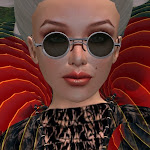
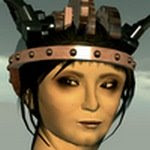
Adolf Svoboda, the valiant pilot of the Search & Rescue Organization of Second Life, half brother of Hardwarehacker Hoch. A quiet country lad, a clean innocent face - however, dressed today in Whitenoise. Trust me, in his everyday existence he is not scary at all... Cinzia Zanzibar, the dark exotic beauty in her dance silks and her nemesis Erdbeermund Schnute, also clad in the very same apparel - and oh what a difference... Falsche Hoffnung, very much the girl next door with her cute little freckled nose. Somehow it seems to me that the dance silks do not look quite right on her... Schwanzlurch Salamander, in all of his Whitenose regalia... Hegemon Maximus, an elderly sage whose passion and mission are one and the same: Cardboard... Inworld Zapatero, who has spent an entire autumn hanging out outside his little hut in the sun, on his tiny island... His brother (?) Inworld Placebo, on whom I cannot say much, having only become aware of his existence quite recently. The same of which would also apply to Hirnhaut Suppenkraut, although Cosima Snook I do know. I even took her shopping once a long time ago...
Cinzia Zanzibar
Schwanzlurch Salamander
Avatar art: I do believe I want to coin a phrase here. This is avatar art. The virtual instantiation of the splitting of the human self into many many selves. The acknowledgment of the many facets residing within our labyrinthine psyche. And giving them all their day in the sun. How did Hardwarehacker phrase it again? "Our human operator is a spiritual machine which should be set on sedatives to derive more freedom in our schizophrenic relationship". Playing ourselves against ourselves. MosMax Hax is an undoubted master of the craft.
They all love to fly helis. Every last man, woman, child and furry...
This fluid space is not just there to amaze you in its intricacy. It is a complex theater building housing a complex drama - the one of the "many selves". And if there is a riddle here, for me it is not one of technology. I am not concerned with how this was built. And you know what? I am not even so wrapped up in how beautiful it is. And yes! It is, in fact, very beautiful this space. The sense of depth and breadth alone... But ultimately, when the chips are down, there are oh so many breathtakingly beautiful constructs to be seen in our virtual world here. So, the riddle for me is the transmission of a psychological state into actuality: The creation of identities out of the one identity. Creating a fluid, wide, deep, transparent and yet opaque stage whereon these identities can find a suitable platform of expression. One which is capable of doing the entire convoluted drama justice. And then the acknowledgment of the male and the female; the beautiful and the trashy; the timid and the adventurous and the elderly and the lazy - all present and accounted for in this entourage of persona conglomerating around the one central figure of MosMax Hax.
MosMax Hax is not a man of many words. I have written this text based solely upon what I have learned about him through my close association with him, with its many ups and downs, in its good days and not so good ones over the past (almost) two years. So, whatever errors of judgment there may be, they are all flights of my imaginative fancy and in no way attributable to him.
...
So, is this a "finished" work? Signed, sealed and delivered to it's audience in its neat little box with a neat little label? I's dotted and T's crossed? All explanations in place? No, most definitely not. Instead it is v.01 of an evolving, emergent artistic process wherein MosMax Hax explores and then projects the workings of the many facets that make up his (non)holistic "human" self. A lifetime's occupation it would seem to me.
I would urge you to visit the skies of Ouvroir by teleporting directly from here to see this "work in progress". There you will find the "stage" all set for the performance of the opera of the "Trivial Mechanisms". And, you will be more than likely to encounter some of the actors of this drama while you are there as well. If they are not all out and about wandering the grid that is...
If however, you make a point of going to Ouvroir at the hours below, over the next 3 days, you will be able to encounter the cast in full bloom, all together, performing for you:
6.feb 2009 1pm SLTime (Opening)
7.feb 2009 1pm SLTime
8.feb 2009 1pm SLTime
...
You can also view more and larger sized images on Flickr here.
...
Update on ARENA, Uqbar: OK folks, here is the story: Although MosMax was added to the Arena Artists group, in order to be able to rez the theater at Uqbar, when he attempted to do so yesterday morning, he found that he did not have the necessary permissions. His designated location did not give his group status rez rights, in other words.
He has been trying to contact the administrators at Uqbar, to fix the problem since yesterday morning however to this hour has been unable to do so, either in-world or through email.
Thankfully the original location at Ouvroir is up and running and thus the opening will be held there today at 1PM SLT, instead of at Uqbar. When the rez problem at Uqbar eventually gets addressed, you will be updated on whether the theater will in fact also get rezed there in the days to come or not.
;-)
Friday, February 6, 2009
Whitetrash plays Whitenoise, Opera 1 Automatica of the Trivial Mechanisms

Friday, December 12, 2008
Exhibiting Art in Virtual Spaces
Posted by Alpha Auer, with a very big thank you to the curator of Avatrait, Stephen Venkman who alerted us to the opening of Avatrait Island.
The new island of Avatrait was launched back at the end of November, so I am somewhat late in posting this piece. However, I wanted to give the matter some thought prior to doing so. I also co-authored a paper for an academic conference on virtual architecture in the interim, and that too has made me hold off and gather all of my thoughts on the subject. I also have to add a disclaimer here and state that I am not an architect but an artist/designer/Second Life® builder, so all of what I write on the subject is based upon mere gut instinct and a general knowledge of architectural concerns as far as they touch upon the basic design considerations common to all visual art and design practices.

What I saw at Avatrait is extremely well conceived, well designed, meticulously modeled and textured; tasteful, functional, user friendly Real Life architecture, which in many ways reminded me of the work of Eero Saarinen (particularly the convex white pavilion shown above), who is possibly my favorite architect of the 20th century. Thus, likening architectural output to Saarinen's is not a compliment I pay lightly and here I do so. Indeed I cannot find fault with the work and were these buildings to be found anywhere in Real Life they would doubtless be the pride of whichever municipality it was that they were constructed in. In fact so pristine are they, that they gave me a strong sense of being in a walkthrough presentation modeled in AutoCad, which a high caliber architectural firm had prepared for a high budget, high maintenance client. So the architects Corbett Howard and Prad Prathivi have done the project proud in many ways.
Then, why am I not completely won over? I believe the answer is already concealed in the word "Real Life" stated twice in the paragraph above. The fact that the structures are rezzed upon huge flipped sculpty rock cones may be an attempt at taking into account the affordances of the virtual, but it is not enough: I am of the tendency to believe that what constitutes the manifestation of the "virtual" in architecture has more to do with imagination than material. Thus, the sculpty rocks may not be possible in Real Life as such, however I suspect that the intention behind them is. While the peripheral pavilions have been rezed by Corbett Howard, the spheroid main exhibition hall is a build by Prad Prathivi - and it is particularly this central edifice that for me is problematic in terms of its virtual attributes. But all in all, none of these buildings seem to leave much to the imagination, do not carry concealed surprises, nothing about them is unexpected. They are very much what they are: Beautiful and functional constructs; built out of brick, mortar and marble, rezzed upon a mini archipelago of islets. The fact that the islands themselves are floating rocks is then neither here nor there.
...
Ouvroir, the Second Life annex of the Gestaltungsmuseum Zurich, dedicated to the work of Chris Marker, was built by MosMax Hax in the spring of 2008. Avatrait island has propelled me towards a comparative examination between Ouvroir and Avatrait: It is not only the fact that both sims are dedicated to the display of (predominantly 2 dimensional) art work or that at both places the central constructs are spherical, which are leading me to this comparison. Indeed it is not the similarities but the differences that seem to me to be decisive here: While Ouvroir is every bit as well conceived, well designed and well built as Avatrait Island (much to his credit Mr. Hax has refrained from using Real Life building textures, thereby greatly heightening the virtual "feel" of the construct); the huge addition that the artist/architect has managed to bring into his work at Ouvroir is the usage of the imaginative element as a design component, particularly in the navigation system of the building. 
While at Avatrait you walk up and down highly predictable staircases complete with banisters around the stairwell, at Ouvroir your only way of seeing the exhibit, which is spread out over a number of floors is by "falling down" to the next level through the designated phantom segments marked out in a semi transparent red. And to come back to the banisters at Avatrait: Why? Are the directors of Avatrait concerned about falling avatars creating liability issues? Health and safety regulations? Really, why?
While at Avatrait all that is there to see is plainly visible almost at first sight, Ouvroir is concealed, revealing itself bit by bit to its visitors. While Avatrait is complete as it is (I cannot for the life of me imagine how a single prim could be rezzed next to what is already there without becoming a major disruption of the whole system); Ouvroir allows for emergence and indeed seems to steadily be growing through the interventions of the members of its group who are continuously rezzing additions to the sim. And such is the mastery of the core red sphere which houses the actual Chris Marker collection at Ouvroir, that every addition seems to fit in, seems to be able to weave its way into the overall design tapestry. In short, while Avatrait is an endeavor to be admired respectfully and from a distance, Ouvroir invites you to be imaginative, to become involved and to play. Both are 3D, you can walk into both of them to an equal degree, but in a very bizarre kind of way Ouvroir is immersive while Avatrait remains aloof.
Keystone Bouchard needs to be taken very much to heart when he states that "architectural fabric created is still largely driven by very literal parallels to the physical world. This happens for good reason, as we have learned to visually organize the world around us, real or virtual, based on familiar cues and patterns. A roof may not need to protect us from the elements in virtual space, but it organizes a space. Even though you can fly, a ramp is still a strong way finding mechanism. While we import these visual cues from physical reality with good cause, I think we also need to consider the native, inherent characteristics of this environment and build a new language of virtual architecture based on those characteristics". Bouchard, is of course, referring to the dynamic element in virtual architecture in this text, to what he continues in the next line to describe as "virtual architecture has the capacity to become far more dynamic; behaving more like a liquid than a static and passive artifact".
I am going to do something quite improper here and use this quote out of the original context in which Bouchard has intended it. In other words, I will make it suit my own needs. Does a building need to be coded and dynamic to become virtual? Or is it more the underlying intention of usage, the very spirit in which it has been conceived of that really makes the difference between what is possible and not possible in Real Life? 
Emergent interventions at Ouvroir: This infovis-like structure featuring a selection of photographs by Chris Marker was rezed in close proximity to the red sphere by Ouvroir group member Lucien Bookmite. Photograph courtesy of Barbara Binder.
Both buildings make usage of Real Life architectural metaphor, such as floors and ceilings and ramps, for the purposes of way finding. And as a construct Ouvroir is as static as Avatrait is. And yet as far as I can see, there is a huge difference and to me that difference lies in the ultimate approach of the architect, the spirit in which the whole enterprise has been undertaken: The one that emphasizes imagination and play over realism. Involvement over spectatorship. Intervention over consumption. Making a noteworthy immersive virtual experience out of Ouvroir and a beautiful receptacle for art work out of Avatrait Island. Thus, to each his due...
You can teleport to Avatrait Island from here, and to Ouvroir from here. You can see a collection of larger sized photographs of Ouvroir here and Avatrait Island here.