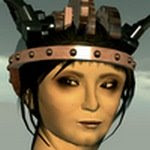
Cao Fei (aka China Tracy in Second Life) is one of six finalists for the 2010 Hugo Boss award. The $100,000 prize is presented every other year to “the artist (or group of artists) working in any medium, anywhere in the world” for making the most important contribution to contemporary art.
In Second Life, we know her as the artist who conceived and produced the four sim/islands work collectively known as RMB City, and also for her 3-part i.Mirror machinima, a documentary shot in Second Life and presented at the 52nd Venice Biennale 2007.
This is a second blogpost in a two-part series we are publishing today. The first, "Wherein I finally love Cao Fei's RMB City," can be found here. 
These days, it is almost impossible to pick up an art journal, read an art blog, or watch a TV documentary on the arts without hearing about Cao's Second Life persona, China Tracy, the pig-tailed avatar that looks to be a cross between a medieval dragon slayer and a space-age bot girl. This global fawning is not without merit. As PBS' Art:21 points out in its recent episode Fantasy and Contemporary Art, Cao "reflects the fluidity of a world in which cultures have mixed and diverged in rapid evolution. Her video installations and new media works explore perception and reality in places as diverse as a Chinese factory and the virtual world of Second Life."
Now that I've confessed (in the preceding blogpost) that I'm late to the China Tracy fan club, I can also say that I've been making up for lost time by learning considerably more about the artist. Soon after my epiphany and subsequent appreciation of RMB City, I sent Cao nine questions, and I didn't pull any punches, either.
B. Tizzy: 如果让你说出你事业中最关键的时刻,它对你选择从事现在的工作起过至关重要的作用,你觉得是什么时候?为什么?
If you were to identify the most pivotal moment in your career; that moment that most shaped what you are doing now, what would it be and why?
Cao Fei: 我创作的发展旅程是一个自然发展和逐渐过渡变化的过程,没有突然的转折点,没有什么重大时刻,它是一个循序渐进的、对这个世界、包括自己的人生的一个慢慢堆积、感悟、理解的过程。
My work has developed along a natural and gradual trajectory. There haven't been any sudden turning points or significant moments. It's been a gradual progression and a process of accumulation, inspiration and understanding of the world, including my own life.
Shot entirely in-world at RMB City, this video is by Lainy Voom, with writing by Wagner James Au (aka Hamlet Au)
B. Tizzy: 你所从事的工作是从什么时候开始有全球性视野的?你是有意决定这样做的吗?
At what point did your work take on a global aspect, and was it a conscious decision?
Cao Fei: 生活在今天的中国,每个个体都不能避免被卷入这全球化的运动,都不能对我们身边的激烈变迁视而不见,我只是在用自己的方式记录、表达我对身边这些变化的深切感受。这是个身不由己的时代,时代会迫使你作出一定回应。
No living being in contemporary China can avoid globalization or turn a blind eye to its acute changes. I am merely using my own method to document and express my honest feelings with regards to the changes that surround me. 


B. Tizzy: 你是使用什么软件建立起了第一个人民城寨••••••是我们一开始在Youtube见到的那个吗?你是先做好了它然后才发现第二人生的,还是你那时就已经是虚拟世界居民了?
What software did you use to create the first RMB City... the one we first saw on Youtube? Did you make it first and then discover Second Life, or had you already become a virtual world resident?
Cao Fei: 我是在2007年1月成为虚拟世界居民,然后用了半年时间在虚拟世界旅行,拍摄了i.Mirror,紧接着,就有了建造人民城寨的构想,并开始用3D Max软件把城市基本构想勾勒出来,也就是后来你们在youtube看到的video: RMB City Planning (2007)。
I became a virtual world resident in January 2007. Then I spent half a year traveling in the virtual world and filming i.Mirror. Soon after, I had the idea of building RMB City and started building the basic blueprint with 3ds Max software. The result is the youtube video which you have seen: RMB City Planning (2007).
RMB City on Cao Fei's computer
RMB City in Second Life
B. Tizzy: 人民城寨备受现实世界艺术评论家以及博物馆和媒体的推崇,但却未得到第二人生居民的充分赏识。我们是应该解决这个问题,还是转向只针对现实世界(Real World)来做这个项目?
RMB City is acclaimed by Real World art critics, museum and media, but under-appreciated by Second Life residents. Does that matter moving forward, or was this project intended for Real Life?
Cao Fei: 我想,这是个悖论,我们总是很难做到周全而完美。要得到更多第二人生居民的赏识,我还需要做很多我不胜任的工作,如如何竭力保持社团的黏性,如何不断组织虚拟居民喜闻乐见的活动,如何发展会员等等。人民城寨项目是一个艺术项目,它具有在当代文化概念上的指涉,以及在这个框架下的实验价值,它不一定要具有虚拟社会内的普罗大众的功能,而做一个在虚拟社会里很pop的地点也不是我的初衷,我更原意把它当作一个超越对固定理解之外的“现场”,不刻意针对现实世界或虚拟社群,甚至忘记其的虚拟特性和现实依据,它是一个模糊的、开放的、不被彰显定义的地带,一切事物都可被卷入而最终不再成为他们的原本。而它作为一个具有沟通现实世界特性的项目,迂回在两个世界之间,这也可能是其他虚拟城市/项目所缺乏的。
I think this is a paradox. It's always difficult to create a perfect thing. To win the appreciation of more Second Life residents, I would have to do a lot of work that I am incapable of doing, such as maintaining a tight-knit community, organizing regular activities that interest Second Life residents, develop membership, and so forth. RMB City is an art project and contains references to contemporary cultural concepts. Given the experimental framework, it doesn't have to serve the proletarian function of virtual societies.
Furthermore, it was not my intent to create a very pop place within the virtual world. I would rather treat it as a "site" that transcends fixed interpretations. I don't purposely address the real world or virtual groups and even forget its virtual characteristics and foundation in reality. It is an ambiguous, open zone that eludes definition. Things get pulled in and may never revert to their original form again. This project channels real world characteristics and rests outside of two worlds, something that perhaps other virtual cities/projects lack.
B. Tizzy: 人民城寨被认为是具有讽刺意味符号集合的典型。事实如此吗?还是你有别的看法?
RMB City is typically described as a satirical collection of icons. Is that what it is or is there something else?
Cao Fei: 除了讽刺,还有赞美,甚至歌颂,但这都不是它的全部。它还有失落、忧郁,以及回忆和怀旧。作为一个文化意义上的“空间”,它具有研究、讨论、实验、实践的特性。作为一个心灵景观,它无时无刻都在上演流动的戏剧。作为一个折射当代中国的镜像,它有着后现代的狂欢和梦呓,同时有着反省与自悟。当然也有包括其他城市都共同具有的特性 ——“虚空”。
There is satire, but also praise and even admiration. But this does not describe it in its entirety. There is also loss, melancholy, memory and nostalgia. As a cultural "space," it lends itself to research, discussion, experimentation and realization. As a spiritual site, it is a constant, ongoing drama. As a reflection of contemporary China, it has the revelry and balderdash of postmodernism. At the same time, it is introspective and self-perceptive. Of course it also includes the one trait that all cities have – “emptiness.”
B. Tizzy: 飞机撞上大楼的景象让美国人见了就火冒三丈,什么促使你把它带进了人民城寨?
The image of a plane flying into buildings is nauseating for Americans. What compelled you to introduce that to RMB City?
Cao Fei: 我想这个问题所表现出来的先入为主是文化差异的表现,或者是差异所导致的联想。我们城市里的飞机不是撞上大楼,而是卡在密集的建筑之间,中国急剧的城市化导致建筑密度大幅增加,不断外扩的CBD淹没我们的天际线,逐渐的,我们只能在楼宇和城中村的缝隙间看到飞机越过天空,而在RMB City,飞机一旦掠过城市,就再也飞不出去了,永远地卡在这个溢出的都市中。
I think immediately of cultural differences, or rather the associations that form as a result of difference. The planes in our city do not crash into buildings; they are caught between densely concentrated architecture. China's rapid urbanization has resulted in a building boom. The constantly expanding CBD has submerged our skyline. Eventually, we will only be able to see planes from inside buildings or gaps within the city. When a plane flies over RMB City, it can never leave, and is forever trapped inside the overflowing city.
B. Tizzy: 人民城寨有什么需要发掘的秘密吗?有什么是第二人生居民不能理解,或是觉得不值得关注的?
Are there any secrets that need discovering at RMB City? What haven't Second Life residents understood or picked out that is noteworthy?
Cao Fei: 人民城寨从来没有什么秘密,也没有什么需要去发掘的,去慢慢体味它可能更适合,或者你尝试放弃飞翔去徒步漫游,再或者飞到城市之颠或无限接近城市的边缘。喜欢一个城市与否,和你喜欢某本书一样,有人喜欢畅销书,有人喜欢冷门的诗歌集,大部分人喜欢流行乐,还是有人喜欢偏门的噪音,这就是趣味和选择,我们很高兴人民城寨能成为另外一种选择或者众选择之一。欢迎大家,也许,有一天你会爱上它,或者短短的一次性旅程能让你记忆深刻,以至于它在某天突然消失了你恍然间感到隐隐不舍。
RMB City has never had any secrets or things waiting to be unearthed. It's probably more appropriate to slowly experience it yourself; you can give up flying and walk around or fly to a high point in the city or one of the countless peripheral points on the outskirts. Whether or not you like a city, is the same as whether or not you like a book. Some people like best-sellers and some prefer obscure chapbooks; most people like pop music, but still some prefer experimental sound This has to do with preference and choice. We are very happy that RMB City can be an option or one of many options.
B. Tizzy: 请再给我们介绍一些关于人民城寨新古根海姆大楼的情况。
Tell us more about the new Guggenheim building at RMB City. 
Cao Fei: I have been invited by the Guggenheim Museum to participate in the 2010 exhibit: “Contemplating the Void: Interventions in the Guggenheim Museum Rotunda” for the museum's 50th anniversary. The Guggenheim invited approximately 250 artists, architects and designers to imagine their dream intervention in Frank Lloyd Wright’s rotunda.
Therefore, I built a virtual Guggenheim that can transform into an "ox horn." I chose an ox horn because of an ancient Buddhist story. Second Life is an intangible non-physical space that has its conceptual foundations rooted in the virtual dimension. As such, our perception and comprehension of this space is largely reliant on visuals and psychological impact. Within Second Life's RMB City, the Guggenheim Museum is transformed into an ox horn floating in the city's sky, like a manifestation of the notion of "nothingness" as depicted in the story of Milarepa Thera and the horn, and the parallel relationships that the virtual and real worlds possess towards "nothingness." On some level, it is also akin to the idea of inherent harmony amongst disparate entities within Buddhist cosmology.
Director: Cao Fei (SL: China Tracy)
Concept/Script: Huang He (SL: QueenShoe Voom)
Translation: Venus Lau (SL: Nokan Vlodovic)
Project Manager: Samantha Culp (SL: Miniature Tigerpaw)
Project Coordinator: Mengxian Li (SL: Ume Freiman)
Engineer of Fengshui Project: Sinewave
Camera / Editing: Avatrian
Co-produced by Kaaitheater, Festival PERFORMATIK 09, Brussels, Belgium
B. Tizzy: 放眼未来,你对未来人民城寨合作在艺术以及艺术家发面有什么期望?
Moving forward, what are you looking for in art and artists for future RMB City collaborations?
Cao Fei: 人民城寨它是一个持续时间为两年的艺术项目,接下来还有1年的时间就要结束了。人民城寨是一个用来运转的作品,它不仅仅是用来看和游览的,它鼓励和邀请人们参与,对系统建设性地提出问题与假设,并向更开放的方向发展。称之为:行动的,自由的,系统之间的。
RMB City is a two-year project. There is one more year before it ends. RMB City is a revolving piece and not just for viewing or visiting. We encourage and invite people to participate and raise questions and hypotheses about the system structure so we can develop a more open(ly and) in an even more open direction. It should be considered: moving, free, seamless between systems.
Many thanks to Philana Woo for making this interview possible with her English to Chinese/Chinese to English translations, and to Honora Shea of Vitamin Creative Space for making the arrangements. I also especially want to thank Cao Fei for graciously agreeing to this interview at a time when she is busy caring for her baby son Cowboy Lim, born in March of this year, in addition to working on her many projects within and outside of Second Life.
Friday, October 23, 2009
An interview in Chinese and English with virtual superstar Cao Fei - Will you be the next artist showing at RMB City?

Sunday, October 11, 2009
NPIRL Fashion: Cutea Benelli's Okeanos maritime gown
Swim with the fishes...

Get yours by teleporting to Grim Bros. directly from here.
See also:
Tuesday, August 25, 2009
Get your steampunk on
Posted by Bettina Tizzy
Nix Sands describes himself as a neo-Victorian, a humble tailor, tinkerer and occasional adventurer, but that representation seems quite muted when one comes across this outrageously good freebie at his shop, Xcentricity: Victorian Steampunk Clothing for Rakish Gents & Reckless Ladies. 

Photos courtesy of Nix Sands
You can pick up your own gloriously free copy of the Monstro hat by teleporting to Xcentricity directly from here.
Then Cutea Benelli, co-creator of Bogon Flux, one of the most imaginative builds in Second Life®, as well as Epsilon's Fabulous Eyestem Thingy, and hundreds of the most delightful cyberpunk fashions and avatars, has insured that future steampunk fashionistas needn't compromise personal sophistication and elegance when it comes to adorning their avatar's feet.

The Vapour Vanity luxury steampunk heels are available in a zillion colors and metals but all feature a "mini-chimney" emitting tiny clouds of steam.
Teleport directly to Cutea's main store, Grim Bros. from here.
Sunday, August 9, 2009
Truthseeker Young and "Voices: Orion's Arm"
Posted by Alpha Auer
...

...
Yes, that's it folks! Absolutely no need for any further pontifications from yours truly on this newest one by Truthseeker Young. Teleport directly from here.
:-)
Saturday, August 1, 2009
The impact of Selavy Oh
Posted by Alpha Auer
By way of an introduction
Anyone who has had the patience to read what I write about will have noticed that I have a few bees in my bonnet to which I keep returning over and over again. One is avatars and identity creation; the other one is the creation of cohesive visual systems over standalone objects/or conversely the presence of a strong system within the standalone object; and the third one is narrative. Now, it is here with this third one that I tend to get into the biggest trouble in that more often than not I end up getting vastly misunderstood: It is inevitably assumed from my lamentably unclear delivery that I am talking about tangible stories with a beginning, a middle and an end - things that are decipherable, that can be conveyed in the spoken language just as well, if not indeed much better, than a visual manifestation. Nothing could be further than the truth - and it is entirely my mistake in that I have really not been at all clear about just what it is exactly that I mean to convey when I say "narrative".
For starters I should probably be using "visual narrative", rather than just "narrative" which does, after all, mean "story". But in any case, here is a quote from Marcel Duchamp, talking about "humor", which does come very close to what I want to convey when I say "narrative" in my hitherto fumbled manner of expression (please note the bold text):
"A great power; humor was a sort of savior so to speak because, before, art was such a serious thing, so pontifical that I was very happy when I discovered that I could introduce humor into it. And that was truly a period of discovery. The discovery of humor was liberation. And not humor in the sense "humorist" of humor, but "humor" humoristic of humor. Humor is something much more profound and more serious and more difficult to define. It's not only about laughing. There's a humor that is black humor which doesn't inspire laughter and which doesn't please at all. Which is a thing in itself, which is a new feeling so to speak, which follows from all sorts of things that we can't analyze with words... ...A large amount of rebellion, a large amount of derision toward the serious word... ...And it's only because of humor that you can leave, that you can free yourself".
And here is yet another quote, this one supplied by Soror Nishi, during a conversation we had going on her blog a while back: "a long, immense and deliberate derangement of the senses" - already suggesting narrative in that in it is embedded the very notion of temporality and process.
So, for me (amongst much else) visual narrative, i.e., the construction of a visual language is primarily a vastly complex set of maybe half verbal and very possibly even entirely non-verbal elements which conglomerate to form "a thing"; a temporality, a process, a visuality in which things are implied, half implied and yes, maybe even not even implied at all. A dark process involving metaphor over description, enigma over clarity. A thing whereby the individual components converge to create a whole larger than the sum total of its parts - a Gestalt.
And no, in no way does visual narrative have to involve recognizable objects, things which are realistic or are endowed with realistic references at least. My own work is of such a kind that a power plant does in fact look like a power plant (well, sort of anyway...) and a gym like a gym (regardless of whether the exercise stations may be placed on steam pipes). It does not mean that this is the type of work which I prefer, which I take to be the sole carrier of the potential of visual narrative. The starkest abstraction can be a powerful conveyor of what I consider to be visual narrative. If anything, indeed probably much more so, since precisely in the very abstraction lies a vast potential for the conveyance of metaphor, of enigma, of process - of the telling of the story that really has no words whereby it can be told...
Which would, of course, bring me to Selavy Oh; an artist whose work I have loved from the very moment in which I set eyes on it.
...
The creation of an identity
I had already assumed that Selavy Oh's choice of name was not a random event, but was closely associated with the famous alter-identity of Marcel Duchamp, Rrose Selavy. And so indeed, the urge to find answers to questions such as "would it be possible to create an identity out of nothing", what exactly "would be needed to create an identity that is separate from your own", and very importantly whether you "would need a history" were what led the human behind the avatar, who incidentally is a computational neuroscientist in Real Life, to the creation of Selavy Oh, whereby a contextual, if not historical, reference to not only Duchamp but to the whole idea of "alter-ego" seems to be implied.
"Impact" and the power of abstraction
The metaverse is teeming with so-called art objects which are meant to interact with the avatar. What is usually meant by that is that something completely ineffectual occurs as I approach or touch the object in question. I say "oh" and move on. I have not changed, nothing fundamental has occurred to me which has brought on "a long, immense and deliberate derangement of the senses". And not only the metaverse obviously: The whole web is a dump site of "interactive" art installations. Very few resonate with me in any kind of meaningful and profound way, they simply do not interact with me, my inner being... 
The Giant Arc, Photograph courtesy of Selavy Oh
So, how is Selavy Oh's work, the kind which does interact with the avatar, different? The keyword here, I believe, would be impact! This is, of course, yet another word hard to pin down into a description in that it could be constituted of different attributes in different cases. In Selavy Oh’s case, at least one of these attributes is scale. So magnificent, so vast, so sublimely endless and yes - ultimately so visually satisfying in its amazingly cohesive system is the huge arc which stretches itself over the virtual sky above the Museum of Hyperformalism (teleport directly from here), and which begins its unutterably sad and yet graceful disintegration and demise upon my touch; that as I watch spellbound, something is in fact changing in me...
...


I am slowly demolishing the cubes...
So absorbing in its complexity, the complementarities of the contrast between the hard edges of the cubes and their soft descent upon my collision, are the nested cubes, which Selavy Oh rezzed for me, thanks to the generous hospitality of Mab MacMoragh, that I spent an entire afternoon and early evening slowly demolishing them.(I am indeed very proud to be able to proclaim that apparently I am the second avatar in metaverse history to have completely done so, the first one being Wizard Gynoid). 
My reward? The magic of having them restructure themselves in a choreography, the enigmatic beauty of which would be very hard to describe in mere words. That is the impact of the abstraction of minimalism when it transcends the ordinary and moves into the realm of the resplendent: You cannot describe it, what it does to you, what it means to you or even how it looks. It is completely intangible and therein lies its huge power. And yes, I dare to say it, again: its ultimate power of narrative - as I define it in "a long, immense and deliberate derangement of the senses"...
...
But does "something" really need to do "something" before it becomes truly "interactive"? The third piece of Selavy Oh's that I wish to talk about after the sky arc and the nested cubes is static: Formes Nocturnes, now no longer in existence - alas. Nothing moves - or at least it did not while I was there. A torrent of bits which has become frozen in a tempest, reminding me of Goethe's famous words that "architecture is frozen music". Interaction is not pushing a button. Or bumping into an object which then goes "squeak" or whatever. Interaction happens in the mind: Something or someone evokes a change in me - interaction has happened.

Formes Nocturnes. Photographs courtesy of Selavy Oh
And with Formes Nocturnes and Goethe's statement I come back full circle to Duchamp, and his pre-occupation with frozen time and space: The strong connection which I felt that the island had to Duchamp's glass painting "The Bride Stripped Bare By Her Bachelors, Even". I was gratified to hear that my instinct was not unfounded, that there had indeed been this connection in Selavy Oh's mind as well. A connection with the temporal fragility of the "Bride" and with happenstance and chance (apparently the glass broke during transportation), as well as the shared obsession that the artist has with Duchamp: "Dureé", temporality and space, reflected throughout the extraordinary output of Selavy Oh.
…
I have been wondering how to end this post and what I think I will do is refer back to an email conversation which Selavy Oh and I have been intermittently conducting over the past week or so, concerning wherein might lie the difference between the creation of cohesive visual systems and visual narrative. One would almost be tempted to say that the difference between a cohesive visual system and visual narrative is a matter of degree. However, ultimately, I suppose the difference lies in the temporal element given that “static” visual work can have a temporal connection/element, be endowed with an attribute of temporality even though it captures only a single instance in time. A cohesive visual system need not necessarily have embedded into the notion of the 4th dimension, whereas visual narrative would. So, in the end, in a way, it is still a matter of degree, I suppose: The output of creative activity (and I would dare to suggest that this would involve the output of all creative activity, regardless of whether it is text, sound, visual or indeed scientific data) relies on the engenderment of systems to come to their full fruition. While textual and audio systems inherently carry the element of temporality, when it comes to static visual systems there would seem to be a distinction, they need not inherently possess this dimension: It is whenever we find that the 4th dimension has been evoked within a static visual system that we can begin to talk about “visual narrative” having begun its magical process. The process of the art of Selavy Oh.
…
Selavy Oh’s Flickr stream from which I have borrowed some of the photos of this post can be viewed here. You can teleport to the giant arc at the Museum of Hyperformalism from here.
Thursday, July 23, 2009
What *has* Nomasha Syaka been up to?
Posted by Bettina Tizzy
When it comes to virtual creations, I'm a snoopy gumshoe. I want to know what everyone's making, and especially a handful of people I keep track of at all times. For the past year I've been pinging "Anything new, Nom?" now and then, and not getting a straight answer. Just invoking the guy's name here with some news makes me happy, for Nomasha Syaka (rez: 9/13/2006) is the British creator of the poetic sculpted Icarus that I often rez at my own Chakryn, as well as the wacky blender where I take folks when we're up for a giggle. His in-world group I use my nose to type is worth joining for the name alone. He is also renown for his electric guitars, sculpted tigers and wolves, among other animals, but he has been suspiciously quiet for a long, long time.
So an IM from the owner of Blackwater Gallery Jurin Juran to say that she was dancing, and why, had the effect of a bottle of vintage champagne. It turns out that he has been making motion capture animations. Like a hundred of them! Fluid, fun, funny and lots of the oolala variety.
The first and most vital necessity was to dance... and obviously to speak with Nomasha.
Nomasha's sim, re-purposed and lovely
So... what have you been up to for the past year?
Nomasha Syaka: Getting these animations ready – they are very difficult to make and process. I made it my mission to produce better animations and I think for the greater part, I have. Most of the feedback I have received so far suggests this and I have been as obsessive about it as I was about making art objects in SL.
Did you have experience with mocap before?
Nomasha Syaka: None at all, nor with animation generally. Self taught. Though I use someone to process the data once it is recorded and he is a real expert.
How did you recruit your dancers? Did you dance, too?
Nomasha Syaka: Lol, my dancing would qualify for NPIRL. No, I use professional dancers always, recruited from London dance agencies.
Fruits and noobs and bears and all sorts of things zoom by and over the animation stands
How do you make mocap animations?
Nomasha Syaka: The dancer wears a special suit and multiple cameras record the dancer’s movement. These calculations are then transferred onto a computer character and a lot of processing has to be done by hand to ‘clean’ the information and make them suitable for Second Life®. The SL avatar skeleton is a freak, so you have to make a lot of adjustments for it.
You were among the first creators to provide Second Life's musicians with beautifully crafted guitars. Do you have music in your background? (There are over a dozen fabulous animations for guitar players, by the way). Why guitars?
Nomasha Syaka: No music background, at all. I learned the violin as a child for a couple of weeks, and then the teacher disappeared and was never seen again by anyone. Later on I learned the flute, but then the school's music building caught fire and burnt to the ground. Not a good history with music. I made the first guitar because I knew it would be difficult, as no one had made any decent ones at all.
I was relieved to discover that you've rezzed the Blender on the revamped sim. I would have been miserable if it had vanished.
Nomasha Syaka: My favorite build... never been sold.
Nomasha makes it possible for you to dance moving over and around a white tiger, via four different animations
Lions and tigers and bears, oh my! Are all your interests coming together with this new venture? Music, tigers, art, and now...
Nomasha Syaka: Time for some more sculptures, I hope!
Will there be a NPIRL category of dances?
Nomasha Syaka: When I record myself dancing – for sure.
You can teleport to Nomasha's Ministry of Motion from here.
Monday, July 6, 2009
My happy place in Second Life - And a fab new Windlight preset by Mescaline
Posted by Bettina Tizzy
Created by Blotto Epsilon and Cutea Benelli, the Bogon Flux (and the new couch for big asses!) - currently at East of Odyssey - is where I go when I want to be happy. I whiled away a very pleasant hour yesterday in Blotto's company and came away with a grin on my face. It's like a vacation in Second Life®. 
This gone-bonkers Steampunk structure builds upon itself and then sheds parts or all but its base to begin anew. Pipes and doorways (many of them open with a touch) make it possible to navigate from one section to another until, that is, it decides to cut you loose. 
There are lots of new modules on the Flux
Teleport directly from here, and by all means turn on your music stream. 
Oh, how happy I would be to have such a couch in Real Life!
These photographs were taken using Mescaline Tammas' appropriately named Sunday Windlight preset.
Mescaline has a new preset, too! The Bristol...
Says Mescaline: (I shot this) "Short film to demonstrate a new Windlight Setting 'Bristol.' Edelwiess reminds me of Bristol which reminds me of Banksy and Massive Attack. This preset is made having 'lived' in shadows for a while, more ambient light than previous settings. Film has no post processing, just cut. Shot in Kirstenlee Cinquetti's S17."
See also:
Strange and Fantastic Buildings (in Real Life)
Posted by Bettina Tizzy
I can't recall ever just linking to another site as the centerpiece for a blogpost, but here you go. Totally worth a visit: 80 Strange and Fantastic Buildings Architecture. Hopefully this will inspire a few more unusual buildings in virtual worlds.
12:18 pm UPDATE: And here are 50 more unusual buildings!
Saturday, July 4, 2009
Groundbreaking, literally - Faith in Selavy Oh
Posted by Bettina Tizzy
And they said you couldn't move mountains... Oh ye of little faith!
Physics and now Land artist Selavy Oh has created a script that operates the terraforming capabilities in Second Life®, resulting in the continuous and automated reshaping of land, even without her presence.
To my knowledge, this is without precedent.
That's me filming in the center of the mountain peaks. Selavy was not even in-world for that portion of the taping!
Filming and editing: Bettina Tizzy
Music: "Truth of the Legend" by Kevin MacLeod
Terraforming, the ability to intentionally transform surface topography, atmosphere, temperature or ecology, is not unique to science fiction or even science (where it is primarily called planetary engineering).
In his book, The Making of Second Life, Hamlet Au (aka Wagner James Au), explained the in-world terraforming process quite poetically: "Standing on a hill like a demi-urge, a Resident can wave her hand and cause the ground to swell, expand, or even collapse into the sea."
In Second Life, terraforming land is a skill that looks easy to do, but frequently results in unrealistic and poor duplicates of mountains, lakes and canyons.
Selavy, who rezzed in February of 2007, is most widely recognized for her physics work with the most basic of prims: the humble but noble cube. She has expanded her range considerably in the past few months and now works with any number of shapes and even Alpha textures, but physics are always involved. Art historian Amy Wilson once compared Selavy to Rauschenberg, explaining that, "I can’t help but think she’s the Rauschenberg of SL, albeit one whose hands are much, much tidier than his ever were (makes sense for the environment we’re talking about). Navigating in this little space created by artists whose work is pure abstraction (DanCoyote, Juria) and artists whose work specifically references real life (Cheen, Nebulosus), she comes to find some very fertile ground indeed."
Given recent developments with Comet Morigi's terraforming explorations and her anchoring of huge prims to sims - thereby extensively and surprisingly expanding the canvas - and now Selavy's epic work - many of the most exciting innovations in virtual worlds at this time have to do with Land Art so extreme that I can't help but wonder what James Turell and Micheal Heizer would think.
Possibly the closest reference to Dancing Mountains in Real Life might be Heizer's 1971 Double Negative project in Nevada, for which he removed 240,000 tons of stone to make two slices 30 ft wide by 50 ft deep on opposing sides of an existing canyon to suggest a line between the canyon walls. His focus was on the removal of something, thereby creating a Land Art piece that stressed space, rather than an object. But I have no Real Life reference for land that wiggles, shrinks and grows, with no attending human, in an automated fashion.
Selavy accomplishes this by leaving her scripts with Negative Overland, a bot that is hidden underwater.
Some years ago, I was traveling in the rain forest in the heart of Costa Rica. My traveling companion and I had just sat down to a white tablecloth dinner at a lodge perched a top a mountain less than two miles opposite the Arenal volcano. The volcano was erupting (and still is to this day). Constantly. With a surprisingly loud and deep rumble, the mountain would cough up the fiery lava and rocks, dressing itself in a never-ending kinetic skirt of thick veins in an orangey red.
We struck up a conversation with the couple sitting at the table next to us. They were vulcanologists from Finland and they spoke about volcanoes the way we talk about virtual worlds. The woman shared how she got a kick out of hugging active volcanoes at the base and putting her ear up to them. She swore they sounded like the loudest heartbeat on earth. That certainly had a lasting impression on me.
For some reason, it was the first thing I thought of when Selavy teleported me in to watch a proof-of-concept demo of Dancing Mountains. She has managed to breathe life into the landscape in ways heretofore unimaginable.
~*~
See also:
- Land Art in Second Life: A historical perspective and an introduction to virtual artist Comet Morigi
- The Patron Saints of Poetik
- It's Hip to be Squarish
- Selavy's page on the Odyssey Art Ning
- "Attention Economy" by Beth Harris on smARThistory
- New York Times piece on art in Second Life
Wednesday, July 1, 2009
Visualizing God: A virtual art show
Posted by Bettina Tizzy
In "Human Destiny," Le Comte Du Nouy wrote, "Any effort to visualize God reveals a surprising childishness. We can no more conceive Him than we can conceive an electron. Yet many people do not believe in God simply because they cannot visualize him." In fact, many Christians feel that images dishonor God because he is invisible. "No images drawn from visible things will enrich our worship of him," said Gordon R. Lewis.
Be it God, Yahweh, Adonai, Allah, Lord, Elohim or Baal, every faith has its rules and designations and many won't even utter His name. Most Christians prefer, instead, to focus their paint brushes and chisels on Jesus since the story goes that he became incarnate and walked among us. John of Damascus wrote, "The Son is the image alive, natural and perfectly similar of the invisible God; he carries in himself the Father, and is identical with him in everything, except for this single fact, that he derives from him as from his [primary] cause."
This thinking becomes particularly interesting and gets mightily challenged when sacred images are considered from the Not Possible IRL (in virtual worlds) perspective.
When LogLady Loon - founder of Freak Show - named her newest collective "GodArt: My faith, between sacred and profane," I'm sure she knew what she was doing. The woman is inciting us again to explore, with art, our deepest beliefs, and this after her Pornosophy and Freaks vs Beauty Paranoia shows. She asks, "Tell me what you believe."
Given my ongoing interest in 3D art, which I view as the ultimate expression of what is possible in virtual worlds, and my disinterest in waiting what seems like an eternity for 2D images to render in-world, I'd abstained in the past from getting involved with Freak Show which is overwhelming about photography, but I find the GodArt theme irresistible.
I'd like to encourage land owners to help sponsor the show and provide as many prims as possible, thereby enabling more artists to present their works three-dimensionally.
The deadline to enter is Monday, August 31st, and only one work is allowed per participant. For more information, please refer here.
Tuesday, June 30, 2009
Happy 2nd Birthday, NPIRL!
Posted by Bettina Tizzy
This Saturday, July 4th, after hundreds and hundreds of in-world notices, 700 blogposts (this is the 701st), and thousands of happy hours celebrating great content that would not be possible in Real Life, we will mark the passing of our second year in the metaverse.
If you consider that each human day is the equivalent of 8 days in Second Life® and OpenSim, that would make NPIRL 16 years old. So either we are entering our terrible twos or we are sweet 16. 
This photo by Sugarbloom Cupcakes
So here's a great big thank you to all the passionate and dedicated members of the incredible Not Possible IRL and Impossible IRL groups who made all this... err... possible! We couldn't have done it without you.
Monday, June 29, 2009
Keystone Bouchard, building community with prims
Posted by Bettina Tizzy
If I were to commission the design of a building - whether commercial or residential - I would vastly prefer the opportunity to walk in and around it before brick and mortar were employed, over looking at CAD animations and illustrations, a flat screen, or even a 3D printout. Wouldn't you? It is such an inexpensive step and so basic to our senses (including common sense!). Using virtual worlds to bring blueprints to life is not only possible but a daily reality in Second Life®.
To me, it looks like the body of an acoustic guitar, or maybe a key hole, or perhaps it is a musical note. When I met with him just hours before the Metanomics studio he had created was about to have its public debut, I completely forgot to ask Keystone Bouchard (aka Jon Brouchoud) if he had implemented Feng Shui techniques in the design. My guess is that he did, whether he is aware of it or not. The thing just flows.
Unless you’ve been living under a rock or are very new to Second Life, then you know that the secret sauce over at Metanomics - the talk show that explores the serious uses of virtual worlds – is its community of suits and geeks who are there to mobilize mostly biz and tech ideas through conversation, together with the occasional sprinkling of left brainers, a smattering of educators and hard-core scientists, and a dash of memes. It’s a hale and hearty concoction.
Le Corbusier defined architecture as the “magnificent play of volumes brought together under light”
Keystone and I had been chatting for well over an hour, with just one interruption (he had to step away from the computer to say goodbye to his grandmother who was visiting his Real Life home – a real family man!), when it occurred to him to share with me that he’d been notified minutes before our meeting that his Studio Wikitecture, which he co-founded along with Theory Shaw (aka Ryan Schultz), had just won the Linden Prize: $10,000 USD for developing an “innovative in-world project that improves the way people work, learn and communicate in their daily lives outside of the virtual world.” And that should give you an inkling of the kind of fellow we’re talking about here.
Fast facts about Keystone Bouchard
- Architect, urban planner and artist; Master of Architecture, School of Architecture and Urban Planning, University of Wisconsin, Milwaukee.Co-founder of Crescendo Design, a residential design studio located in Madison, Wisconsin (Real Life)
- Creator of Autodesk Island, the virtual U.S. House of Representatives, Linden Lab’s Virtual Headquarters, a build-out for a TED conference event, and many other edifices and islands. (Second Life)
- Co-founder of Studio Wikitecture, an open group composed of a diverse range of individuals from varying disciplines, interested in exploring the application of an open-source paradigm to the design and production of both real and virtual architecture and urban planning. (Virtual worlds)
Early Keystone Bouchard video, dating back to January 2007
- Founder of the ARCH Network, a community resource for architecture and virtual worlds, including consultation, training, virtual design, BIM/CAD model import, and hosted Virtual Project Spaces.
- He created the Reflexive Architecture installation, where I first discovered and fell head over heels for virtual architecture.


This photo by Keystone Bouchard
Keystone began the design process for the Metanomics building in February, and it had its unveiling on May 6, 2009. Here is the transcript of our conversation just before the opening.
Would you say that this was the most complex project you've taken on?
Keystone Bouchard: It wasn't terribly complicated from a functional perspective, since the intended use of the space was very clear. As far as complexity, I would say the Linden Lab HQ 4-sim project I worked on in 2007 while I was working with Clear Ink was quite a bit more so - given the magnitude of different program elements it had to accommodate, and the functional goals were much more difficult to quantify.
The biggest difference, I think, was in openness. The Linden Lab headquarters had to remain confidential, and it was harder to gain access or feedback from most of the people who would actually be using it, whereas with Metanomics, I was able to more fully engage the community of people who will actually end up using this space. Everyone was invited to stop by at any time and provide feedback. I think the incorporation of that feedback ended up making it a much stronger design than I could have come up with on my own
Who was on the Metanomics team to create this space?
Keystone Bouchard: Discord Schism, Metaverse Engineer, and Dusan Writer were the main collaborators. I was responsible for conceptual design, Dusan designed the set, Metaverse Engineer did all of the landscaping and various detail elements, and Discord Schism built out the event partner hub and other detail elements. Joel Savard was the Project Manager. I also did 99% of the construction on the main building shell and most of the texturing.
What was the plan?
Keystone Bouchard: My brief was to provide an event space for Metanomics that would span 2 regions - the set on one (to help resolve lag issues), and audience on the other, and also to provide space to display additional content - material from past shows - and design for the site to scale over time, with additional buildings to be added later. My goal was to design something that everyone could feel comfortable with, and to invite community wide feedback throughout the design process. We had regular community forums, where we solicited feedback, and presented the design's progress.
One of the things I observed before starting this project was that Metanomics can be as much about the back-chat as it is about the show itself. So many people expressing so many different ideas and opinions, yet, they're all coming together at that moment - around this show. I wanted to design something that was a visual metaphor for the coming together of ideas – the coming together of the community - so, the early conceptual designs were very literal. There were lots of building pieces coming together from all different angles - to create the auditorium.
In the final manifestation, that visual metaphor was represented with structural columns, while earlier on it had been more literal. It became a much more subtle expression, as though there are many individual pieces that are working together. None of them could visually support the structure alone.
How was this experience different from designing in Real Life, other than taking backchats into consideration (although nowadays twitter IS the equivalent of backchat in Real Life)?
Keystone Bouchard: It was much easier to express the idea here. In Real Life - conveying a design is a very abstract experience. You're sharing 2D plans, or sketches, and trying to imagine what it will look like - and trying to help the client imagine what it will be like, so, you're always trying to build a portal into that dimension - and show them that world - like from the outside looking in.
That’s similar to how it went down for DB Bailey (aka David Denton, AIA, in Real Life) and his Egyptian client recently. Once the client saw it in Second Life, it was something palpable. He could walk around it. He had a sense of perspective. In Real Life, the best you can do is create an illustration - which is static - and it is only one view. Animations (via CAD) get closer, but they're time consuming and expensive and still very prescriptive. The viewer has no control, and creating that illustration is an 'event.'
So how does the experience compare directly with CAD?
Keystone Bouchard: You decide, at some moment in time, to take a look at what the design will actually look like; whereas here, it’s always there… constantly. You're always in real-time 3D. There's never a moment when you have to stop and say, “Ok, let’s look at it in 3D.” It’s always 3D.
How often do those moments come up in a Real Life situation?
Keystone Bouchard: That's the other part of it. The client only gets to see your progress at bi-weekly meetings. Here, the client can make an appearance at any given moment. And that is just the design process. Some designers might consider that unnerving - but I find it to be invaluable. I like sharing the burden! If I'm stuck on something, I love being able to bounce ideas off of people. It becomes much more efficient because I’m not working in some direction for two weeks and then showing it to the client.
At what point in the design process did you introduce the stretched canvas texture? Did you originally think in terms of canvas? I'm reminded of Franklin Lloyd Wright and also Paul Klee. It seems organic, like a skin.
Keystone Bouchard: Yes, I've always been a fan of the idea of translucent marble that is cut so thin that light can permeate. It is possible to do in real life, but incredibly expensive. The idea with the outer shell was for it to be 'skinnable.' This is just one possible solution, but I hope in the future that it can be re-skinned with other textures: perhaps dynamic, maybe reflexive, or maybe (it) changes color based on concurrency or the mood of the community - like a visual display.
Or seasonal?
Keystone Bouchard: Yes, maybe something about the upcoming show; maybe competitions to design the best skin. Whatever the result, the goal was to make it very flexible.
What was the stickiest point?
Keystone Bouchard: Scale. It is still a challenge. I think the seats are too far away from the set, for example, because I wanted it to feel intimate, yet, it has to accommodate a large and growing audience.
Is that for purposes of the studio cameras? What percentage of the design discussions took the camera into account?
Keystone Bouchard: Camera had a lot to do with it. I was told 'no alpha' early on. I designed an inner shell where the camera is, for the lion's share of the show - with no alpha - so I could get away with having an alpha outer shell.
The spiraling swirls above the building...
Keystone Bouchard: NPIRL ;-) (Not Possible IRL). At one point, the idea was for the build to start very “Real Life” at the base - where it meets the ground - as though there were already this kind of historical archeology - and building over the top of that as it rises in the Z-axis, it becomes increasingly NPRIL. The idea of NPRIL came up dozens of times in design iterations. At one point, I was talking to Scope Cleaver (another virtual architect) about this. I pinged him often during the course of design development, and he said, “Wouldn't it be cool if the building were actually rising up out of the ground - as though the community were a kind of current - and this building was picking up on that, and crystallizing around it?” A brilliant idea, but as I thought about it, it’s more like something that zips around and orbits.
Later in the conversation I learned of Studio Wikitecture's Linden Prize win, and of course, I had to ask about it.
Keystone Bouchard: When we first started brainstorming the idea of applying principles of open source, and Wikipedia-style collaboration to architecture and the built environment, we knew that Second Life was exactly what we needed to make this work. The ability to customize and program elements within this platform was huge. We were able to build the Wiki-tree here, using this platform, and do lots of unique things with it, like being able to tie it in with a website. The diversity and size of the community is requisite in collaboration like this. Also, prims - believe it or not, prims! - are an important part of why Wikitecture works in Second Life. They're granular, so individual parts of the design can be modified, and the building tools are easy to learn.
That's why Second Life became a platform for experimenting with an augmented form of architectural collaboration that I sincerely believe could be an improved design methodology - and a more effective means of harnessing the collective wisdom of communities - the people who actually use architecture and the built environment. Buildings are just too big, and too complicated for a single firm or individual to fully comprehend and, ultimately, the urban fabric is a lot like one vast operating system upon which we run our lives. Linux was developed by many, many people - maybe architecture can be, too.
How radical is this thinking in the architectural community today?
Keystone Bouchard: O'Reilly called it 'Radical Collaboration' - so - I guess it is radical.
There is no other platform that offers this combination of features - the simple building tools, the immersive, realtime, multi-user experience - the ability to program a technology plug-in into it - and more - because of the fact that this combination doesn't really exist in other software applications. There isn't anything quite like it.
About a year ago... at least that is how I recall it... you seemed to be going through a period of real disenchantment with Second Life and virtual worlds. I felt as though you were... disengaging. Is this true and what happened that changed that?
Keystone Bouchard: When I started using Second Life, I was most impressed by what I assumed it was 'about to become' - not necessarily for what it was. I saw it as a tool. A platform. I knew an environment like this could be powerful in architectural and AEC practice, and I couldn't wait until X, Y and Z feature were implemented. I kept saying, “Imagine what this will be like in a few years!” After two years, it started to feel like nothing had changed and nothing was really getting any better, but that's when a kind of transition occurred and I started to think of it more like a place than a tool. It was then when I began to appreciate it for what it is - not for what I hope it will someday be. I think the fact that it has this 'real life' association - the land, the sky, the human avatars - is why we get disappointed with it when it isn't Real Life. We're comparing it with the physical world, when it really is a place, a context, and an environment all its own.
You can teleport to the Metanomics building directly from here.
See also:
- New York Times, T-Magazine: "Original Sim" by Sam Lubell - Dec. 2008
- Architectural Record, "Wikitecture: From clicks to bricks, avatars to architects" by David Sokol - Oct. 2008
- Business Week, SmallBiz: "Business, and Startups, in Second Life" - Aug. 2008
- NPIRL: The Impossible Made Possible: A Panel on the Future of Architecture
- NPIRL: Reflexive Architecture by Keystone Bouchard at 2nd Live
- NPIRL: Wikisonic to get Real at the Tech Virtual Museum
- NPIRL: Winner of the 2007 AMD Open Architecture Network's Founders Award
- New World Notes: Top Ten Art Installations of Second Life
- Keystone Bouchard’s Flickr stream
- Studio Wikitecture Flickr stream