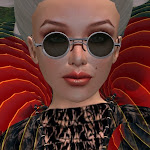
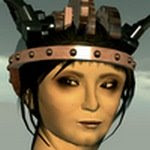
German Felixx Shepherd (aka Martin Vieweg) explained his Garden of da Vinci sim this way: "I build here all my dreams of childhood, you might say. All what fascinates me. I'm a big LEGO child... in Second Life® for one and a half year, and this grew step by step. Some say that my buildings look like the ones of the movie "Lord of the Rings."
Or Disneyland?
And what he built is a lovely series of villas and observatories with Roman, Greek and Renaissance elements on the ground...


...coupled with sea and space exploration below and above. 


Felixx was about to release something quite fun at the Garden of da Vinci when I visited him: a space rocket that enables you to orbit the planet of your choice as well as the sun. When you arrive at your destination, you can generate a space station and sit and watch the planets - and even the sun - comfortably and in close proximity!
At present, you can already visit Mars, generate your own fireworks display, or simply have a picnic under a tree. There are numerous freebies available, too.
Teleport directly from here.
Sunday, August 24, 2008
Garden of da Vinci - Where beauty meets science

Thursday, March 13, 2008
Dr. Ruth Ballard: Virtual worlds and their tools can be used for science
On January 27th of this year, the Not Possible in Real Life (NPIRL) group launched an initiative to identify and extend invitations to people we admire and whom we believe would derive pleasure in discovering the creation and communication tools available to them in the 3D virtual world known as Second Life. There is certainly a very appreciative - and growing - audience waiting for them. It is our hope that they will take us up on our shout out and make the pilgrimage to check it out. Today, I welcome this introduction to Dr. Ruth Ballard by guest blogger and NPIRLer Bjorlyn Loon.
by Bjorlyn Loon
When geneticist Ruth Ballard went on vacation to Africa, she had no idea she would come home with a DNA database as a souvenir. On a climb of Mount Kilimanjaro in 2001, Ballard found herself wondering whether the Tanzanian population had been adequately tested for DNA, so she took home samples from the native porters assisting on her journey.
Upon her return to the United States, Ballard contacted the Tanzanian government in Dar es Salaam to request permission to conduct more extensive studies of the many tribes in the nation. To her surprise, the government approved her application to begin testing the Maasai, but with a catch: officials asked that Ballard begin the process of mapping the country's entire population of more than 30 million people, and also that she train Tanzanians in the forensic techniques required to use the database effectively.
Dr. Ruth Ballard in the company of Maasais
While Americans tend to think of forensic genetics in terms of crime scene investigations, the focus in many nations is on establishing paternity. In areas where people transit between remote rural villages and the cities, children and spouses may be left behind. To obtain means of support for dependents, the establishment of a full map of genetic markers for a population and subsequent forensic DNA testing of individuals enables governments to identify a child's natural parents.
This humanitarian goal has provided a focus for Ruth's efforts. She returns to Africa during the summers on "saliva safaris" to collect DNA samples that reflect the great human genetic and cultural diversity of the subcontinent.
But the challenge of training African scientists has proved to be more difficult.
While Ballard has developed a forensic biology concentration for undergraduates at California State University Sacramento (CSUS) (where she serves as an Associate Professor for the Department of Biological Sciences), it is difficult to provide the same kind of experimental experience to people on another continent.
Fortunately, Ballard's efforts have coincided with a proliferation of forensic and genetic science opportunities in Second Life. The CSI:NY programs (teleport directly from here) as well as islands such as Genome (teleport directly from here) in the SciLands archipelago would seem to offer a ready-made training ground for Real Life scientists. 
Photograph courtesy of CSUS
A true explorer, Professor Ballard seems like a natural to introduce to our virtual world, and involving her colleagues in Africa to Second Life would be an added joy.
Like artists, scientists are benefiting from the opportunity to use Second Life as a distance-spanning collaborative workspace and educational tool. Just a couple of notable examples:
* Dr. Bob Amme and Jeff Corbin of the Science School islands are constructing a model nuclear reactor to teach students from Denver University how to manage nuclear waste. Via a $200,000 grant from the Nuclear Regulatory Commission, the Second Life installation will engage students in virtual nuclear experimentation, sans the real-life risks of radioactive contamination and terrorist exploitation.
* In February, NASA streamed their Next Generation Exploration Conference into Second Life. Over four days, Second Life residents literally sat at the table to offer ideas and expertise as an integral part of conference working groups. The program is designed to give a boost to potential lunar entrepreneurs in anticipation of setting foot on the moon in the coming decade.
But much of science is still in the dark about the value of virtual worlds. I hope that Professor Ballard will be the first of many scientists recruited by NPIRL.
You can hear Ruth Ballard's story on KXPR's Insight, the Sacramento National Public Radio affiliate, here.
Saturday, September 15, 2007
Earth Primbee's Machinima - Using virtual environments to benefit Real Life
One of NPIRL's charter members, builder of the much admired Inspire Drive-In and Inspire Space Park, dreamer and machinima maker Earth Primbee, alerted us to two new vids he's created. Here are instances where Second Life's virtual environments accomplish things that would not be possible in real life, but also turn right around to benefit the real world.
NASA CoLab
"It is especially important when considering science and technology to seek the potential as much as the present value in new ideas," said Earth. "So many great things in our lives are a result of ideas born at the edge of "that's impossible" or "that's ridiculous." It is my hope that this video will not only encourage NASA's efforts to harness the power of virtual worlds, but help the world see how it will and does benefit everyone."
"The Narrows" song by Broet
Earth told us that he's been experimenting with using prims as an alternative to traditional lighting instruments in Second Life for some time. He added, "the band Broet knew I loved to create music video style clips. They asked me to throw something together for a show they had coming up in Austin, TX. I decided to push my lighting prims to the limit and really see what I could do. This video is a combination of some of the clips I produced in Second Life that I projected behind the band during the live performance in real life. I thought their song was perfect for the mood of the NASA CoLab video and ties the two examples of the uses of Second Life together."