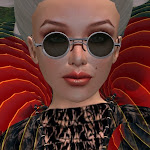
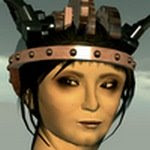
Photographs courtesy of [DAM]Berlin - All rights reserved
Posted by Bettina Tizzy
In Hammering the Void, there isn't just one Gazira Babeli, there are 14 and they all fight against an inner void. 14 clones of an artificial person, they are each named after Virtues and Sins: Greed Petrovic, Sloth Swansong, Temperance Navarita, Courage Sparta, Envy Sixpence, and more. Equipped with a hammer in their hands, they descend from the pedestal in the gallery, they swarm to openings of exhibitions and public events. They strike other unsuspecting avatars with blows from their hammer as if to say: "Wake up! Defend yourself! Act!" They force others to react. You love them or you hate them, but you cannot remain indifferent against this aggression, which can be understood as an attempt to awaken the intellect or simply as a malice.
Friday, May 29th marks the opening of Gazira Babeli's newest mixed realities show, which will run through July 31st at the [DAM]Berlin gallery in Berlin and concurrently in Second Life®. A new film will be screened.
May 29, 2009:
10pm - 12am at Locusolus - [DAM]SecondLife, teleport directly from here
7-9 PM in the gallery [DAM]Berlin
Man Machinaga (aka Patrick Lichty) is a technologically-based conceptual artist, writer, independent curator, animator for the activist group, The Yes Men, a founding member - along with Gazira - of the virtual performance art group Second Front, and executive editor of Intelligent Agent Magazine. He is a member of the faculty of the Interactive Art & Media Department of Columbia College, Chicago. He writes...
By Patrick Lichty
As I write this, Gazira and I are talking about my reflections on Hammering the Void, and in dealing with the moral tropes of Sin, Virtue, and most romantically, Truth, it seems that my text less resembles an essay and is more like a sermon. As this is no more surreal than reflecting on the moral implications of a horde of fourteen proxies wielding cartoon mallets, I'd like to frame this under just such a conceit of a sermon on virtual existence. Let us consider then, my Brothers and Sisters in Virtuality and Hypereality, the implications of unleashing Pandora's Box, of unfurling the Sins and Virtues forth into the Nets, armed with nothing less than Vulcan's Hammer itself; let us consider the effects thereof. I want to say that in setting this forth, the traditional Sins and Virtues give rise to four Principles of experience that remain in virtuality, and those are: Affect, Agency, Volition, and Complicity. It is through these that while after shedding the physical coil, humanity follows us into the Void. Let us meditate upon these in that we may understand the Void.
In the beginning of the Hammering the Void introductory video, Gazira and I (or my Man Michinaga proxy) sit before a screen in Second Life, marveling at an opening of 90's net artists, Vuk Cosic and Alexei Shulgin. We gesticulate excitedly like old heavy metal fans about the “Monsters of net.art." We agree that she must set the cloud of Gaziric Sins and Virtues upon the world, equipped with large mallets, perhaps as inquisition, perhaps as divine intervention. For the rest of the video, the Gazirae invade virtual social events akin to a host of viral Agents (as per the “Smiths” from Matrix Reloaded) creating avatar mosh pits and hammering the hapless onlookers. All of this would appear as simple farce; but I know Gazira, and we know one thing...
The Truth is out there, we are all complicit in its creation, and Gazira is hammering you over the head with it.
One point that is essential to consider when looking at the gaggle of Gazirae and their accouterments, is that she has provided the hammer in the gallery for you. 
Nice to Meet You Mallets
They aren't inflatable hammers, either. They're probably oak or maple, engraved with the Deadly Sins and Noble Virtues, inviting you to pick them up and play. As a side note, I had considered being more explicit in regards to “play," but doing so would have been too heavy-handed, which is unnecessary when one is wielding an oak mallet.
As Gazira and I have continued to make works in virtual worlds for years, the question returns to the “why," which may return us to the Cartesian cogito. However, I would like to remap the Cartesian assertion into a consideration of the increasing retreat into virtual worlds in asking about some of the things that remain in our Pandora's Box of simulation when we remove materiality and embodiment. This leads us back to the fulcrum of our sermon; the median icon of our discussion.
The sign at the center of this discussion is the hammer, the archetypal sign of Vulcan/Hephaestus, the God of Technology and Artisans. In Hammering the Void, perhaps the null-stuff of virtuality is the metal of disembodied existence that the Gazira-Hephaestae forge into an ironic tool for dragging our own mortal encumbrance into cyberspace. Her traditional Sins and Virtues infest the online worlds, placing all they encounter upon the existential anvil or litmus test of action and reaction. There is little time for reflection, for what is under the hammer nothing less than our human nature. What do you do? From this vantage point, the result is the transmutation of the traditional Sin/Virtue binaries into monads of four human elements of virtual existence. These Monads, as we have transmuted beyond Sin or Virtue, are the principles of Affect, Agency, Volition, and Complicity. which are all complex significations embedded into Gazira's Hammer.
Affect: Identification with the act. One of the most striking images of the Gazirae is that of the fourteen Sins/Virtues rampaging before their puppeteer in a bold thrust, akin to an ideologue ordering their army into action. This encapsulates this writer''s fascination with the evident identification of increasing numbers with virtual worlds, and as of this writing, there were 65,000 people logged into the single online world of Second Life alone, showing the “reality” of virtual reality. This evidence is also embedded within the results of each intervention of the Gazirae, from the amusement of the appearance in the Uqbar region, varying to confusion and even anger in other instances. The paradoxical question of the visceral reaction to virtual events shows that affect is not just for identification for another body, but for an identification with their proxies/avatars as well. Although the avatar version of Burden's Shoot (Kildall or Mattes) is different from the first, both create a “gut reaction”. There is reality in the virtual.
Agency: The act of intervention. If the avatar did not have some sense of real agency, some ability to intervene in affairs, this essay would not exist, as Gazira would have had no effect. Perhaps this is a realization of Baudrillard's primacy of the hyperreal – the object/image that has greater effect than its subject. But this is in agreement with the principle of Agency, as Gazira, and her doppelganger Gazirae, the replicants controlled by a simulacrum, create reaction to her actions. Although this may sound like the erection of a wilderness of mirrors, there are vectors of effect as well as affect when the hammer swings. The effects of the impact (to paraphrase Sanborn) of the virtual mallet are evident in that they set off chains of causality in the physical, even if they are as simple as the fact that she occupies a space in which the hammer is realized in a gallery, asking you to pick it up and swing it yourself. And more specifically, the way she does.
Volition: The will to action. The fact that Gazira sets her plan in motion is a testament to the principle that one has the ability to act through the virtual. The Aktion zur Macht breaks the stasis of virtuality, setting forth the path of agency to the creation of affect. Through the creation of the Sins and Virtues, Gazira has set them upon others, setting up causal chains, however slight, but this prime mover, probably the simplest, is a fundamental factor of intervening.
Complicity: The inseparability from the act, or the impossibility of total abstraction. The double sign of the hammer in the virtual and the physical and their similar functions illustrates our complicity with actions in either world. Through the hammer, argument of separation of subject and object through mere virtuality implodes, as the difference is far more complex. It is no longer the question of the effects of hitting someone with the hammer in the gallery or in the virtual, as both actions hold us complicit with the real issue of violence itself actual or implied, leaving the hammer itself transparent. Violence through cartoon or oak mallet differ little in terms of their being consistent with the same practice, and that is the gesture of the swing, and the effect of the impact. Gazira and her vices/virtues ask you to pick up the hammer and hit your friend over the head with it, but then say, “Funny, that doesn't happen here... Ahahahah....” through this doubling and the resultant difference of effects, Gazira holds us responsible for the violence of signs, the affect of the impact, the effect of the hammer's extancy, the volition of the swing, and the complicity to the hammer and its function.
Before ending my sermon, I would like to talk about the narcissism of the Global Village; of cyberspace. As McLuhan said,
"The global village is a world in which you don't necessarily have harmony. You have extreme concern with everybody else's business and much involvement in everybody else's life. It's a sort of Ann Landers column writ large... huge involvement in everybody else's affairs. So the Global Village is as big as a planet and as small as the village post office."
In many ways, this intense concern is emblematic of the collective dream of pop technoculture less from from Star Trek and more to World of Warcraft. The shift of focus away from the outward vision of Buckminster Fuller 's “Spaceship Earth” to the inwardly looking complicit panopticism of McLuhan's “Global Village” seems to be the object of the swing. Perhaps this inward look is the gaze into the abyss that Gazira is hammering at. Rather than “leaping into the void” a la Klein, is Gazira hammering away at the null-sets of illusion in the void of cyberspace to get at the truths that remain in virtual existence? Is there anything there?
Or is she merely asking you to hit your friend in the face with an oak mallet because that is the most fundamental form of human communication remaining?
In the end, what remains is a communion of reflection; something that is considered an endangered species in the age of constant partial attention deficit. As the Gazirae descend upon us, there is a moment in which we are forced to meditate upon the four elements of human existence in the virtual, and then the offering is put forth.
The Hammer of Gazira. Given for you. May it dispel your illusions.
Now, SWING.
Amen.
Patrick Lichty
Thursday, May 28, 2009
She[s] got a hammer: Hammering the Void

Is Second Life the theatre of the absurd? Ask the Kool-Aid Man in SL
Posted by Bettina Tizzy
Net Art/New Media artist Jon Rafman has been getting rave reviews and first-rate press coverage with the likes of Rhizome and other coveted art outlets as the Kool-Aid Man in Second Life®, offering free guided tours in-world. His dedicated website features a promo video that I guarantee will produce an emotion in Second Life residents, and invites folks to sign up. I first got wind of this video when Paddy Johnson of the art blog Art Fag City twittered “Best Link Ever! Kool Aid Man gives a guided tour of Second Life and it doesn't suck (like most SL art)!”
Unlike every other machinima I have seen that strives so hard to get past the technical challenges to convey the beauty, the love, the horror, the possibilities within, because of, and thanks to our virtual lives, Jon’s is a breezy, often hilarious tour that celebrates the absurdity of our immersiveness. Second Life users will recognize many favorite builds and installations.
WARNING: This video contains a lot of X-rated content.
Kool-Aid Man in Second Life (.com) - Tour Promo from on Vimeo.
Jon rezzed in Second Life on 12/10/2006 but used it sporadically until recently. I’ve spent a couple of evenings this week in-world with him and I can tell you that he’s a pleasant, intensely curious, and intelligent fellow. He received his Master of Fine Arts degree from the Art Institute of Chicago, and double majored in philosophy and English. I’d call him spontaneous, easily bored, and a fascinated yet detached explorer. I expect you’ll be as curious as I was to hear what he had to say about this. I sent him some rather open-ended questions via email to see what I’d get back.
Why did you elect to omit music to that video?
Jon Rafman: There is a tendency to use music as a crutch and let the soundtrack manipulate the tone of the work. I want the visual aspects of the video to speak for themselves. The formal qualities of the landscapes should dictate the mood of the piece rather than the soundtrack. Moreover, I always felt like the generic in-world sound effects, like the ominous low-pitched wind that blows across SL, creates a subtler emotional resonance than music.
Kool-Aid Man is on a quest for sublime kitsch in Second Life. Music used inappropriately corrupts the underlying mundanity of my avatar's search.
At certain points in the video there is music; however it's always what was streaming in that sim during the time of capture.
I don't want to assume anything so I have to ask: Are you really going to give guided tours?
Jon Rafman: I like this question. It forces me to ask myself: Where's the "Art" happening in this project? How important is the actual tour-giving process to the Kool-Aid Man in SL? Is the core of the artwork the video and photo collections? Or is it the process of the tour itself and the interaction with people in a virtual world that is the core of my project?
Yes, I'm giving tours. It is not a hoax!
But...
Even if the tours were a hoax and the project existed only conceptually, I'd be cool with that, too. I'm a big fan of work that walks the line between fake and real, ironic and tragic, fiction and documentary.
Do you intend to continue your work in Second Life?
Jon Rafman: I'm currently integrating some videos I've captured in SL into a larger documentary film about professional video gamers. I'm searching for ways to transcend the kitschiness inherent in the SL aesthetic and haven't decided yet on how significant of a role SL will have in the film yet.
I'm also toying with some story ideas for a few Kool-Aid Man in Second Life short video series. There's so much potential with Second Life machinima, but I have yet to see a work of machinima that's truly inspired me. Maybe I haven't looked hard enough though.
What do you want Second Life'rs to know about you most of all?
Jon Rafman: I found an analogy for surfing the web in the act of exploring Second Life as Kool-Aid Man. User-generated realms of Second Life can be viewed as a 3D virtual expression of the Internet’s anarchic psyche. Kool-Aid Man is my alter-ego, a secular icon that resonates with decades come and gone.
I see Kool-Aid Man as a self-conscious professional web surfer “breaking through walls” into various Second Life communities and subcultures. He never fully fits in, but he empathizes with whatever he passes. Like Baudelaire’s Flaneur, wandering the arcades of Fin-du-Siecle Paris, Kool-Aid Man keeps a cool and curious eye, strolling through the virtual world in search for the banal sublime. Kool-Aid Man's motto is best summed up by a line at the beginning of Chris Marker’s Sans Soleil: "I've been round the world several times and now only banality still interests me. On this trip, I've tracked it with the relentlessness of a bounty hunter."
I wondered as I read Jon's response if he was aware that French author, photographer and film director Chris Marker is very active in Second Life. Perhaps there are two bounty hunters then? It is unlikely we'll ever know, given that Marker famously does not take interviews.
Jon Rafman: The Kool-Aid Man in Second Life project is partly an attempt to investigate certain 'outdated' concepts from bygone eras and to reframe them or test them out in distinctly contemporary pop-cultural contexts. I am interested in the disjuncture between earlier uses and my own use and what this reveals about how consciousness has changed over the past decades. Whether a fundamental change has occurred is an open question as the forms of alienation that existed one hundred years ago are present today in mutated forms. But these subtle changes are revealing of what it means to be alive today. What are these subtle changes I mention?
The fragmentation that started with the emergence of mass culture has only intensified. Decentralized global society is epitomized in the World Wide Web. This is not to say that the power of centralized authority has declined or that a new genuine techno-democracy has been achieved. This is far from the case; I’m interested in the ways that self-regulating authority manifests itself from the ground up.
I do think that the task of grasping the present clearly has become more difficult because so much now obscures us from seeing it. I frame my quest for the banal sublime as doomed from the beginning because I am trying to highlight the loss of a certain type of consciousness.
Am I nostalgic for Fin-du-Siècle Paris?:
Yes, my project is a somewhat melancholic attempt at pointing towards the importance of understanding the historical context in the digital age. I can’t deny my nostalgia for earlier modern periods; however I am also aware that the image of the past that I yearn for reveals less about the past and more about an acute lack that exists in the present. And it is this “lack” that I want to point towards.
Jon moved to Montreal from Brooklyn, NY recently. He prefers that I not reveal his in-world name. So what do you think, Second Life residents?
Saturday, December 15, 2007
Concept Art that's fun, or intellectual - you decide: Gazira Babeli's "Collateral Damage"
The day that code performer Gazira Babeli (rezzed March 31, 2006), joined the Not Possible IRL group, I became so excited that I informed my Real Life friends and family. It's just that no other content creator in Second Life has managed to encapsulate, illustrate and celebrate the core concept of our group better than Gaz. Plus, she's got one wicked sense of humor.
Gazira's "Collateral Damage" show at her Locusolus sim is simply the most sumptuously diabolical and hilarious venue in Second Life. If you haven't experienced it, then allow me to nudge you as politely but as firmly as is necessary: on your feet, go, go, go, get a move on right over there quick quick. You can thank me later :P Oh, and your experience will be greatly enhanced if you take a friend or two along. Really.
Until today, I had held back from revealing much about "Collateral Damage" other than to gently but enthusiastically urge you to go, largely because the element of surprise is a bonus... but alas, some people won't take a friendly hint. ;) Fact is, I am always astonished when I learn that someone hasn't been there.
Art critic and curator Domenico Quaranta has already done a brilliant job of analyzing the show, and numerous other fascinating write-ups exist, such as this one by Esther DeCuir, so I will limit myself to sharing a pop/superficial - though blissful - review, and here it is: Gazira amuses herself and you by taking liberties with your head and your avatar.
Earlier this week, I had the distinct pleasure of introducing three charming individuals to some elements of the show, on the pretext of snapping some pics for this very blog post...
There are two very tall towers near the sim's entry point marked with a plaque that reads: "Unbroken Eggs: Monument to Luciano Fabro, July 2007." Chance Abattoir and I watched as Jurin Juran walked between them.
Within seconds, the buildings collapsed atop Jurin. 

This being a virtual environment, the buildings promptly reassembled themselves and Jurin rejoined us, along with SuezanneC Baskerville, who had just arrived.
SuezanneC got into the spirit of things right away, and began trampling the pizzas, which responded by melodically bouncing her off, all the while bleating riffs from that Neapolitan tune "O Sole Mio," and emitting generous clouds of particles. 
Meanwhile, Jurin had been caught inside a can of Campbell's soup and was getting a peppy shake. Chance was mid-air, having disobeyed instructions that read "don't say new media," and being subsequently possessed by a mini-tornado that didn't let go until some precise words were uttered. 
Then, SuezanneC and Jurin discovered some large slabs of concrete that simulate a rather vigorous earthquake when stepped on. 
They proved to be brave souls and forged on. We all reconvened at a platform surrounded by poseballs, and hopped on. "Come together" - as it is called - would be putting what happened next, lightly. Each avatar is taken through a series of fun and silly animations separately, but all participating avatars are merged together.

There are several other remarkable pieces within the installation, but probably the most controversial is "Avatar on Canvas," where Gaz has set up three Francis Bacon paintings with chairs that - once used - deform the avatar. Most of us treat our avatars with the same degree of narcissism and reverence that we do our Real Life bodies, so participating in this exploit requires a bit of open-minded loosening up. Speaking for myself, I can't recommend this enough. No matter how many times I've done it, it invariably cracks me up all over again.


I heartily recommend jumping back on the "Come Together" platform for some after-merging, and suggest that your little group consider following that up with a shopping or dancing expedition. It's guaranteed to bring down the house, not to mention the distinct probability that you will never feel quite the same about your avatar again... 
...and, I believe, that is exactly what Gazira set out to accomplish.
Ready? Teleport directly from here.
Many thanks to Jurin Juran, SuezanneC Baskerville and Chance Abattoir for being such good sports, as well as great fun and top-notch conversationalists all through this comical experience.