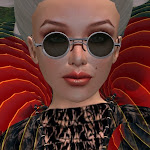
Before I attended Second Life®'s Community Convention in San Francisco earlier this month, I knew that Tezcatlipoca Bisiani (aka Andrew Sempere) was the Boston-based cross-eyed jackal avatar who conducted design research and taught computational art for IBM's Collaborative User Experience Group/Center for Social Software. I knew that he holds a Bachelor of Fine Arts from the School of the Art Institute of Chicago and a Masters of Science from the MIT Media Lab, and that he was the University of Kentucky's first Visiting Curator in Virtual Residence and that he curates IBM's art sims (Glyph Graves and Bryn Oh shows were nothing short of magnificent). Andrew first experienced Second Life as an alpha tester for LindenWorld (circa 2001), but logged off "relatively unimpressed." Seems he returned to Second Life in 2006 and soon discovered "what LindenWorld had lacked: a community of skilled content creators whose work was playful, engaging and beautiful."
In San Francisco, I discovered that his eyes twinkle, that he wears his great hair a little bit spiked and leans forward and really listens with his whole body, and that he has an air of playfulness about him that's contagious. I hope I will know him the rest of my life. - Bettina Tizzy 

Andrew and Tezca - Universally interesting and interested in everything - BT
by Tezcatlipoca Bisiani
When Bettina asked me to write about my experience at SLCC I thought perhaps I'd write about the keynotes (in general very disappointing), the incredible tour of the Exploratorium courtesy of Patio Plasma (amazing, thank you!), the delicious NPIRL Dim Sum (all the food was PIRL, but honestly with Dim Sum that's just fine). In the end I think what I want to focus on here is us, and what we can do as a group to further the cause of shared 3D virtual worlds as a place for creative exploration, because much like everything else in Second Life, no one else is going to make it happen.
If there was one thing that my visit to SLCC last week brought home for me it is the conviction that Second Life is not, and never has been, about the technology. It is not, and never has been, about Linden Lab, nor any other company or organization. Everything good about this universe comes from the people in it, in all their messy chaotic glory.
I'm not suggesting that we ought to give up trying to influence our infrastructure, but whenever I used to speak about Second Life to people less familiar with it, I found myself in an uncomfortable position as apologist. Why was the server so slow? Why was the interface so difficult to use? What about those flying penises? No doubt you have fielded dozens of these questions yourselves, and to be fair to Linden, things are much better than they were, But I for one have always found these questions incredibly frustrating. They're not the right questions! Instead ask me this: Why would an otherwise sane and healthy adult professional work a full work week and then spend hundreds of hours logged into a virtual world? Why, exactly, do we care so damn much?
In its specifics, the answer is as varied as each of us, but in general it all ends in relationships, and community, and the sheer joy of building a world with people of like mind. So these days, when people ask why I spend an inordinate amount of time in this odd artificial universe I have an answer, and if you read nothing else in this post, read this: it’s you (or most of you, anyway). It’s the community that includes many of the Linden staff, and also independent scholars and musicians, professors, painters, physicists who run hands-on museums, ad executives, business professionals, students, mathematicians who explain hyperbolic space with aplomb, magicians who perform even when their hands get stuck in car doors, writers, IT directors, teenagers, illustration students willing to share their avatar making secrets, weekend Goths, vampires, old, young, straight, queer, able bodied and not, sushi experts, world record holding skydivers – even the griefers who rent party busses and cover corporate headquarters in chalk slogans.
This is so true that even a week later I’m still thrilled by it. To be sure there is the happy conference bubble (short time frame, beer and free food make many things possible), but even accounting for that, the last thing Eshi Otawara said to me, standing outside of Lori's Diner before heading out for the day, rang true: It's about the sense of touch: "We can be anything we want in Second Life. Friends, even lovers, but in-world we can't hug." Unexpectedly for me, this became the proof I never knew I needed, confirming what I’ve known only with my eyes and my brain for the last few years: SL is real. You can touch it.
Second Life is now in the downward slope of the Gartner Hype Cycle, and rather than being upset about this, I think we should rejoice: it took the dot com bubble bursting for the real value to emerge, and now that the novelty has worn off, those of us who are left standing can get down to the business of showing the world what really matters. Unfortunately this also means that we should see less direct support for our work, because Second Life in general, and our corner in particular, is so small from a business perspective that it amounts (in the words of Clay Shirky) to a rounding error. Moreover, our job as creative content creators is to push the boundaries of the universe, and the goal of any profitable company is to trend towards commodity users. It's not that we're at cross purposes exactly, but we certainly serve a different set of ideals.
Again, I don't think this is cause for despair, but it does mean that we need to become ever more self reliant, and the onus on outreach is on us. If you are part of a professional community and you believe in virtual worlds, focus your attention on bringing your community to us - we can only be strengthened by connecting to the real world. You don't need to tell the world how amazing SL is, instead tell us the amazing things your RL communities are doing with SL. Inspire us. If you are an artist, work on connecting your in-world practice to those on the outside. Share your world, don't leave it locked inside a server somewhere. Go and get the audience, don't expect them to just show up.
If you want something to happen technically, focus on supporting the open source communities that are trying to make it happen. Support the development of unofficial viewers. Think carefully about the need for Second Life alternatives, content portability and free reliable backups, not because you want to boycott Linden in a fit of pique, but because you care about this community and realize how fragile it is to hang on the future of a single corporation. Start truly respecting your work, because it really shouldn't be surprising (as I learned at SLCC) that someone like Ina Centaur pays her actors union wages. She said it herself: they are a professional theater company, why wouldn't I?
Above all continue to push the boundaries of the universe in surprising and exciting ways because that's really the reason we're all here. And when someone asks you why you spend so much time online, or inquires as to the business value of virtual worlds, answer them loud and clear: It's all about the people, and the community, and what we continue to build together.
Wednesday, August 26, 2009
Tezcatlipoca Bisiani: Thoughts on SLCC

Tuesday, July 14, 2009
The Machine Poems and (virtual) sculpted storybook by Bryn Oh
Posted by Bettina Tizzy
Poetry by Bryn Oh
Photography by Dil Spitz "DilSpi" - ©All rights reserved
An acquaintance of mine has had several of her storybooks for children published with some success. In fact, she makes a decent living in Los Angeles in this manner and that is quite an accomplishment given that writers and illustrators with ideas for children's books are a dime a dozen. But there is an opportunity created by virtual worlds that intrigues me and I expect will pique the interest of book publishers, too. Eventually... One of these days now.... Seriously! I cannot, for the life of me, understand why they haven't capitalized on this platform already. Certainly animation studios and production houses are beginning to look at virtual world imagery as both a source and a resource (I can tell you that folks from Disney are frequent readers of this blog) and conceptually, I do believe that even a television commercial for a major brand may have been heavily inspired by content created in Second Life®.
Virtual artist Bryn Oh is already considered a master at delivering supremely immersive environments through the use of her sculptures coupled with original prose, poetry and even a play in which the attendees took part. There are simply thousands of us - virtual residents - who have attempted to explain to each other how moved we've felt by what we've experienced through her art via photographs, blogposts and machinima.
Her newest installation, curated by Tezcatlipoca Bisiani (aka Andrew Sempere) at one of the two IBM art sims in Second Life - Rabbicorn - is a second installment on her dark but moving Daughter of the Gears story. And it really is a story. Instead of turning the pages, we teleport to the next chapter. Instead of gazing upon the illustrations on a 2D page, we walk around the characters and situations. We hear the music, we move in and out of light and shadows. We are right there. But even if you never logged in to Second Life, the potential for the events to unfold in a traditional book is very much there through the use of well executed photography.
German photographer Dil Spitz "DilSpi," instantly agreed to capture some images of Rabbicorn for this blogpost when I approached her, given that she is already a fan of Bryn's work. Dil donates the proceeds of all sales of her images taken in Second Life to organizations that help stalking victims in Real Life. Keep in mind that Rabbicorn is a predominately dark build, so photography in this case was a challenge and Dil respectfully did not tweak the gamma or brightness.
The Machine Poems that follow on this page were written by Bryn for previous installations and not for Rabbicorn, but I thought I'd post them here to give you a taste of her storylines.

Charlatans
All my friends
Are charlatans
Beetlebots
And Videonauts
In dark nights
With search lights
Broken hearts
Are useful parts
Carry me
From the street
And love me though
I'm obsolete


26 Tines
The laboratory is silent
The scientists gone
We have seven hours
Before the dawn
Come to me through the half-light
To my jar by the rack
Surrender your cord
To the adaptor on my back
26 tines
At the end of your cable
Connect you to me
So that we are able
To feel emotions drawn
Through the cables caress
And forget till the dawn
Our loneliness


All my dreams
Were programmed by you
So that they would
All come true
Fly on the wall
Then to the street
Robots
When obsolete
If I could only see you
One more time
Maybe you would
Change your mind
Resale hunters
With laser beams
Take all the parts but
My hardwired dreams


Teleport to Rabbicorn directly from here.
Here are just some of the blogposts we've done about Bryn and her work in Second Life:
Saturday, May 23, 2009
A sculptural installation that has attained A State of Grace
Posted by Bettina Tizzy
Glyph Graves' latest, largest and certainly most stirring installation had many births. Originally conceived in early spring of 2008, it didn't reach fruition due to his busy schedule and limited prim availability. Since that time, however, he has made a name for himself as a notable sculptor in Second Life®, and today marks the public opening of his Strangers Also Dance, the inaugural show at IBM's brand new art and architecture exhibition space, curated by Tezcatlipoca Bisiani (aka Andrew Sempere, Research Designer at IBM's Center for Social Software).
Glyph is an Australian biologist who's virtual self is best known for kinetic, mostly abstract alpha sculptures that emit musical notes and eerie-to-sweet sounds when triggered by an avatar's proximity, though he is increasingly working with partially inverted solid-textured sculpts.
I've been a fan of Glyph's work for some time now and frequently feature his work on my own sim. This winter I happened upon this video by Todd Vanderlin and shared it with him as it reminded me of the behavior of several of his undulating sculptures and their responsiveness to avatars.
Scary Vines from vanderlin on Vimeo.
Glyph has since incorporated this thinking and included it in his reactive reeds. I mention this because he is an artist that is unusually receptive to new ideas and, like his sculptural work, acknowledges and rapidly evolves with his environment. This isn't to say that he is malleable or excessively adaptive. Rather, he is acutely aware and sensitive to exploration.
Strangers Also Dance is a remarkably immersive installation based on a poignant story that conjoins our Second Life universe with an alternate reality sweetly suffered by jellyfish that ventured too far from their warm gas giant home, becoming displaced in an environment that they find difficult but make the best of.
Importantly, Glyph approached the design of this build and its narrative beginning with its climatic circumstances. The Second Life ground upon which the adventure begins is suitable for humans (aka avatars) but too cold for these extra-SLterrestials and plants. Even so, the landscape is other-wordly. Obeying the laws of natural selection, a delicate pink creature was unable to keep up with its peers and has crystallized, laying dormant until it is visited, and touched, and therefore warmed by the avatar's body.


The avatar is enveloped by the creature, which begins to whisper to its guest:
Freed Alien Jelly: Nothing that will hurt you little one. Your warmth has freed me from the cold down here. Let me show you something few have ever seen... rest now. In your sleep, strange fragments of dreams of swimming in strange clouds come unbidden. Suddenly you feel disturbed as the hard crystalline surface you rested on melts away, then comforted by a sense of gentle enfolding and warm gratitude.
Delicately, a luminous jellyfish breaks free from the crystal, enclosing the avatar and floating upwards, all the while reassuring its capture that it will be gentle until...

... finally, almost tenderly, it deposits its human prize somewhere new, somewhere quite different, on a strange and wonderfully tropical terrain.

Sit on one of the immense tubes and you are one with this new matrix, downloading information as quickly as the creatures can share it.

The time was a memory past
through banded clouds
over hot seas
we swam
then later,
of cold stars and eternal night
we arrived,
we stayed too long
we could not go back
Released, you begin to explore, learning as you go about their sorrowful plight which they seem to accept with enormous grace. As I listened and absorbed their story, I couldn't help but admire their forbearance. My empathy grew.
"Do you want to know how we felt?" asks Biocrystal darkness. "When we first left the cradle of our world? Remember, our home, always bathed in warm clouds, always immersed in soft light. (Silence) Then dark. (Silence) What light there was, sharp like thorns and cold. (Silence) Enter. And feel."
Technically, there are a number of hallmarks: All sounds throughout the installation are played note by note. The speakers (the green plants) are designed to produce a spatial sense by cascading the notes down prim by prim as well as having them arranged around the sphere. A stereo effect is created by splitting the stereo track into mono components and playing them in opposite prims, which is also swirled by playing the pairs in consecutive prims.
Glyph's cellular automata react to both the avatar touching them and to the state of each of their local neighbors. After they've been touched, the music begins to self-propagate in a repeating pattern, which is different each time.
Since 2006, IBM has played an active role in empowering Second Life content creators with the IBM 6 sandbox which recently doubled in size and is open to all residents on the grid, whether they work for IBM or not. PatriciaAnne Daviau, its manager, has done an admirable job of maintaining a lively and active community there, though I can't help wishing that they didn't force teleports to one central location. It makes it very difficult to share works-in-progress with others who must then go by the coordinates to find their way.
Thanks to Jessica Qin's (aka Craig Becker, CIO Office of Strategic Initiatives) initiative and drive, IBM has moved to advance its presence with the content creation community, and particularly fans of art and architecture, with the launch of the new two-sim IBM Exhibition Space.
Teleport directly from here.
Monday, May 4, 2009
Bryn Oh pokes fun at da boys
Artist Bryn Oh has discovered machinima, and we never know what she's going to do next!
Tuesday, April 21, 2009
The Alien Factory
Posted by Bettina Tizzy
Once in a blue moon (heh!) I just grind my heels in the ground and quit blogging for a bit. When I do, I get downright stubborn about it and nothing can compel me to post a thing on this blog for days or even weeks. It's my way of staying sane, I guess.
I was in this mode just about a month ago when, on a whim, I whipped up a little machinima to share the fun of a new avatar-generating gizmo that Madcow Cosmos had come up with, with a little help from his friends Tezcatlipoca Bisiani (scripts) and Lorin Tone (sounds). I happened upon my vid just now as I was browsing through friends' works and thought "what the heck," so I'm posting it here for posterity. Y'all have probably seen it already and that's okay. You can just watch it again! Oh, and you can get your own alien avatar for free here, at Alien Isles of course.
And if alien avatars aren't your thing, you can head on over to the Museum of Robots where Madcow and his pals have created a variation on the same theme: Yep, you guessed it, a Robot Factory and also free. Teleport directly from here.
I've also been meaning to tell you that Madcow's got a new blog, too. So there you have it. You've been war..told.
Thursday, March 5, 2009
This is what Second Life should be like (and sometimes is)
Posted by Bettina Tizzy
Tezcatlipoca Bisiani sent me a video this morning, along with a note that reads, "This is what Second Life® should be like, (and sometimes is)."
For those who have never been a part of a virtual world... and for those of you who have and are sometimes frustrated by the technical inefficiencies, here's an inspiring glimpse at what content creation is like when everything rocks and rolls.
World Builder from Bruce Branit on Vimeo.
Tuesday, November 11, 2008
Just press play: The rocking-est avatars at NPIRL's Halloween parties, as seen by Tezcatlipoca Bisiani
Artist, writer and sometimes guest blogger here, Tezcatlipoca Bisiani, sent in these pics of some of the avatars at the NPIRL Halloween parties that caught his eye. 
Tezca didn't suit up for the parties... nope. Instead, he got real casssh as can be seen on the right. But who is the avatar in the Marie Antoinette "do"?
I can never keep a straight face when extreme explorer Naxos Loon is around, and this night was no exception.
Glyph Graves took a break after creating many of the special effects for the incredible roller coaster rides at Plasma Co. Mining Colony
I know that this ringing avatar's first name is Narita, but what is the surname?
Cube Republic has been awfully busy lately. Not only was he on the crew of builders for Plasma Co. Mining Colony - and I am fond of some of his sculptures there ;-) - he also DJed at NPIRL's Halloween party and has been leading the 5,000+ member-strong SOS (Save Our Openspaces) group. Who is the gentleman on the right?
To the left and barely visible, thomtrance O'toole knocked out tune after Goa trance tune at both of the parties. thom is my guru when it comes to exploring Opensims. On the right, award-winning Viennese artist and lecturer, MosMax Hax 
That kitteh! Artist Sabine Stonebender just finished the first phase of rebuilding her Zero Point and I love it! That's me drifting in the air to the right, being witchy in Eln Alter's freebie witch avatar
See also:
* The setting for NPIRL's Halloween parties: Plasma Co. Mining Colony
* The exotic and fun avatars at NPIRL's Halloween parties
* The incredible avatars at the NPIRL Halloween parties: "Take Two" by Skycat Ranger
* Scene stealin' avatars at NPIRL's Halloween parties, as captured by Cyberloom
* Trinity Outlander's double-takes at the NPIRL Halloween parties
Tuesday, July 29, 2008
Michel Tcherevkoff would have us all wearing a floral bouquet on our feet
Blessed are those who think NPIRL, and not all of them inhabit virtual worlds.
A little over a year ago, professional photographer Michael Tcherevkoff had just completed a photograph of a leaf for a cosmetic client when it occured to him that it looked like a shoe. He manipulated the image on his computer and was so pleased with the result that he began to frequent the wholesale flower market just four blocks away from his home in New York City. He then twisted and bent and cut each flower into a fantastical shape, photographed it, and edited the image... to breathtaking effect.
Michel crafts each shoe from a single variety of flower or plant. In fact, every time he sees a flower, he thinks of a shoe. “Taking pictures of something that just exists was never interesting to me,” he says. “I’ve always gravitated to photography that’s more illustrative in nature, where I can create my own reality — with a twist.”
Lillywhite
This fresh work first came to my attention when Tezcatlipoca Bisiani shared the Virtual Shoe Museum with me. Created by Liza Snook, that website is pure ambrosia for anyone who embraces NPIRL thinking and merits serious browsing. 
Divine
For those of you who live in Paris, Michel's collection “Shoe Fleur, A Footwear Fantasy” will be on display at Le Bon Marché through August of this year. 
Salvatore
Michel's Shoe Fleur book was first published in English with texts by Myrna Kresh as "Shoe Fleur: A Footwear Fantasy" in September of 2007 by Welcome Books, a division of Random House Publishing. The French translation is called "Bouquets de Souliers" with texts by Anne Chabrol was published by Chène. The English version of the book is available worldwide through Amazon.com. Hi-Res images of the book covers are available through either publisher. You can view the English version online .
All concepts and photography by Michel Tcherevkoff. Many thanks for allowing us to republish them here.
Saturday, July 19, 2008
Roald Dahl feast at Relay for Life
Combine two of our best loved stories for children (and grown-ups, too!) by Roald Dahl with some of Second Life's® most accomplished content creators, and you have magic.
Orchestrated by PatriciaAnne Daviau, two stories unfold: James and the Giant Peach, with little boy James, trees and a big juicy peach by brilliant 3D modeler Colin Fizgig, fantastical insects by Madcow Cosmos, Cloud Insoo's perfect seagulls, and LittleToe Bartlett's fanciful textures... 

... and a Willy Wonka factory by Tezcatlipoca Bisiani, complete with a candy cane forest by PatriciaAnne Daviau, strange plants by Tezcatlipoca and robotic creatures by Bryn Oh. 


There is so much to see and do this weekend at the Second Life® Relay for Life (RFL) event. More than 80 teams have come together to create an experience with the goal of raising $125,000 US.
Teleport directly from here.
Saturday, June 21, 2008
Garden freebies to die for... and yes, you have to go to heaven or hell for 'em
UPDATE - June 24, 2008: The Garden of NPIRL Delights has closed. Thanks to everyone who created it and to those who visited it, and special thanks to RightasRain Rimbaud and his team at Rezzable Productions for sponsoring it.
The Garden of NPIRL Delights will end on June 23rd, and several of the very gifted content creators have decided that their work should not disappear. Just look at what they are giving away! Hurry hurry! 
DB Bailey's Purgatorio (Take everything home!) - slurl
Photograph by Ka Rasmuson 
Eladrienne Laval & Kheph777 Enoch's Tower of Industrial Judgement (Steampunk Bosch Wings) - slurl
Photograph by Alpha Auer
Tezcatlipoca Bisiani's Laberinto de Mictlan (You get the prize - the puzzle box and the postcard!) - slurl 
Bryn Oh's Steamgarden (Several items from her build! If you put the structure on your land, send her an IM and she will come and place the beetle and the carousel on it) - slurl 
four Yip's Elevator Angels (everything! - touch the panels at the entrance to choose) - slurl
Photograph by Azwaldo Villota 
Alpha Auer's The NPIRL Garden of Delights Public Baths- (Her monochromatic and health-inducing jellyfish!) slurl
Madcow Cosmos' Heterotroph (avatars) - slurl 
Yoa Ogee's Happy Humans! (avatars) - slurl
Yeti Bing's Perfect Universal Companionship (avatar) - slurl
This video by Crap Mariner 
Gore Suntzu's "Tame a Thorn" sculpture : (This beauty could be yours!) - slurl

Thursday, May 1, 2008
Using game technology to explore the "unreality" of virtual landscapes
Scalable City - a project by Sheldon Brown and Experimental Game Lab - creates environments, from urban to rural, via a data visualization pipeline.
Now Scalable City has opened at one of my favorite museums in the whole wide world, The Exploratorium in San Francisco. As you move through the interactive exhibit, you literally "paint" the flying landscape with highways, buildings, and automobiles. According to Sheldon's website, "Each step in this pipeline builds upon the previous, amplifying exaggerations, artifacts and the patterns of algorithmic process. The results of this are experiences such as prints, video installations and interactive multi-user games and virtual environments."
Here is the trailer...
In addition to exploring artistic opportunities arising from computer technology, Sheldon is Director of the Center for Research in Computing and the Arts (CRCA) at the University of California at San Diego (UCSD) where he is a Professor of Visual Arts and the head of New Media Arts for the California Institute of Telecommunications and Information Technologies (Cal-(IT)2).
Many thanks to Tezcatlipoca Bisiani for bringing this to my attention.
Friday, March 7, 2008
Jaymin Carthage gets the boot from Linden Lab for his "branch"
11:25am update: Per Jaymin Carthage himself (see third comment to this post), he just got his account back.
Via Tezcatlipoca Bisiani, I've just learned that Jaymin Carthage's Second Life account has been suspended for two weeks because of his "branch." 
You may recall this story I ran on February 17, 2008: Jaymin Carthage's fast-propagating "Branch" - Scripting in the service of bodacious virtual nature, where I demonstrated Jaymin's "branch" that, once rezzed, self-replicates into a fractal - or tree - via some handy scripting.
Per Jaymin to Tezcatlipoca in an email, "Second Life upgraded their server code last night and it decided, in it's infinite wisdom, that something I was doing constituted a "Global Attack" and my account has been suspended for two weeks."
Tezcatlipoca commented, "Besides making interesting things, Jaymin used to run twice weekly script workshop classes. He's the complete opposite of someone you would want to ban. It makes me cranky they would do this. There are other people who are working on getting him reinstated, but in general it's a big question: I think we're all in Second Life to push the boundaries of the medium. If we can't do this without getting killed, it's not a lot of fun anymore... also, unless I'm wrong, the trees he built never existed on the mainland or in public areas, just the private sandboxes, so in short, it's possible to write code using the LL supplied tools, run it on your own land and get banned for it? I would dearly love to hear the official explanation."
Me, too.
Sunday, February 17, 2008
Jaymin Carthage's fast-propagating "Branch" - Scripting in the service of bodacious virtual nature
Not so long ago, there was a freakish bit of "News of the Weird" about a tree that tried to eat cows... and then there's the Royal Empress tree that can grow up to 25 feet in three years... but nothing in Real Life can compare with Jaymin Carthage's "Branch."
Acting on Tezcatlipoca Bisiani's hot tip, I wrote to Jaymin - an IBM software architect and active Second Lifer - to learn more about his "Branch."
I was at my home in Chakryn Forest on Friday evening, conversing with Morris Vig, founder and owner of Second Life's much-esteemed Oyster Bay Gallery, and learning the sad news that he is closing its doors, when Jaymin sent me a "Branch" of my own. Not thinking, I rezzed the one-prim-wonder in front of me and continued chatting with Morris.
In under five minutes - and much to our astonishment - the branch had gone bananas (actually, in this case apples) and was growing this way and that, spewing apples and particle effects and what not, until finally it stopped when it had filled the parcel's remaining allotment of just over 500 prims. 
Jaymin explains that his supernatural self-growing fractal tree is "(very) loosely based on the description I heard of a tree at Burning Man made of welded brass tubing that shot out flames at night and a cooling mist by day."
Instructions for the organic plant-and-grow system are simple but think twice where you do this! Rez the root branch and click on it once. 
To give you a demonstration, I textured the root branch and touched it, and within one minute it had already become a strong little sapling.
According to Jaymin, "It will then start to grow taller, sprout branches, and eventually spout flame or mist and drop apples. After about an hour it will be full size and consume, roughly 1000 prims at default setting."
Within 15 minutes, the tree had outgrown the black shadow box I had rezzed it in for photographic ease.
While the "Branch" is freeware, and you can copy, modify, and even resell it, Jaymin asks that - if you are so inclined to compensate him for it - you make a contribution to Heifer International via AM Radio's celebrated wheat field, "The Far Away," which is currently running a creative writing and photography competition.
Furthermore, you can "prune" the growing branches, turn the whole shebang off by touching the root prim once again, and when you move the trunk, the rest of the tree will slowly follow.
Twenty five minutes after rezzing the root prim, or "branch," my tree is fully grown.
In the accompanying notecard, Jaymin explains how it works:
"As a fractal, branch works through self replication. Real trees work similarly, and that's why there is a resemblance. Other than fruit, there is only one prim, and one script. Each branch or limb is a repeat of the same thing. It rezzes a copy of itself as each limb that grows.
When a child branch is created, it is passed a generation number through the start parameter. This is used, at a base level, for scoping, so that it does not grow indefinitely. By default it is restricted to 8 generations.
Each child is also passed the identity of the parent that it came from. This is important for positioning. A child takes its position cues from the parent. So as the parent grows, the child adjusts itself. This makes the whole tree grow organically.
Lastly the child prim gets passed a sort of "serial number". The root has a serial number of "T". Each of its limbs has a number of "T0", "T1", "T2", etc. "T0"'s children are "T00", "T01", "T02", etc. This is used to facilitate preferential killing. Essentially when you prune a limb, it announces this with its serial number. Any limb that also begins with the same serial number, suicides.
The tones used for the collision sounds on the branches and fruit are cello plucks taken from a mediawiki site. Taking inspiration from the orchestral crescendo of "A Day in the Life" by the Beatles, they are all steps in the chord of A major. Each higher order branch is tuned to a note further up the arpeggio... so when they sound together it is melodious and not discordant."
Monday, February 4, 2008
Dear Robert & Shana ParkeHarrison: Virtual worlds await you
One week ago, the Not Possible in Real Life (NPIRL) group in Second Life began an initiative to identify and extend invitations to people whom we believe would derive pleasure in discovering the creation tools available to them in this environment. There is certainly a very appreciative - and growing - audience waiting for them here. It is our hope that they will take us up on our shout out and make the pilgrimage to check it out. Today, I welcome this introduction to Robert and Shana ParkeHarrison by guest blogger and NPIRLer Tezcatlipoca Bisiani.
By Tezcatlipoca Bisiani
I first encountered the work of Massachusetts native Robert ParkeHarrison at the DeCordova Museum and Sculpture Park. The exhibition was an accident for me, a casual visit that turned into a long afternoon spent wandering around from image to image and back again. Since then, I have been reminded of them while visiting the best Second Life builds; those rare spaces which, through care and humor, are both intrinsically beautiful and capable of evoking a reflective emotional response. It is perhaps true that the relative rarity of this is what makes them so special, but to succeed in a meaningful way, Second Life needs even more artists of this caliber. 
Cloud Burst
Like many artists, the scale of ParkeHarrison's work is an expression of his working conditions. Early work is small and portable, the more recent large: six to eight feet, presented offset from the wall on borderless frames, coated in beeswax. The sheen and the three dimensional frames give a sense of ponderousness to already weighty images... the impression being that these images are artifacts - monuments belonging to a different time or place. It's an effect that is somewhat diminished when you see the images in print or on the web, but the content is nevertheless beautifully evocative, and funny.
As one who makes both art and a living with the digital, I can't help but make my parallels there: "Exhausted Globe" from the Architect's Brother series is an obvious exhortation to conserve, but reminds me of a decent game of Katamari Damacy.
Exhausted Globe
"Patching the Sky," "Reclamation," "Windmaker," "Turning the Spring": All remind me of a long day's pixel pushing, winding the machine to make the illusion happen.
But while the humor and my own read are not accidental, there is a sharp universal poignancy to these images. The suit is one size too small, the struggle to put the pieces of an impossibly broken universe back together is futile. We can laugh only because of the beauty in the effort; the nobility of the Impossible Task. Humor at the polar opposite of Murakami's superflat. These are ecological pleas, but in the most plaintive tones.
ParkeHarrison's images are photogravures, an archaic photographic technique that uses paper negatives. The stage is set with hand built props and backdrops assembled from found objects. ParkeHarrison himself "performs" the image, dressed in the custom made costume. Several images are made, and the negatives are collaged, printed, then worked with paint and finally coated with wax.
That these fantastic spaces are created by hand in a painstakingly manual manner is critical to an understanding of ParkeHarrisons work. "Garden Of Selves," for example, may appear to be a photoshop trick, until you spend time looking closer and realize that not one of the boxes (or men) is the same as the next. 
Garden of Selves
This level of detail and staging is not possible alone, and in fact ParkeHarrison is really two people: Robert and his wife Shana, who is an intimate collaborator in the process (in more recent work, the two receive equal billing).
But despite the elaborate effort that goes into creating each image, these are not trick photos except in the most glorious sense of theater. These images are trickster-like, the result of deep effort that reveals more than it conceals, and rewards both careful observation and patience. ParkeHarrison's images grow better with each return visit, and are worthy of every minute of time you spend on them. On a bad day in Second Life, I flip open my copy of the Architects Brother monograph and wish for more builds that share these characteristics. On a good day I find such builds, and spend hours gleefully discovering the gifts left for me by a masterful artist - tiny textured prims, extra effort spent on the handrail of a building, clever use of a simple idea, belabored effort on the curve of a shape. All subtle variations that show that craftsmanship can exist just as strongly in the digital as the analog.